The best place to sell an ebook isn't automatically the biggest marketplace. It depends on how readers find you, whether you need marketplace discovery or audience ownership, who will handle delivery and tax requirements, and how much control you need over your margins and customer relationship.
Amazon KDP, Apple Books, Google Play Books, Kobo, Barnes & Noble Press, and Draft2Digital serve retail discovery and distribution. Gumroad, Payhip, Shopify, and taap.bio serve direct conversion, storefront control, or creator commerce. For many authors, the strongest setup isn't one platform. It's a retail channel for discovery plus a direct-sales channel for readers who already follow your work.
Amazon remains the dominant ebook marketplace in major English-language markets. One industry summary estimates that it controls about 67% of U.S. ebook sales by unit, rising to about 83% when Kindle Unlimited borrows are included, while another report places its UK share at around 88% of yearly ebook sales. Industry coverage of ebook marketplace share makes the case for starting on Amazon, but also for reducing dependence on one retailer.
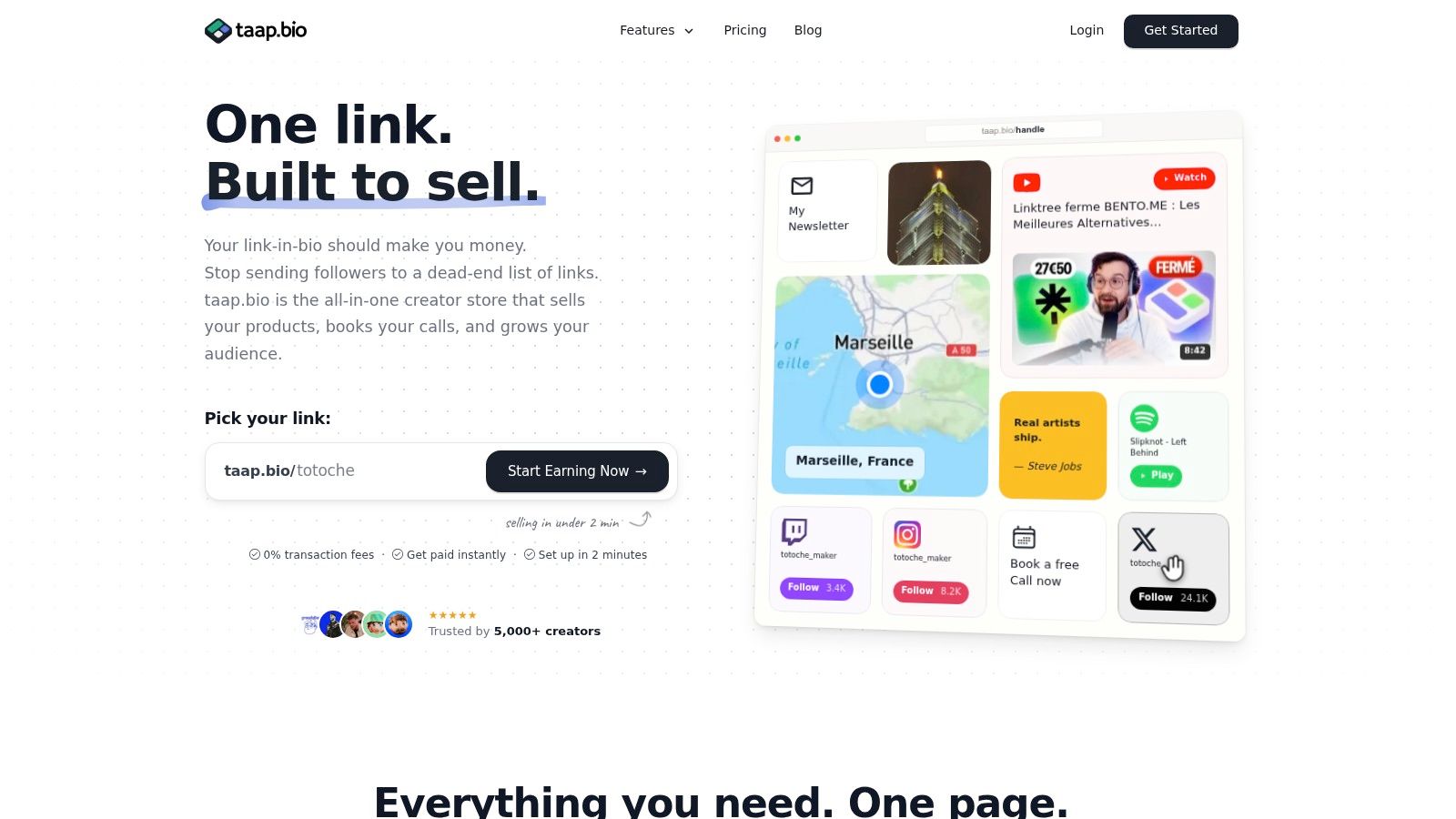
If your traffic starts on Instagram, TikTok, YouTube, podcasts, or a newsletter, taap.bio deserves special attention. It turns one mobile-first link into a creator storefront with ebook checkout, instant delivery, email capture, paid bookings, and analytics, so social traffic can move directly from discovery to purchase without a chain of disconnected tools.
Table of contents
1. taap.bio for social traffic and direct conversion
taap.bio is the strongest choice when your readers already encounter you somewhere else. Instead of sending a follower from a social profile to a link list, then to a product page, then to a separate checkout, you can place the ebook, purchase flow, email signup, bookings, and supporting media on one mobile-first bento page.
The product block supports digital goods such as ebooks and guides in PDF or EPUB format, with checkout and automatic file delivery after payment. You can also add YouTube, Spotify, maps, video, image, and other rich-media widgets through a drag-and-drop editor. That makes the page useful for an author who sells a guide, a coach who sells an ebook alongside paid calls, or a musician who bundles a digital booklet with releases.
Why taap.bio ranks first for owned traffic
The commercial advantage is control. taap.bio advertises 0% platform fees on sales, with instant payouts to a connected account. Payment-processor charges still apply, so you should check the total cost for your payment method and region, but the platform itself doesn't take a percentage of each ebook sale.
It also combines functions that creators often buy separately. Built-in email signup supports one-tap subscriptions and CSV export, while paid bookings use an on-page calendar, upfront payment, and automatic invitations. Per-widget analytics and live visitor counts show which page elements attract attention and which ones lead to action.
Practical rule: Use taap.bio for traffic you already own, then use marketplaces for readers who are still searching.
The service advertises a 14-day free trial and $19 per month after the trial on its site, although some regional pages display different currency pricing. Verify your local price before subscribing. taap.bio also states that it has been adopted by 5,000+ creators, and its infrastructure includes France-based hosting, GDPR-by-default practices, ISO 27001 certification, and alignment with SecNumCloud foundations.
The limitation is just as clear. A one-page bento storefront is excellent for conversion, but it won't replace a complex multi-page ecommerce site with advanced catalog management. Read taap.bio's guide to selling digital downloads before choosing it for a large catalog.
2. Amazon Kindle Direct Publishing for marketplace discovery
Amazon KDP is the right starting point when your main problem is being found by strangers. Its Kindle Store gives fiction authors, practical nonfiction writers, and specialists a retail environment where readers already browse by genre, topic, author, and recommendation.
KDP offers 35% and 70% ebook royalty plans, depending on price, territory, and other eligibility conditions. The 70% option isn't universal, so review the royalty terms for every market where you plan to sell. KDP also supports preorders up to 365 days, built-in conversion and metadata tools, promotional options such as Free Book Promotions and Kindle Countdown Deals, and detailed sales and Kindle Unlimited reporting.
The exclusivity decision
KDP Select adds access to Kindle Unlimited page-read earnings and promotional tools, but enrollment requires 90-day exclusivity. That means the enrolled ebook can't be distributed through competing ebook retailers during the enrollment period. Select can make sense for authors whose audience is heavily concentrated among Kindle readers, especially when subscription reading is central to their launch strategy.
The trade-off is audience ownership. Amazon gives you discovery, payments, delivery, and tax administration inside its marketplace, but it doesn't give you the same direct customer relationship as a storefront you control. You can't place a normal email signup or direct upsell beside the Kindle purchase.
Amazon KDP is the best discovery engine in this list. It isn't the best home for your entire publishing business.
Choose KDP first if you have no established audience, write for a broad consumer market, or want Kindle Unlimited access. Keep the book wide if you want to sell through Apple Books, Kobo, Google Play Books, and other retailers at the same time. For practical setup guidance, see how to sell ebooks on Amazon, and review this Amazon ebook publishing guide from Reddog Consulting Group.
3. Apple Books for Authors for iOS readers
Apple Books for Authors is the clearest direct-retailer choice for readers who use iPhone, iPad, and Mac. It gives you access to Apple's reading ecosystem without requiring exclusivity, and its royalty structure is easier to understand than KDP's tiered approach.
Apple advertises a 70% royalty on ebooks, regardless of price, with no delivery fees and no price-band restrictions. Those terms make Apple Books attractive for premium guides, short books, and titles whose pricing doesn't fit another retailer's preferred bands. You can manage sales analytics through the publishing dashboard and use affiliate links to support promotion through partners and your own content.
When direct Apple distribution makes sense
Choose Apple Books directly when you want retailer-specific control and don't mind managing another publishing dashboard. The platform is especially useful when your audience is already concentrated in Apple's device ecosystem. It also gives you a clean retail listing to use in email campaigns, podcast descriptions, and author websites.
Discovery is more curated than Amazon's broad search environment, and Apple Books has a smaller U.S. market share than Amazon. That makes it a weaker single-channel launch option for an unknown author, but a valuable part of a wide strategy.
Some authors use an aggregator to avoid uploading metadata and files to multiple retailers. That saves time, but it introduces an intermediary and can reduce the amount you earn compared with publishing directly. If margin and promotional control matter most, use Apple Books for Authors directly. If administrative simplicity matters more, route Apple distribution through Draft2Digital.
4. Google Play Books for Android reach
Google Play Books Partner Center is the best retailer for reaching readers already embedded in Google's Android and Chrome ecosystem. It gives authors a direct route to Google Play Books, international pricing controls, automatic currency conversion, and integration with Google's wider product environment.
Partners who accept the updated terms can receive 70% of the list price in most supported countries, although revenue terms can vary by territory or account situation. That makes Google Play Books particularly useful for lower-priced ebooks and international catalogs where transparent currency handling matters.
Choose Google when device ecosystem matters
Independent marketplace coverage notes that Google Play Books can reach around two billion Google users, although that figure describes the wider Google audience, not guaranteed ebook buyers. A marketplace overview of ebook distribution still makes the strategic point: Google, Apple, Kobo, and Amazon each connect sellers to different device habits and geographic audiences.
Google Play Books isn't the easiest retailer for every beginner. Merchant setup, tax compliance, and territory-specific terms can feel more technical than the process on some competing platforms. The effort pays off when your audience uses Android devices, your catalog has international potential, or you want another direct retailer rather than relying only on Amazon.
Use consistent metadata across Google, Apple, Kobo, and Amazon. Keep the title, subtitle, author name, series information, description, and cover identity aligned so readers recognize the same book wherever they encounter it.
5. Kobo Writing Life for wide international distribution
Kobo Writing Life is the strongest direct platform for authors who want to publish wide without treating Amazon as the center of their business. Kobo has meaningful international reach, strong visibility in Canada and other markets, and additional routes into subscription and library reading.
Kobo Writing Life offers 70% or 45% royalties, depending on price band and territory. It also includes a Promotions Tab for price drops, promo codes, and merchandising opportunities. Authors can access Kobo Plus subscription markets and library distribution through OverDrive, which gives the same ebook another path to readers who don't buy individual titles.
The operational role Kobo fills
Kobo works best as part of a diversified retail portfolio. It may not match Amazon's U.S. market share, but that isn't the relevant test. The question is whether Kobo reaches readers and institutions that Amazon doesn't reach as effectively. For wide authors, the answer is strong enough to justify direct publication.
The platform's near-real-time sales dashboard helps you monitor results, while promotional tools give you more merchandising opportunities than a basic upload-only retailer. You still need to meet the required price bands to qualify for the higher royalty rate, so review territory rules before setting a global price.
Choose Kobo directly if you want retailer control and are willing to manage another account. Choose Draft2Digital if you want Kobo, Apple, Barnes & Noble, and library distribution from one dashboard and accept the aggregator's commission in return for less administration.
6. Barnes & Noble Press for U.S. retail presence
Barnes & Noble Press is a focused choice for authors who want access to BN.com and the NOOK ecosystem. It isn't a global distribution solution, and it shouldn't be your only retailer if you want broad international reach. It does give U.S.-oriented authors another established storefront and a direct relationship with a recognizable bookseller.
The platform offers a straightforward 70% ebook royalty at the retail price you set. You upload once for BN.com and NOOK, and titles can reach the shelf relatively quickly. Barnes & Noble also provides opportunities for U.S.-focused merchandising and category placement.
A useful secondary retailer
This platform fits authors whose buyers already shop at Barnes & Noble, publishers running a U.S. retail strategy, and wide authors who want an additional direct account. It can also support a launch where physical bookstore recognition matters, even when the product itself is digital.
The limitations are practical. Distribution remains limited to BN.com and NOOK, so the platform doesn't solve international reach by itself. Operational policies, including title limits per account, may also matter to high-volume publishers with large catalogs.
Use Barnes & Noble Press when the retailer's specific audience is valuable to you. Don't choose it because you expect it to replace Amazon, Kobo, Apple Books, or Google Play Books. Its job is targeted U.S. retail access, not universal distribution.
7. Draft2Digital for hands-off wide publishing
Draft2Digital is the best choice when operational simplicity outranks maximum retailer-level control. You upload an ebook once, then distribute it through multiple retailers and library platforms from one dashboard. That central workflow reduces repetitive metadata entry, price changes, file updates, and reporting work.
Draft2Digital can distribute to Apple Books, Kobo, Barnes & Noble, Amazon as an option, libraries, and other channels. It also provides monthly payments, reporting, optional print services, and payment splitting for collaborations. The Smashwords Store adds another sales route, with favorable splits for eligible price tiers.
Pay for convenience deliberately
The cost is an aggregator commission. Draft2Digital keeps roughly 15% of retailer proceeds, so your net earnings will usually be lower than publishing directly through every retailer. In exchange, you get centralized control and less risk of an update being missed on one of several separate dashboards.
That trade-off is attractive for authors with multiple books, frequent price changes, co-authored projects, or limited administrative time. It's less attractive when a single retailer drives most of your sales and you want direct access to that retailer's promotions, merchandising programs, and reporting.
Use Draft2Digital when the hours saved are worth more to you than the commission retained by publishing direct.
A sensible wide strategy is to publish directly on the retailers where you actively pursue promotions, then use Draft2Digital for the remaining stores and library channels. That hybrid model keeps high-value control where it matters without turning distribution into a full-time administrative job.
8. Gumroad for simple direct sales
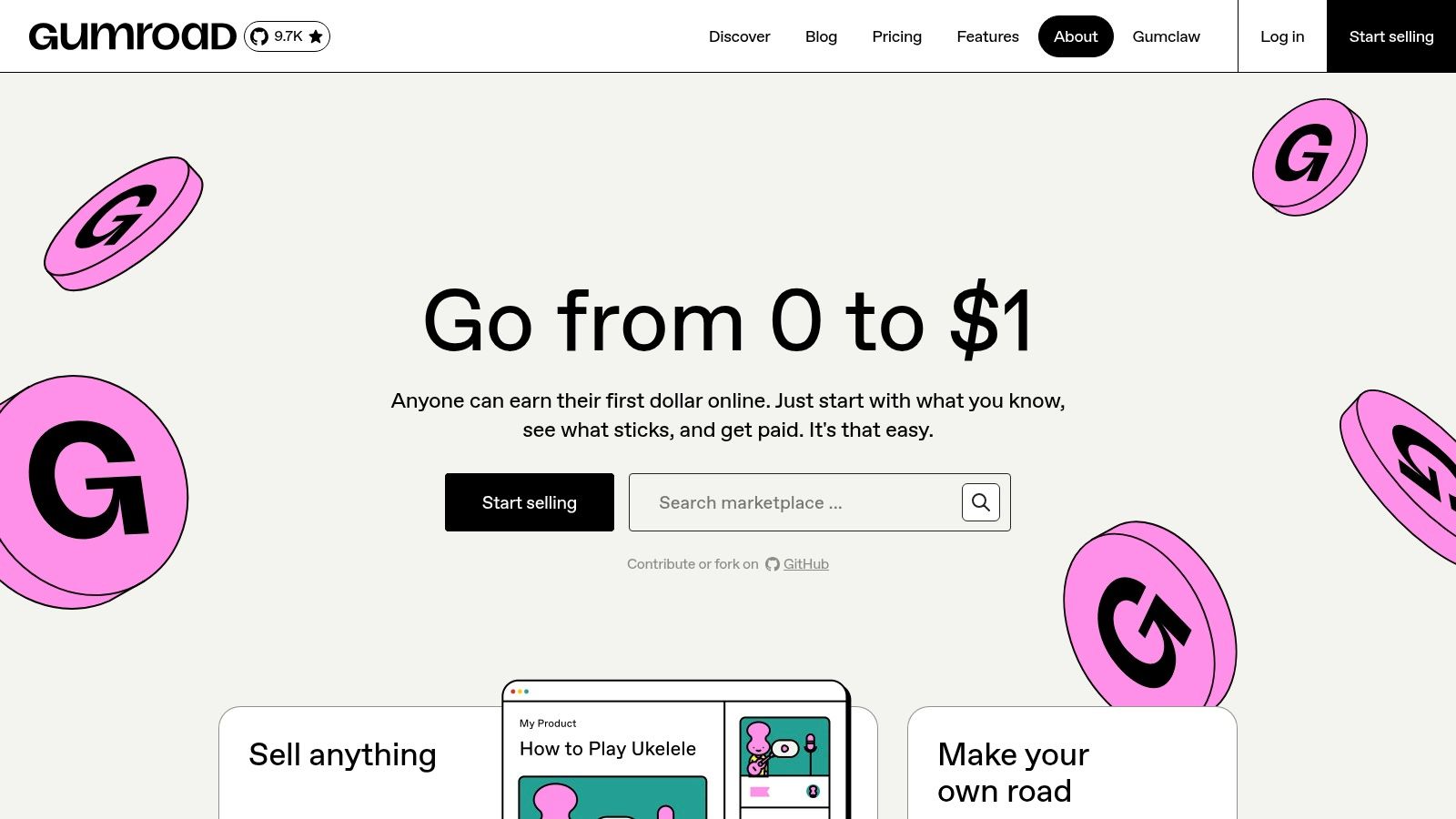
Gumroad is built for creators who already have traffic and want to sell an ebook without building a full ecommerce store. Upload a PDF, EPUB, or other digital file, create a product page, connect payments, and share the checkout link through your newsletter, website, or social profile.
The platform provides hosted file delivery, updates, redownloads, memberships, bundles, and simple checkout. It also handles many indirect tax and VAT obligations as merchant of record. Its optional Discover marketplace can provide additional traffic, but sales sourced there use a different fee structure.
The margin trade-off
Gumroad has no monthly fee, which makes it useful for validating an ebook before committing to a subscription-based storefront. Platform fees can still become meaningful as sales grow, especially for low-priced products. Discover-sourced sales incur a 30% flat fee including processing, so don't treat marketplace discovery as equivalent to direct traffic.
The buyer experience is fast and familiar, but Gumroad isn't designed for a large branded catalog or advanced retail merchandising. You also have less storefront control than you would with Shopify or a dedicated creator store.
Choose Gumroad when you want speed, hosted delivery, and minimal setup. Move to a lower-fee or more controlled storefront when your audience grows and the recurring loss on each sale matters more than the convenience. Before publishing, review whether Gumroad is safe for selling ebooks.
9. Payhip for low-friction direct storefronts
Payhip is the practical middle ground between a marketplace and a full ecommerce system. It gives you hosted product pages, checkout, automatic ebook delivery, download limits, coupons, cross-sells, and email capture without requiring you to build a website first.
The platform supports Stripe and PayPal, handles EU and UK VAT requirements, and offers tiered plans intended to reduce platform fees as sales increase. Instant payouts to connected accounts are useful for creators who don't want to wait for a marketplace reporting cycle before accessing revenue.
Choose Payhip when you bring the audience
Payhip doesn't give you a major built-in discovery engine. You need to drive traffic from email, search, social platforms, partnerships, or content. That isn't a weakness if you already have readers. It is a serious limitation if you expect the platform itself to introduce your book to a large audience.
The paid-plan structure gives you a clear choice. Start with a simple setup while demand is uncertain, then move to a plan that lowers platform fees when the savings justify the subscription. Payment-processor charges still apply in addition to Payhip fees.
Payhip suits independent authors, educators, coaches, and niche publishers who want direct checkout without the cost or complexity of Shopify. For a practical launch workflow, read how to sell ebooks online.
10. Shopify with Digital Downloads for storefront control
Shopify fits authors who want storefront control and a branded commerce operation. Discovery is not its job. Add the free Digital Downloads app to attach an ebook file to a product, automate delivery, and sell from a custom domain. For setup steps, see how to sell digital products on Shopify. Shopify also supports themes, analytics, marketing, social channels, physical products, and a broad app ecosystem.
Build Shopify around the catalog
Choose Shopify when an ebook is one item in a wider catalog. Publishers can sell digital guides beside print books, merchandise, templates, courses, or other products. Personal brands can keep ebooks, services, and physical goods in one checkout and customer journey.
Shopify is a poor fit for delivering one PDF on its own. You will pay a monthly subscription, payment-processing costs, and potentially app costs, while supplying your own traffic. Unlike Amazon, Kobo, or Apple Books, Shopify offers limited built-in ebook discovery.
Use Shopify when custom domains, brand control, cross-selling, and catalog growth justify recurring costs. It suits authors with an email list, social audience, or established site who want direct conversion and control over the buyer relationship. Keep the store focused, install only the delivery and marketing apps you need, and test the full purchase and download journey before sending traffic.
Top 10 eBook Selling Platforms Comparison
| Product | Core features | UX & quality ★ | Pricing & value 💰 | Audience & fit 👥 | Unique edge ✨ |
|---|---|---|---|---|---|
| taap.bio 🏆 | Drag‑drop bento page; storefront + bookings; built‑in checkout; email capture; real‑time per‑widget analytics; instant file delivery | ★★★★★ Fast setup; mobile‑first; low drop‑off | $19/mo (14‑day trial); 0% platform fees on sales | Creators, musicians, coaches, freelancers | 0% platform fees + GDPR‑by‑default (France), ISO27001, live analytics |
| Amazon KDP | Ebook conversion tools; preorders; KU program | ★★★★ Large marketplace discovery | No monthly fee; 35%/70% royalties; KU exclusivity option | Authors targeting mass U.S. retail reach | Biggest on‑platform audience; KU & promotional tools |
| Apple Books for Authors | Direct ebook sales; analytics; marketing tools | ★★★★ Curated iOS/macOS experience | 70% royalty; no delivery fees or price bands | iOS/macOS readers & authors | Stable 70% royalty with no exclusivity |
| Google Play Books Partner Center | Global ebook store; auto currency conversion; Google integrations | ★★★★ Strong Android/Chrome reach | 70% in many countries (terms vary by territory) | Authors seeking Android/global reach | Integration with Google ecosystem & search visibility |
| Kobo Writing Life (KWL) | Direct publishing; Promotions Tab; Kobo Plus; OverDrive library reach | ★★★★ Good Canada/international reach | 70% or 45% depending on price/territory | Authors publishing "wide" & seeking library placement | Promotional merchandising & library distribution |
| Barnes & Noble Press (NOOK) | BN.com & NOOK distribution; quick time‑to‑shelf; merchandising | ★★★ U.S.‑focused retailer experience | 70% royalty | U.S. authors targeting NOOK/BN shoppers | U.S. merchandising and NOOK audience niche |
| Draft2Digital (D2D) | Aggregator: one upload → many stores; print & payment splits | ★★★★ Simplifies multi‑store management | Aggregator fee (~15% of retailer proceeds) | Authors who want wide distribution with low effort | Centralized metadata + Smashwords/library channels |
| Gumroad | Hosted checkout; secure file delivery; merchant‑of‑record; Discover | ★★★★ Quick setup; simple UX | No monthly fee; platform & processing fees (higher on Discover) | Creators selling direct digital goods & bundles | Merchant‑of‑record tax handling; simple direct sales flow |
| Payhip | Hosted product pages; VAT handling; coupons; email capture | ★★★★ Predictable tiers; instant payouts | Tiered plans to reduce platform fees; Stripe/PayPal fees apply | Creators wanting simple hosted store with control | Tiered pricing reduces fees + built‑in marketing tools |
| Shopify (Digital Downloads) | Full branded storefront; themes; digital downloads app; apps/integrations | ★★★★★ Enterprise‑grade UX; highly customizable | Monthly plans + payment processing & possible app costs | Creators scaling mixed digital & physical catalogs | Full brand control, apps & multi‑channel sales |
Choose your channel by traffic source and trade-off
Start with Amazon KDP when you need broad U.S. marketplace discovery, write for Kindle readers, or want Kindle Unlimited to be part of the offer. Accept KDP Select exclusivity only when the subscription and promotional benefits outweigh the value of selling the same ebook elsewhere. If wide distribution matters more, publish without exclusivity and add other retailers.
Choose Apple Books, Google Play Books, Kobo Writing Life, or Barnes & Noble Press when you want direct retailer accounts, wider geographic or device coverage, and more control over each store relationship. Apple is the natural fit for Apple-device audiences. Google suits Android and international ecosystem reach. Kobo is the strongest wide-publishing addition for international, subscription, and library access. Barnes & Noble Press is a targeted U.S. retailer.
Use Draft2Digital when you want those channels without maintaining every dashboard yourself. Its commission reduces net earnings, but centralized distribution, reporting, and metadata management can be worth more than the difference for authors with several books or limited operating time.
For direct sales, choose Gumroad or Payhip when you want a fast hosted storefront. Gumroad is useful for quick validation and simple file delivery. Payhip gives you a more structured storefront with VAT handling, coupons, email capture, and plans designed to reduce platform fees. Choose Shopify when you need a larger branded catalog, custom-domain control, and a commerce system that includes physical and digital products.
Choose taap.bio when social traffic, email capture, paid bookings, and a low-friction single-page buying experience are central to your business. Send marketplace readers to the retailer where they discovered you. Send newsletter, podcast, and social traffic to the channel that gives you the strongest margin and customer relationship. That usually means using retail platforms for discovery and taap.bio, Payhip, Gumroad, or Shopify for owned-audience conversion.
Subscription access deserves a deliberate decision. Mordor Intelligence reports that subscription platforms captured 55.72% of ebook market share in 2025, while individual consumers represented 62.05% of demand and North America held 39.45% of global share. Mordor Intelligence's ebook market coverage supports a clear operating rule: broad consumer fiction and recurring educational content should consider subscription reach, while niche professional ebooks can prioritize direct margins, marketplace search, and customer ownership.
Direct sales also deserve more attention than most platform lists give them. One market report projects direct sales as the fastest-growing self-publishing distribution channel, at 13.7% CAGR from 2026 to 2034, while online retailers held 62.8% of channel share in 2025. The ebook sales platform market report points to the practical split. Use retailers to reach new buyers, then use direct commerce to build retention and protect margin.
Before launch, run this checklist:
- Test every ebook file: Open the PDF and EPUB on the devices and reading apps your audience uses.
- Standardize metadata: Keep the title, author name, subtitle, description, categories, keywords, series data, and cover identity consistent across retailers.
- Review price and royalty terms: Check each territory, royalty band, delivery charge, subscription setting, and exclusivity requirement before publishing.
- Test delivery yourself: Complete a real purchase or test transaction and confirm that the receipt, download link, file access, and redownload process work.
- Verify tax and payments: Confirm payout details, tax forms, VAT or sales-tax handling, currency conversion, and payment-processor charges.
- Tag analytics consistently: Use campaign links and platform analytics to separate marketplace discovery from newsletter, social, podcast, and website traffic.
- Review platform terms on a schedule: Retailer royalty rules, exclusivity programs, fees, tax policies, and delivery requirements can change, so revisit them before every major launch.
The global ebook market is still expanding. One forecast estimates USD 22.74 billion in 2026, rising to USD 43.68 billion by 2032 at an 11.36% CAGR, with growth connected to smartphones, cloud reading apps, broadband, and EPUB/PDF delivery formats. The ebook market forecast makes the technical recommendation straightforward: publish clean, lightweight files that work across devices, then distribute them where your readers already spend time.
If you want strangers to discover your book, begin with Amazon KDP and add the retailers that match your geography and device audience. If you already have attention, don't surrender every sale to a marketplace. Put the direct checkout, email capture, and customer relationship on a channel you control, then use retail listings as another entry point into your publishing business.
taap.bio gives ebook sellers a mobile-first creator storefront with built-in checkout, instant digital delivery, email capture, paid bookings, and per-widget analytics on one page. If your readers come from social media, newsletters, podcasts, or personal content, visit taap.bio and turn that existing attention into direct ebook sales and an owned audience.