You've finished the ebook, exported the file, and uploaded it to Kindle. Then the silence starts. A few sales arrive, but you don't know who bought, why they bought, or how to reach them again without paying another platform to put your title in front of them.
That's the wrong business model for most independent creators. An ebook should be a useful, paid introduction to your work, not the final destination of your audience. If you're learning how to sell ebooks in 2026, build the sales system around a direct relationship, a clear promise, and a next step for the buyer.
Table of contents
Why Most Ebook Sellers Stay Stuck
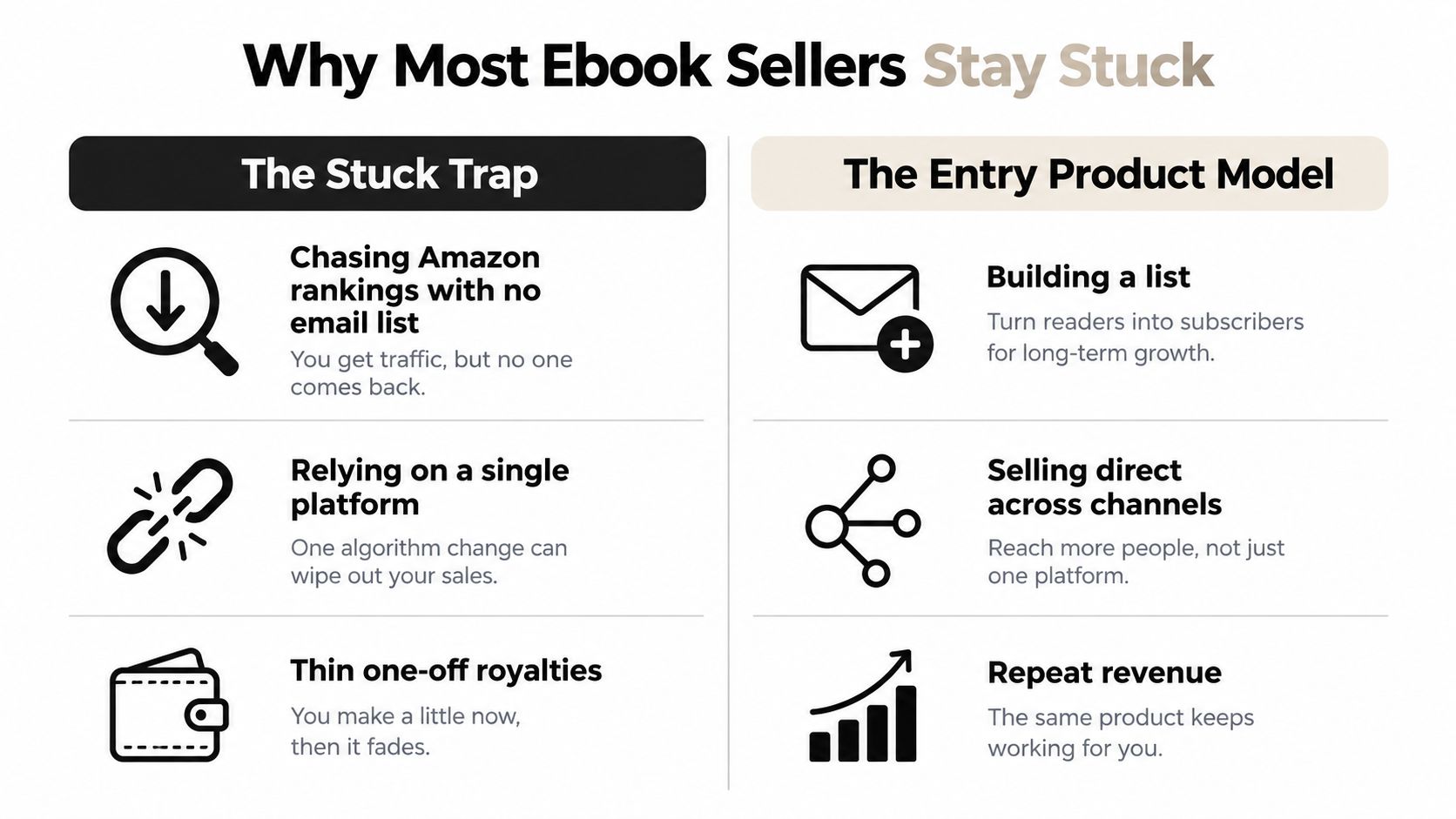
The common assumption is simple: selling an ebook means publishing on Kindle, choosing categories, and waiting for Amazon's discovery engine to do its job. Amazon can provide reach, but reach isn't ownership. A ranking can change, a review can disappear, and a platform policy can alter the economics without giving you a customer email address.
The market itself makes the old approach less compelling. The global ebook market was estimated at $14.92 billion in 2025, up from $11.29 billion in 2017, but annual growth has slowed from gains of more than 20% a decade ago to roughly 1% to 3% in recent years, according to ebook market data from BestWriting. The category is still large, but broad market growth won't rescue a weak offer.
Three traps keep creators stuck:
- Chasing rankings without building a list: You optimize keywords, categories, and reviews, but the people who buy remain invisible to you.
- Treating price as a race to the bottom: A cheap ebook may create more clicks while attracting buyers who don't read, recommend, or purchase again.
- Producing a manuscript instead of an offer: You spend months polishing chapters without deciding what specific result the reader is paying to reach.
Self-publishing proves that independent creators can win without relying entirely on traditional publishers. Reporting based on Bowker data says self-published titles grew 38.7% in 2025 to more than 3.5 million titles, while self-published authors captured 51% of overall ebook unit sales and more than 34% of ebook retail revenue. Those figures are summarized in self-publishing market data from SelfPublishing.com. The lesson isn't that every author will win. It's that distribution, positioning, and audience ownership matter more than institutional permission.
Practical rule: The ebook should turn a stranger into a buyer, then turn that buyer into a subscriber you can serve again.
A one-page creator store gives that model somewhere to live. Put the promise, preview, checkout, instant delivery, and email consent on one focused page. Use Amazon as one discovery channel if it suits your audience, but send social traffic to the page you control. Resources such as ebook categories from TheContentMap can help you study angles and formats, while this guide to selling digital products for beginners is useful for thinking beyond a single marketplace listing.
Choosing a Niche and Writing the Ebook Buyers Actually Want
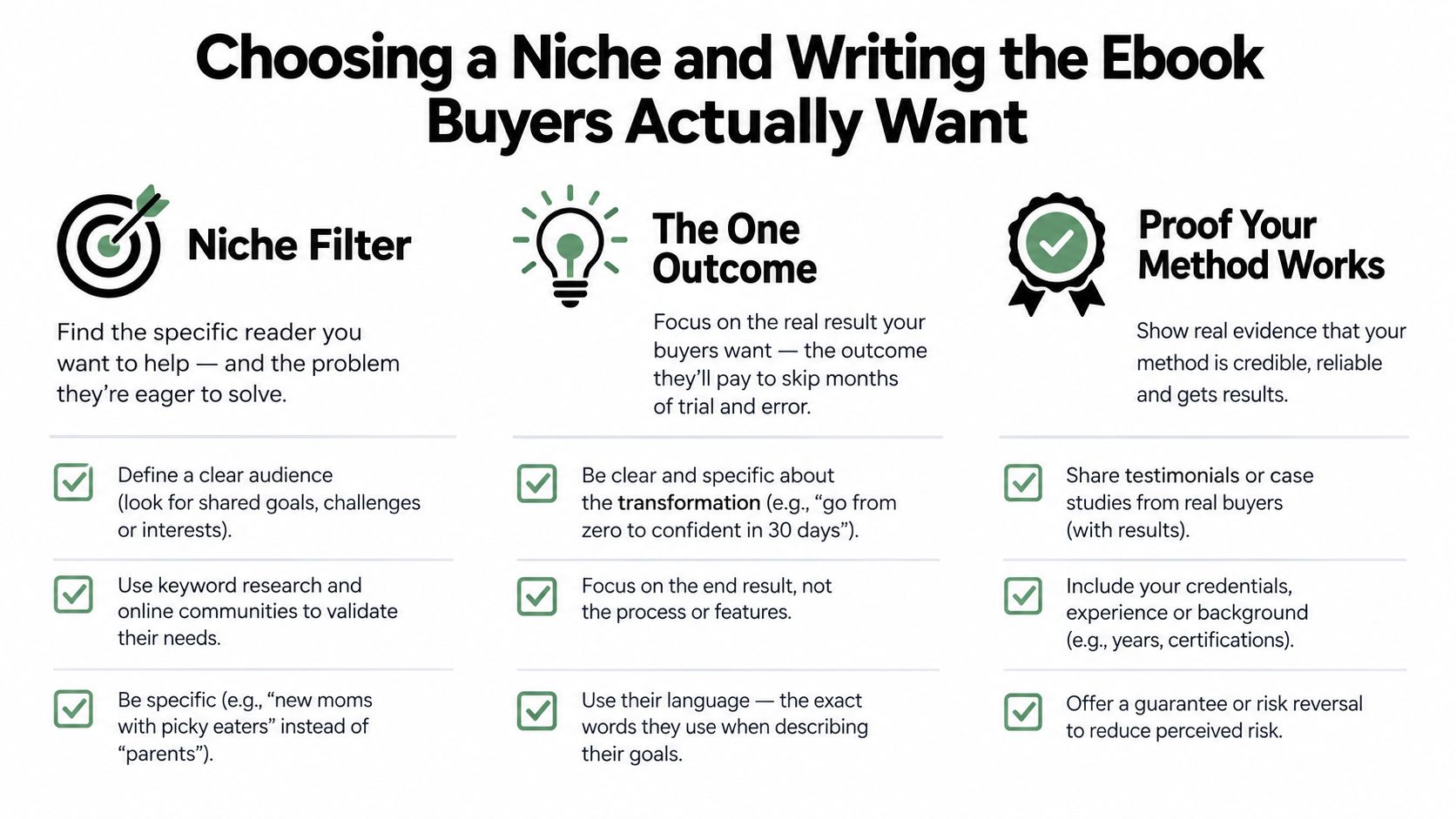
A profitable niche isn't a broad subject. It's a defined reader with an expensive or frustrating problem and a reason to solve it now.
Start with three questions:
- Who is the reader? Name their role, experience level, context, and immediate constraint.
- What outcome will they pay to reach faster? “Learn marketing” is weak. “Create a repeatable launch system for a small email list” is actionable.
- What proof supports your method? Use your own results, client work, experiments, templates, or a clearly explained process. Don't manufacture authority.
Validate the idea before writing the book. Study paid products, course outlines, Udemy cohorts, Reddit questions, and niche newsletters. Look for repeated questions that receive incomplete answers. Read product reviews for complaints, especially comments that say a resource was too broad, too theoretical, or difficult to apply.
You're not searching for a topic nobody has covered. Competition often confirms that buyers exist. You're looking for a sharper promise and a more useful execution.
Write the sales page before chapter one
Draft the commercial skeleton first:
- A headline naming the reader and desired result.
- Three benefit bullets describing what changes after reading.
- A table of contents that proves the book has a logical path.
- An FAQ addressing objections, format, use case, and expected effort.
This reverse-engineering step prevents a common failure. Writers often create a thoughtful manuscript, then struggle to explain why anyone should buy it. If you can't write a credible headline and three concrete benefits, the idea needs work before the prose begins.
Each chapter should make one core promise. End it with something the reader can use immediately, such as a worksheet, checklist, template, example, or decision rule. A buyer should feel progress while reading, not merely admiration for your knowledge.
Write in focused sessions, then edit for clarity and momentum. Cut introductions that delay the useful material. Replace abstract advice with examples. Format for phone reading, because many buyers won't consume the file in a dedicated reading environment. For a practical framework on narrowing your angle, use this resource on how to find your niche.
Packaging, Pricing, and Setting Up Your Sales Page
A strong ebook can lose sales before the buyer reads a sentence. The file looks awkward on a phone, the cover is unclear at thumbnail size, or the checkout creates doubt. Packaging affects perceived value, usability, and refund risk.
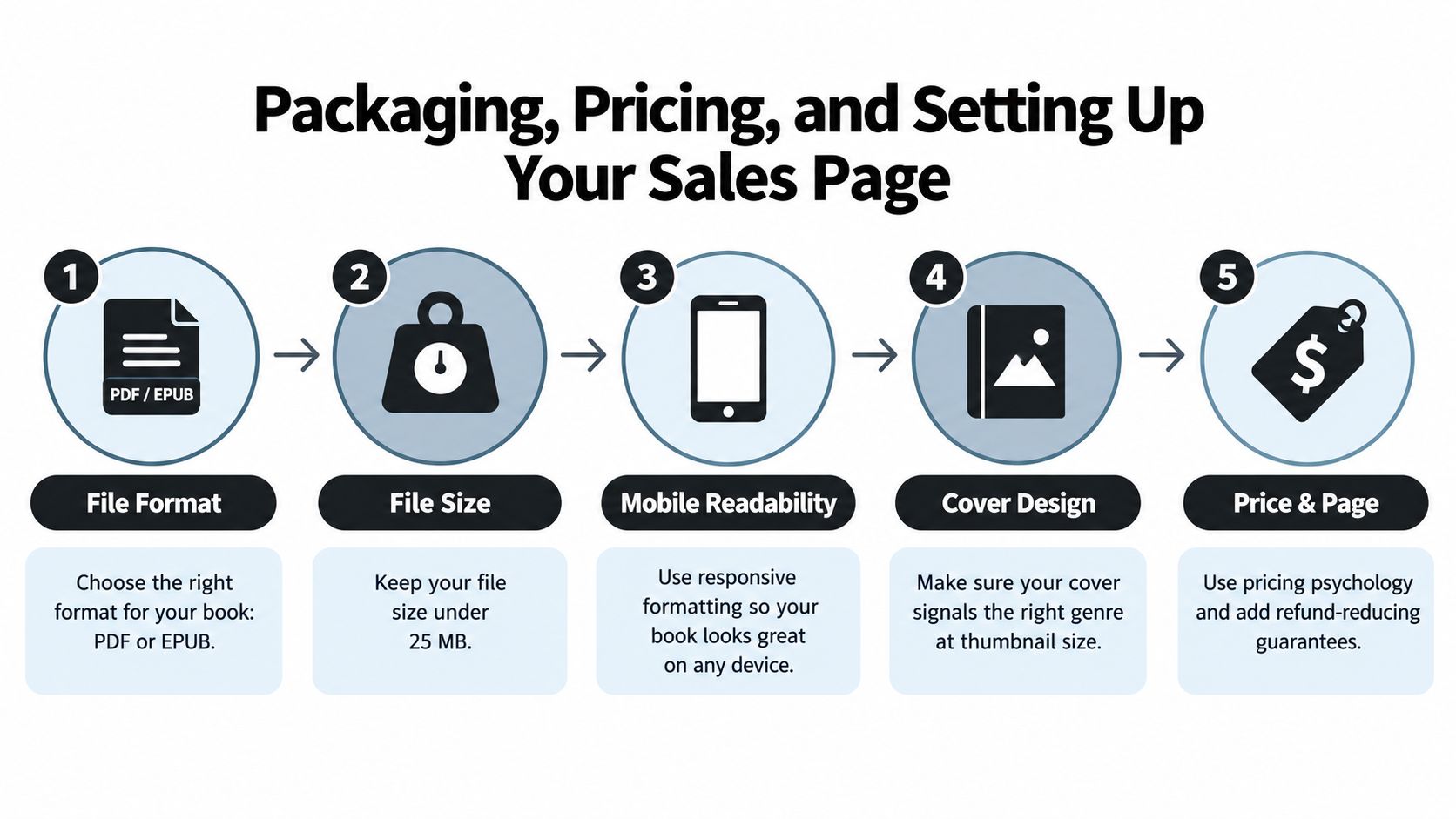
Choose the format based on the content. A reflowable EPUB works well for text-heavy books because readers can adjust the display. A PDF makes more sense for workbooks, visual guides, and resources where page layout matters. If you offer both, label them clearly and explain which format suits which device.
Keep the reading experience simple:
- Use generous spacing and readable type.
- Make headings easy to scan.
- Check links, page breaks, images, and tables on mobile.
- Give the cover a clear genre and outcome signal at thumbnail size.
- Keep the cover, sales page, receipt, and download email visually consistent.
Build one page that does one job
Your storefront page should answer the buyer's questions without sending them through a maze of redirects. Put the title, audience, promise, preview, benefits, format details, price, purchase button, and next step in a deliberate order.
The checkout should trigger an automated download link immediately after payment. If you use Stripe or PayPal, verify that the payment event connects to the correct delivery workflow. The buyer shouldn't have to email you because the file never arrived.
Your email form needs a clear, GDPR-friendly consent line. Tell subscribers what they'll receive, obtain the appropriate permission, and include an unsubscribe option in every marketing email. If you serve European buyers, check where customer data is hosted and which processor handles payment and tax obligations. Don't treat compliance text as decorative copy.
Tracking should follow the customer journey:
- Landing page view: confirms that traffic reaches the intended page.
- Add to cart: shows whether the offer creates buying intent.
- Purchase: confirms completed transactions.
- Email signup: measures the audience-building side of the offer.
Before sending traffic, complete a real purchase from different networks and devices. Confirm that the payment succeeds, the download email arrives promptly, the file opens, the subscriber enters the welcome sequence, and every analytics event records correctly. Read the receipt as if you were a cautious stranger.
For help shaping the page copy and structure, use this guide to create a sales page. The important point is operational, not aesthetic. A polished page that fails to deliver the file is still a broken sales system.
Finding the Right Price Point and Testing It
A reader lands on your one-page creator store, buys the ebook, and joins your audience for the next offer. Price that first purchase for the whole customer journey, not just the file. A direct ebook can produce revenue, qualify buyers, build your list, and introduce a higher-value product. That job makes it different from copying Amazon's default price.
Neutral pricing guidance places standard ebooks and guides around $5 to $30, with a commonly cited sweet spot between $12 and $19, as described in digital product pricing guidance from Ruzuku. Use that range as a starting point, not a commandment, and review this digital product pricing strategy to model fees, refunds, and contribution margin before testing. A narrow specialist guide can justify more than a general introduction. A short checklist may need a lower commitment.
Build the price from unit economics. Subtract payment processing, storefront or platform fees, refunds, support time, and the value of the email subscriber. If you sell through a non-Amazon channel, include delivery costs and GDPR-ready hosting or processor expenses where they apply. Then check whether the remaining contribution can fund promotion, customer support, and the next product. A low price can reduce your ability to improve the offer.
Run a clean price test
Test two plausible prices. Keep the headline, sales page, traffic source, and email message as consistent as possible. Change one variable, then compare:
- Conversion rate.
- Revenue per visitor.
- Email opt-ins per dollar spent.
- Refund behavior.
- Sales of the next offer.
Run the test sequentially across two-week windows, as recommended in the Ruzuku guidance. Do not choose a winner because one version sold more units. A higher price can produce fewer transactions while generating more revenue per visitor and better-qualified buyers.
A price test should answer a business question, not satisfy your curiosity.
Use the result to build a simple value ladder. The entry ebook solves one defined problem. A bundle can add templates or companion materials. A higher-intent offer can provide feedback, implementation, training, or access to you. The ebook earns its place by moving the right reader toward that next purchase.
Selling Beyond Amazon and Owning Your Audience
Amazon can put your ebook in front of readers already searching for a purchase. It should not be the whole business. Recent distributor reporting found that 71.5% of ebook sales through one major distributor occurred on Amazon Kindle in 2025, while 92% of Amazon ebook sales through that channel came from publishers and 8% from independent authors. The same report highlights growth in markets including Mexico, Brazil, Italy, France, Ireland, and Spain. See the details in Amazon ebook sales trends from PublishDrive. Use that information to keep Amazon as a discovery channel while building a route to readers outside one marketplace.
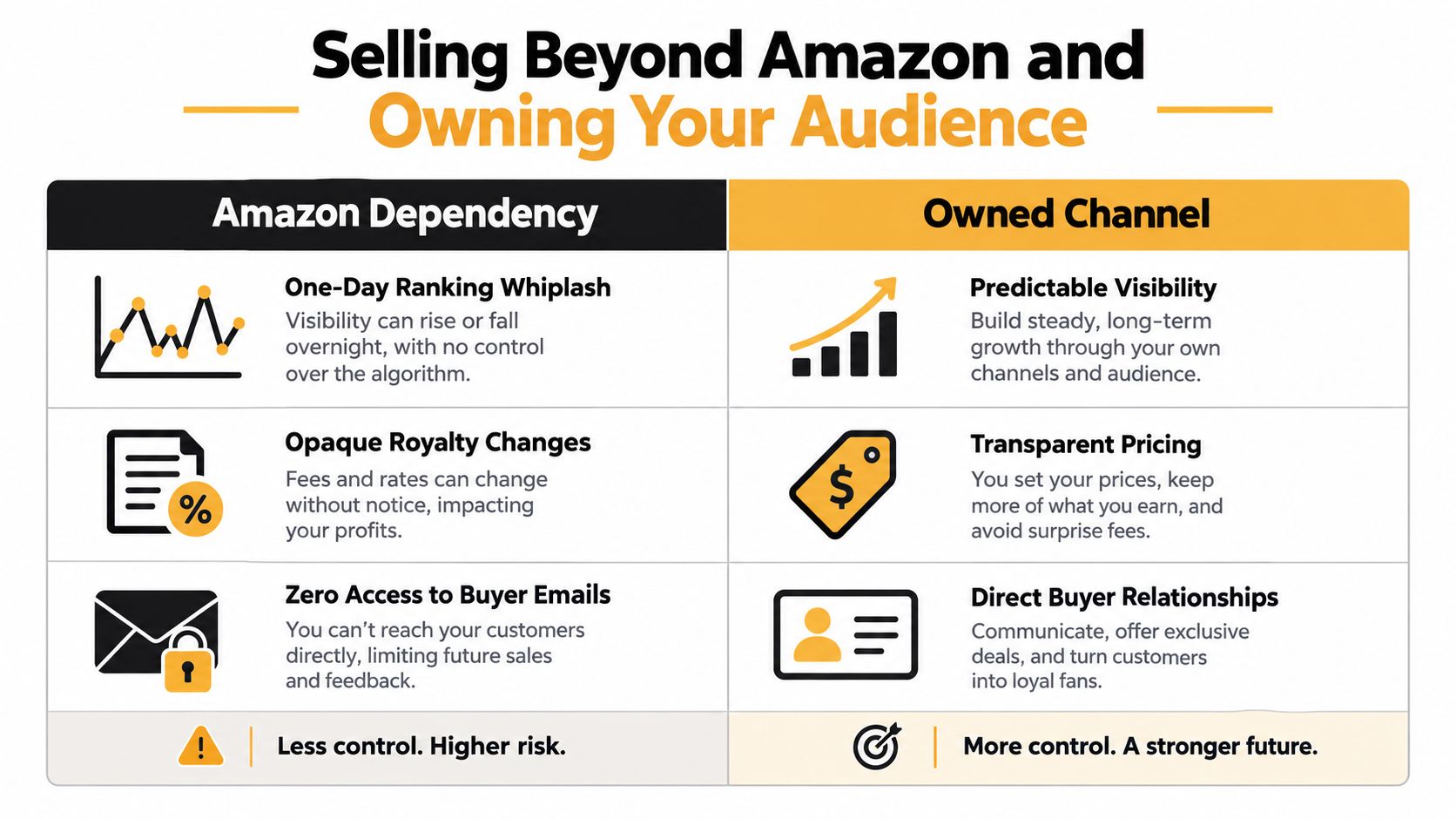
Amazon dependency creates three practical risks:
- Ranking volatility: A title can lose visibility even when the book itself has not changed.
- Opaque economics: Royalty rules, promotional conditions, and marketplace policies remain outside your control.
- No direct buyer relationship: A transaction does not automatically give you permission to email the customer or learn what they want next.
Build a one-page creator store around the ebook. The page should explain one clear promise, take payment, deliver the file, and invite the buyer to join your email list with explicit consent. The ebook becomes an entry product for a permission-based relationship, not a standalone listing that ends at checkout. Your store also gives you a place to sell bundles, templates, or later products without paying a marketplace fee on every sale.
Choose a sensible channel mix
Compare creator storefronts, Lemon Squeezy, Payhip, Shopify with a digital delivery app, and a WordPress site connected to a payment plugin. Choose based on your audience, tax requirements, design preferences, and willingness to maintain the setup. This guide to e-commerce for indie founders offers a useful comparison of non-Amazon options.
Treat GDPR hosting as an operating requirement. Check EU data residency expectations, request explicit consent at email capture, include a visible unsubscribe link in every email, publish a privacy notice, and select a processor that handles VAT correctly for your situation. Stripe and Paddle are common examples, but you still need to configure the customer journey correctly.
Keep Amazon for marketplace discovery and readers who already shop there. For listing and category setup, see how to sell ebooks on Amazon. Send social, podcast, and newsletter traffic to your own storefront, where each direct purchase can grow your permission-based audience.
This short video explains the role direct distribution can play in a creator business:
Launching and Marketing Your Ebook in 30 Days
A launch doesn't need a complicated campaign. Use one sales page, one delivery system, one segmented email list, and a small number of traffic sources you can measure.
Days one through seven
Build the waitlist before the ebook is finished. Offer a useful free chapter, checklist, or worksheet connected to the paid promise. Tag subscribers as warm leads so you can distinguish people who requested the free resource from existing readers and prior buyers.
Use the responses to sharpen the offer. Ask what they're trying to achieve, what they've already tried, and where they get stuck. Their language belongs in the sales page and email subject lines.
Days eight through fourteen
Lock the offer and finish the sales assets. Use your price-testing process to choose the launch price, then write three emails:
- The story email: Explain why you created the ebook and identify the problem it addresses.
- The benefits email: Show what the reader will be able to do, using specific examples from the book.
- The objection email: Answer concerns about time, format, difficulty, price, and whether the method fits the reader.
Don't write three versions of the same announcement. Each email should remove a different obstacle.
Days fifteen through twenty-one
Open the cart and send traffic to the same page. Use social posts, a podcast appearance, and one relevant partner promotion if those channels fit your audience. Add UTM tags so analytics can distinguish traffic from email, social, partners, and other sources.
Segment your launch messages. A subscriber who hasn't opened the first email needs a different reminder from a prior buyer. A person who clicked but didn't purchase needs more clarity, not louder urgency.
Days twenty-two through thirty
Close the launch window, review the campaign, and decide what becomes evergreen. Keep the sales page automated if it continues to convert. Add the ebook to your weekly newsletter, publish related organic content, and send new readers to the entry offer.
Track email opt-in rate, revenue per visitor, checkout conversion, and refund rate. Ignore vanity signals that don't connect to revenue or audience quality, such as raw impressions, follower counts, and isolated open-rate celebrations. A smaller campaign that produces qualified buyers teaches you more than a large burst of unmeasured attention.
Email remains a powerful channel when the audience is relevant and segmented. One industry report summarized by ebook marketing data from AMRA and ELMA reports average B2C ebook email-to-purchase conversion of 4.1%, with AI-personalized sequences reaching 6.8%. The same source reports $3.74 in revenue per email for segmented launch-week campaigns versus $0.89 for untargeted broadcasts. Use those figures as reported benchmarks, not promises. Relevance and segmentation matter more than sending more messages.
Turning One Ebook Into a Sustainable Creator Business
The ebook becomes valuable when it sits inside a repeatable operating loop.
Publish useful organic content around the reader's problem. Send interested people to the ebook page. Capture consent from visitors who aren't ready to buy. Deliver the book automatically to buyers. Nurture the list with practical advice, then offer the next product to the segment that has shown intent.
That next product might be a template pack, a workshop, a cohort, or a service. The format should match the problem. Someone who buys a guide on setting up a sales page may want templates. Someone who buys a strategic ebook may want feedback on their implementation. Don't force every buyer into the same upsell.
Measure the loop, not the launch
At the end of each cycle, review five inputs:
- Opt-in rate: Does the page give non-buyers a reason to stay connected?
- Checkout conversion: Does the offer make the promised outcome clear?
- Upsell take rate: Do buyers have a logical next step?
- Refund rate: Did the product match the sales page?
- Thirty-day revenue per acquired email: Does the list create value after the initial transaction?
A mature ebook market makes this discipline more important. One source projects global ebook revenue at $14.92 billion in 2025 with a 1.24% compound annual growth rate to 2030, while another estimates global ebook user penetration at 13.7% in 2025. That combination suggests a large but established category, not an effortless growth wave. The figures and interpretation appear in G2's overview of the ebook market.
Self-publishing competition is also intensifying. The same market overview reports 3.53 million self-published titles in 2025, up 38.7% year over year. A listing alone won't distinguish you. A precise promise, useful delivery, owned audience, and measured follow-up can.
Your ebook doesn't need to carry the entire business. Its job is to create a qualified first transaction and prove that your method helps. Keep improving the page, the emails, the product, and the next offer. That cadence is more durable than waiting for one launch to change everything.
Taap.bio gives creators a single page for selling digital products, collecting email signups, accepting paid bookings, and reviewing page analytics, with built-in checkout and instant file delivery for products such as ebooks. Visit taap.bio to set up the direct-sales layer that turns your ebook into the first step of a real audience business.