TikTok Shop doesn't broadly allow most digital products. In the United States, virtual goods are limited to invite-only sellers, while ordinary downloadable files remain prohibited outside approved categories.
That's the counterintuitive part of the answer to can you sell digital products on TikTok Shop. TikTok Shop has become a major commerce channel, but its reach doesn't mean every creator can list an ebook, template, course, audio file, or consultation and send access after payment. The practical route for many digital sellers is to use TikTok for discovery and a compliant owned checkout for the transaction.
Table of contents
The Real Answer About TikTok Shop and Digital Products
TikTok Shop does allow some digital products, but only through a restricted approval path. TikTok's U.S. Virtual Goods Requirements define virtual goods as non-physical products delivered electronically and state that selling them is limited to invite-only sellers who must receive approval before listing or offering them.
That approval gate changes the answer for nearly every independent creator. Approved examples include software delivered through a digital license key, activation code, or secure download, along with certain standalone video games and downloadable game content. An ordinary PDF, ebook, template, audio file, course, or consultation shouldn't be treated as eligible just because the buyer receives it electronically.
The confusion usually comes from collapsing two different activities into one phrase: selling on TikTok and selling through TikTok Shop. A creator can promote a digital product in a video, build interest through livestreams, and send qualified viewers to a storefront. That doesn't mean the same product can appear as a TikTok Shop listing with native checkout.
Quick Classification
| Product Type | Typical Status |
|---|---|
| Software license key | Potentially eligible for approved sellers |
| Standalone video game | Potentially eligible for approved sellers |
| Downloadable game content | Potentially eligible for approved sellers |
| Ebook or PDF | Generally not safe to list without specific approval |
| Template or audio download | Generally not safe to list without specific approval |
| Course or consultation | Often restricted, product and market dependent |
| Membership or subscription | Restricted, with separate requirements |
| Physical product | Standard TikTok Shop model, subject to its own rules |
Before building a funnel, classify the offer by product type, seller approval, delivery method, and market. Creators researching income from social media with LesFM may find the broader monetization context useful, but the TikTok Shop policy question still needs a product-level answer.
For a focused look at the alternative route, see how to sell digital products on TikTok. The key point is simple: TikTok Shop isn't a universal digital-download store, and copying another seller's listing isn't proof that your offer is permitted.
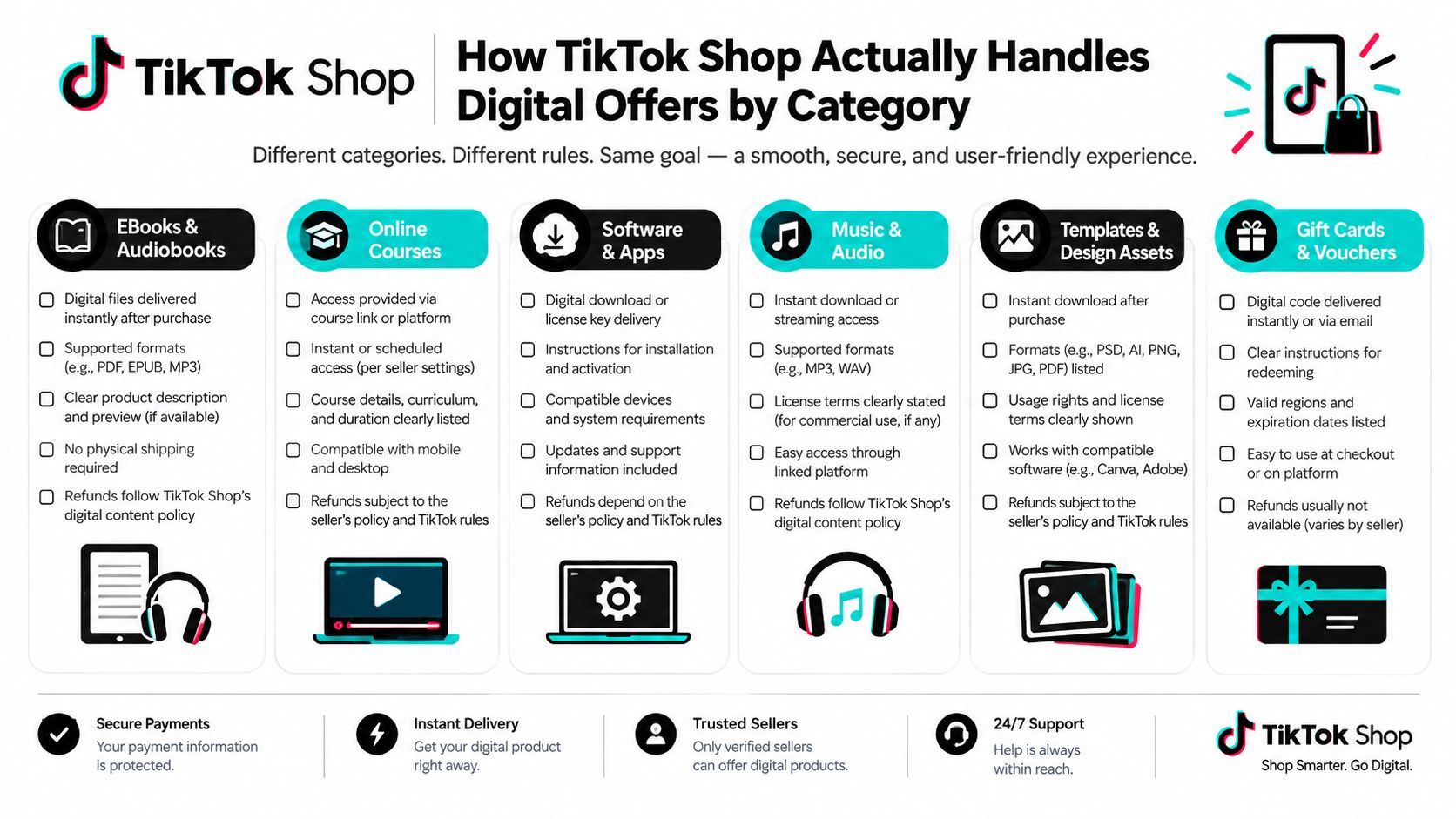
How TikTok Shop Actually Handles Digital Offers by Category
The safest way to evaluate an offer is to start with the category, not the file format. A downloadable file can belong to a permitted virtual-goods category, or it can remain prohibited because the underlying product is an ebook, service, course, or subscription.
TikTok's U.S. digital product requirements state that virtual or digital products are prohibited unless the seller is approved for the Virtual Goods category. The same rules describe access as invite-only, so “I'll add the product and email the file after checkout” isn't a reliable workaround.
Start with the fulfillment method
For an approved virtual good, TikTok expects an accurate listing and secure electronic delivery. That can include a license key, activation code, or secure download, depending on the approved product and market. The delivery method needs to match what the listing promises. A seller shouldn't describe a software license and then provide an unrelated file, or use vague access instructions that leave the buyer uncertain about what they purchased.
Software and certain games are the clearest examples of offers that may fit the approved category. Even there, approval isn't automatic. The seller must confirm that the account has access and that the specific offer meets the current requirements.
Treat adjacent categories as separate decisions
Memberships, subscriptions, stored-value products, services, consultations, and course-related offers can trigger different restrictions. A prepaid digital entitlement isn't automatically equivalent to a recurring subscription, and a consultation isn't automatically a virtual good just because the booking happens online.
Use this self-audit before you prepare a listing:
- Identify the deliverable: Is the customer receiving software, game content, a file, access, or a human service?
- Check seller access: Does Seller Center show approval for the Virtual Goods category?
- Confirm market rules: U.S. guidance doesn't establish permission in every country. TikTok's Vietnam guidance, for example, identifies digital downloads of books, magazines, newspapers, music, and videos among unsupported virtual products.
- Match fulfillment: Can you deliver the approved item through the secure method required by the listing?
- Review the current policy: Don't rely on screenshots, competitor listings, or old tutorials.
Creators who want to understand the promotional side can also review these practical TikTok live shopping tips from Next Point Digital. Promotion tactics may help generate attention, but they don't remove the approval requirement.
A broader explanation of the formats creators sell appears in what digital downloads are. The useful distinction is between an approved virtual-good offer and an ordinary download that still needs an external sales flow.
Why Forcing Every Digital Offer into TikTok Shop Fails
The common assumption is that TikTok Shop must handle the checkout because TikTok generated the attention. That logic works for eligible physical products, but it creates friction when the offer is an ebook, template, course, booking, or recurring service.
A forced listing can produce the wrong kind of operational problem. You may need to misclassify the item, explain an unusual delivery process, or depend on a fulfillment workflow that wasn't designed for your product. If TikTok reviews the listing and decides that the category, description, or delivery method doesn't match, the short-term convenience can turn into listing removal or account restrictions.
There's also a business problem. A link-list page can send a viewer through several choices before they reach checkout. A scattered stack of storefront, scheduling, email, analytics, and file-delivery tools adds maintenance. Fees and redirects matter even more when the product has a modest price or the buyer needs a quick decision.
Separate attention from transaction
TikTok Shop's scale makes the restriction strategically important. TikTok Shop launched in the United States in September 2023, and third-party market data reported approximately $9 billion in U.S. gross merchandise value during 2024, an estimated 650% year-over-year increase. The same data reported about 398,000 U.S. live stores by December 2024, with approximately 216,000 recording active sales. TikTok separately reported in June 2025 that U.S. TikTok Shop sales had increased 120% compared with the same period a year earlier. These figures describe commerce overall, not unrestricted digital-product sales, as TikTok's newsroom coverage makes clear.
The rational response isn't to ignore TikTok. It's to assign each channel the job it handles well:
- TikTok creates discovery: Demonstrate the problem, show the product in use, and answer objections in public.
- Your checkout handles delivery: Provide the file, booking, access instructions, or confirmation through a workflow designed for that offer.
- Your audience system supports repeat sales: Capture permission-based email contacts where appropriate, rather than losing every interested viewer after one visit.
Practical rule: Don't disguise a digital product as a physical product. If the offer doesn't fit TikTok Shop's approved category, change the checkout path, not the product description.
TikTok's rules can change, and market restrictions differ. An owned funnel reduces dependence on one listing format, but every promotion still needs to follow the platform's current rules, especially where external payment or purchasing language is restricted.
Choosing Between a TikTok Shop Listing and an Owned Checkout
The decision comes down to permission and control. A native TikTok Shop listing can make sense when you have explicit Virtual Goods approval, your offer fits an approved category, and your delivery method follows the applicable requirements. Without those conditions, an owned checkout is usually the safer operating model for ordinary digital products.
| Situation | Recommended Channel |
|---|---|
| Approved seller offering eligible software | TikTok Shop, after checking category requirements |
| Approved seller offering qualifying game content | TikTok Shop, with secure electronic fulfillment |
| Ebook, PDF, or downloadable template | Owned checkout |
| Audio or video download | Owned checkout, subject to market and promotion rules |
| Consultation or paid booking | Owned checkout with scheduling |
| Course or information product | Owned checkout unless specifically approved |
| Recurring subscription | Owned checkout, after checking TikTok's promotion rules |
| Mixed catalog with physical and digital items | Separate the eligible TikTok Shop catalog from the external digital catalog |
When native checkout earns its place
The TikTok route gives an approved seller a platform-native purchase experience. It may be useful when the product is already recognized as an eligible virtual good, the seller can meet the listing requirements, and the target market supports that category. It also keeps the transaction close to the content that generated demand.
The trade-off is flexibility. You accept TikTok's approval process, product taxonomy, fulfillment rules, market limitations, and policy changes. That isn't necessarily a problem for an approved software or game seller, but it becomes a poor fit for a creator whose main catalog consists of flexible downloads and services.
When owned checkout is the cleaner option
An external flow gives you more control over the product page, file delivery, booking logic, email capture, and customer experience. You can present an ebook as an ebook, a template as a template, and a consultation as a consultation instead of trying to make every offer resemble an approved Shop category.
The right landing page should make the next action obvious. A one-page checkout can reduce unnecessary movement between pages, but it doesn't override TikTok's market-specific rules. If TikTok prohibits a particular off-platform purchasing instruction in your market or placement, adjust the disclosure and call to action accordingly.
Decision test: If approval is uncertain, don't build your revenue plan around native listing access. Build the content and owned checkout first, then treat TikTok Shop approval as an additional channel rather than the foundation.
Using TikTok for Discovery with Compliant Off-Platform Delivery
The strongest setup for many creators is a division of labor. TikTok supplies attention through short videos, livestreams, and demonstrations. A separate storefront handles the transaction, delivery, bookings, and follow-up for products that aren't suitable for TikTok Shop.
A creator might demonstrate a template on screen, show how an audio preset changes a track, or explain what a course module helps the buyer do. The profile link then leads to a focused page where the visitor can review the offer and complete the permitted purchase flow. This preserves TikTok's discovery role without pretending that an ordinary download qualifies as a native Shop item.
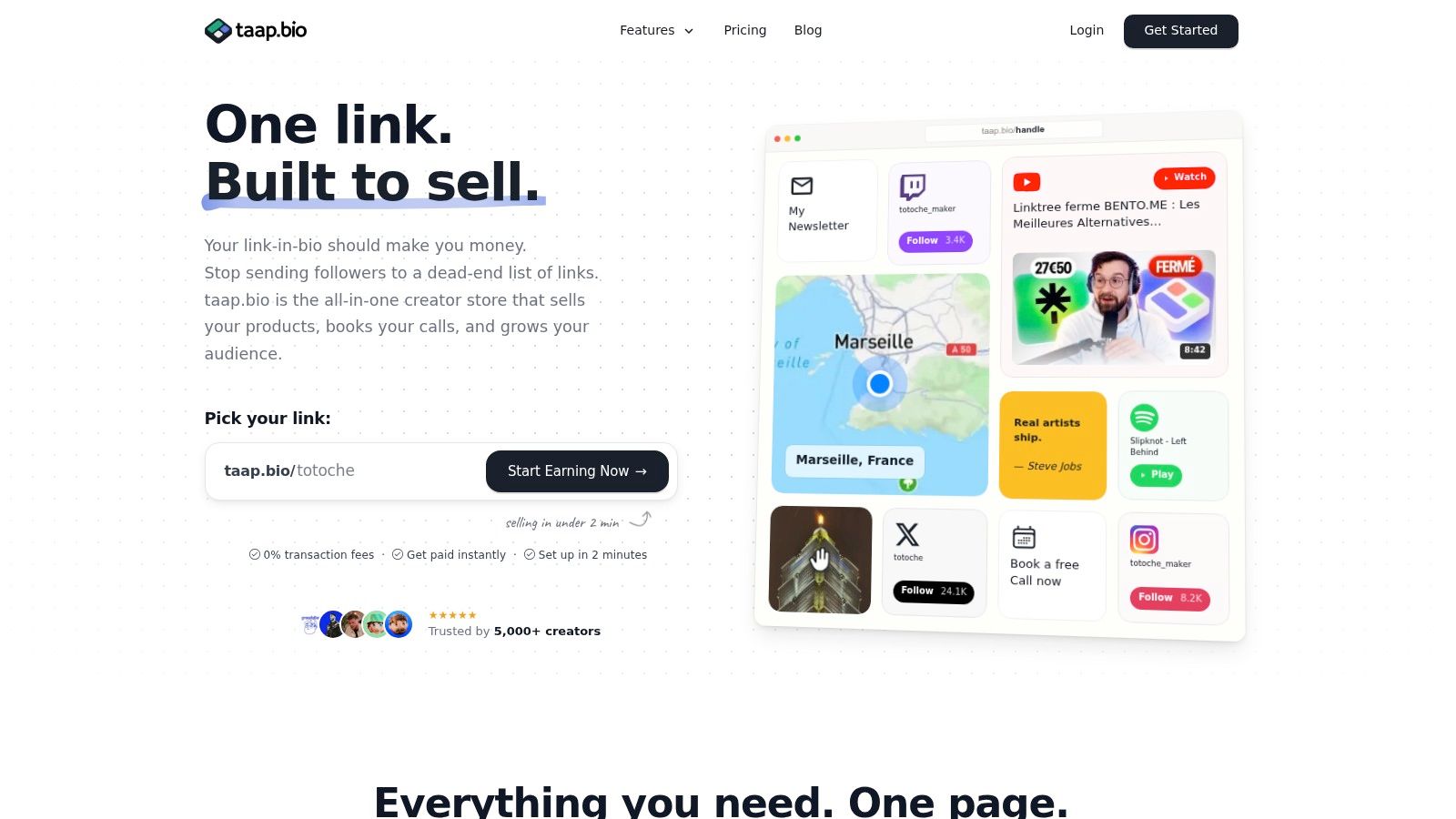
taap.bio is one option for this setup. It combines a storefront, scheduling, email capture, analytics, built-in checkout, and rich media widgets in a drag-and-drop bento layout. The platform supports product sales, paid bookings with upfront payment and automatic calendar invites, email signup with one-tap subscribe and CSV export, and instant digital file delivery after payment, according to its product overview.
Consolidate the operating pieces
The practical benefit is fewer disconnected handoffs. Instead of maintaining separate tools for a link page, digital storefront, email form, booking calendar, and analytics, a creator can place those actions on one public page. A custom domain option is also available for creators who want a branded destination.
That consolidation doesn't make the funnel automatically compliant. You still need to describe the offer accurately, follow TikTok's disclosure requirements, and avoid presenting an external purchase path in a way that violates regional rules. The storefront solves delivery and customer experience. It doesn't grant permission to bypass TikTok policy.
A useful profile destination should answer three questions quickly:
- What does the creator offer?
- Which product or booking should the visitor choose?
- What happens immediately after payment?
For more context on the profile destination itself, see what a link in bio on TikTok is. Keep the page narrow enough that a viewer arriving from one video doesn't have to search through unrelated options.
Here's how the flow can look in practice:
- A TikTok video demonstrates a specific problem and the creator's method.
- The profile directs interested viewers to the creator's page.
- The visitor selects the relevant download, booking, or signup.
- The checkout delivers the permitted product or confirms the appointment.
- The email option gives the creator a lawful way to continue the relationship with subscribers.
The product page should make no promise that the product can't support. Clear copy protects the buyer and gives the creator a more durable business process.
Setting Up a taap.bio Funnel Linked from TikTok
Start with the offer, not the tool. Write down exactly what the buyer receives, how delivery happens, and which market you're targeting. If the product is a normal download that lacks TikTok Shop approval, plan for TikTok discovery and an external checkout rather than trying to force a Shop listing.
Build the page around one action
Create the page, choose a bento layout, and add the product widget for the offer you're promoting. Enable instant digital delivery for a file-based product, or add the booking widget when the buyer needs a paid appointment with calendar coordination.
Then add an email signup widget. Explain what subscribers will receive, collect permission clearly, and keep the contact export available for your own records. A focused page can also include a video, image, or product demonstration so visitors understand the offer before they reach checkout.
Connect the page to your content
Place the page in the TikTok profile where the account supports a website destination. In videos, use accurate language about the resource and avoid implying that every digital product is available through TikTok Shop. If a market restricts off-platform payment or purchasing instructions, follow that market's rules instead of copying a call to action from another region.
You can use custom landing page builder features when the standard page needs a more custom presentation. Test the complete path yourself, including payment confirmation, file access, booking confirmation, email signup, and mobile display.
Launch check: Visit the page as a first-time viewer. If the product, price, next step, and delivery expectation aren't immediately clear, simplify before sending TikTok traffic.
TikTok remains valuable as a discovery engine even when TikTok Shop isn't the right checkout. A single-page funnel lets you keep the product accurate, delivery controlled, and audience capture connected without building a fragile collection of separate tools.
taap.bio gives creators a single page for digital products, paid bookings, email capture, checkout, and delivery, which makes it a practical alternative when ordinary downloads don't qualify for TikTok Shop. Visit taap.bio to create a focused destination for your TikTok audience and connect discovery with a controlled sales flow.