Turning your art into a business that actually thrives online is about more than just creating beautiful work. It starts with a solid plan. Before you even think about listing your first piece, you need to get strategic about your goals, your brand, and who you're trying to reach. This groundwork is what separates artists who make a sustainable living from those who just occasionally sell a piece.
Think of yourself as an entrepreneur, not just a creator. This slight shift in mindset is the key. It's not about selling out; it's about setting your art up to be discovered, appreciated, and purchased by the people who will truly value it.
So, where do you begin? It all starts with getting crystal clear on who you are as an artist and who your ideal collector is. Are you creating calming, minimalist pieces for chic, modern homes? Or are you making vibrant, pop-culture-inspired art for a younger, edgier crowd? Knowing this defines everything that comes next.
Find Your Niche and Pinpoint Your Ideal Collector
In a sea of incredible artists, your "niche" is your anchor. It’s that sweet spot where your unique style, subject matter, and the audience that craves it all come together. Finding it helps you stand out and connect with buyers on a deeper level.
To zero in on your niche, ask yourself a few honest questions:
- Who is my art really for? Go beyond simple demographics. What do they care about? What’s their lifestyle like? Where do they hang out online and what other brands do they love?
- What purpose does my art serve? Does it create a sense of calm in a busy home? Does it spark conversation and make a bold statement? Or does it simply bring a little bit of joy into someone's daily life?
- What makes my artistic voice unique? Is it your specific brushstroke technique, your unconventional color combinations, or the powerful stories woven into each piece?
Once you have a picture of this person, your ideal collector, you can stop shouting into the digital void and start having meaningful conversations with people who are already searching for art just like yours.
The digital art world is booming, and the numbers back it up. There's a massive, engaged audience out there ready to connect with artists directly.
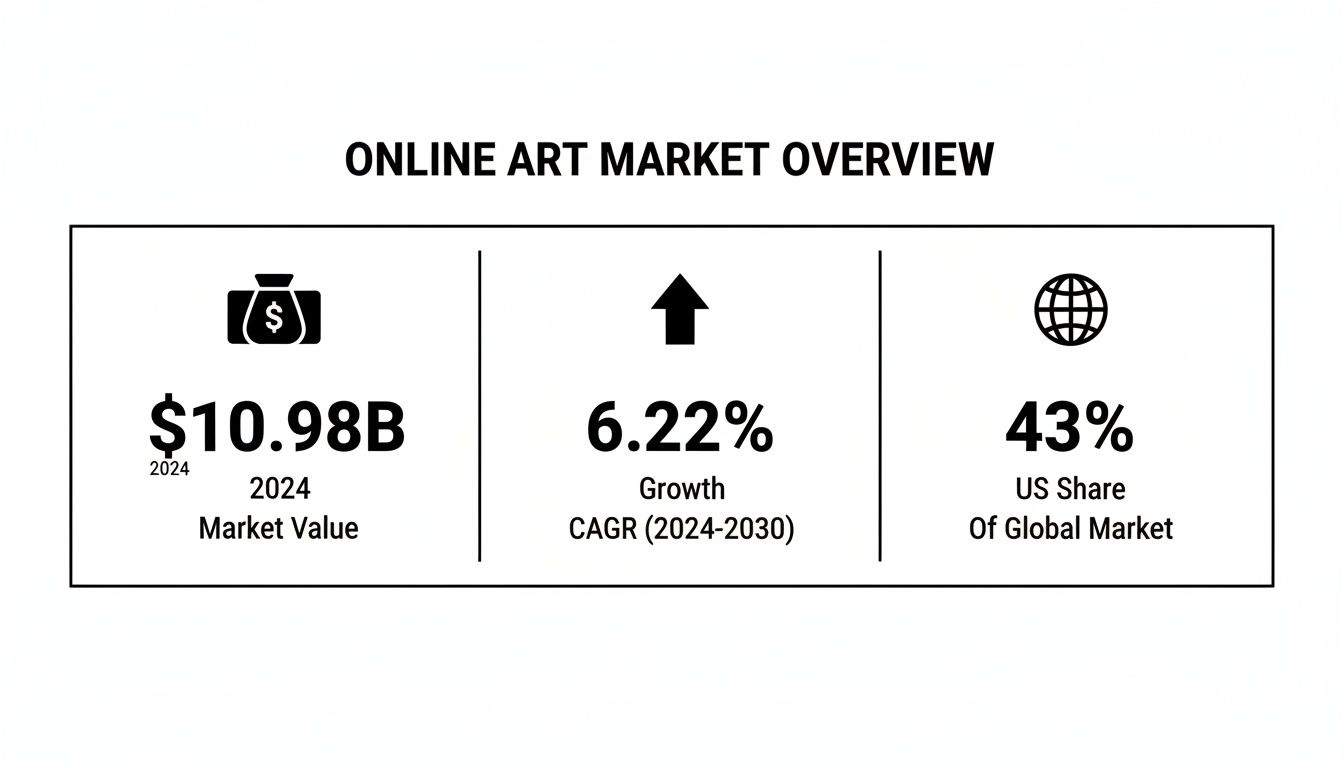
This isn't some fleeting trend. The market is huge and it's only getting bigger, which is fantastic news for independent artists.
Set Goals That Actually Mean Something
Knowing who you're selling to is half the battle. The other half is defining what success actually looks like for you. Vague wishes like "I want to sell more art" won't get you very far. You need concrete, measurable goals to guide your efforts.
Think in terms of SMART goals (Specific, Measurable, Achievable, Relevant, Time-bound).
Here’s what that looks like in practice:
- Instead of "get more followers," a better goal is "Grow my engaged Instagram audience by 500 followers in the next three months by posting 3 Reels per week."
- Instead of "make more money," try "Generate $2,000 in revenue this quarter by selling 5 original paintings and 20 limited-edition prints."
These kinds of targets give you a real roadmap. They transform your creative passion into a focused business. And the opportunity is massive—the online art market hit $10.98 billion in 2024 and is on track to reach $18.90 billion by 2033. Platforms that let you sell directly have blown the doors wide open for artists, with the US alone making up 43% of the global market.
Build a Brand People Remember
Your brand is so much more than a logo. It's the entire vibe a collector gets from your work—from the moment they land on your website to the way you package their order. A strong, cohesive brand builds instant trust and makes your art unforgettable. For many artists starting out, browsing a platform's listings, like an Etsy product catalog, can offer inspiration on how others present their brand.
Your brand identity is the visual and emotional language you use to tell your story. It should be authentic to you and resonate deeply with your ideal collector, making your work unforgettable.
To start shaping your brand, concentrate on these key pieces:
- Visuals: Your logo, fonts, and color palette should feel like a natural extension of your art style.
- Voice: How do you sound in your captions, emails, and art descriptions? Whether it's witty, thoughtful, or mysterious, keep it consistent.
- Story: People connect with stories. Share the "why" behind your art. What inspires you? What’s your creative process really like?
Nailing down your brand from the beginning makes everything else—from building your portfolio to running ads—infinitely more effective. And speaking of portfolios, we have a great guide on how to build a stunning one using an online portfolio builder free of charge.
Table of contents
Price Your Artwork to Sell and Scale
Let's get real for a moment. Turning your creative passion into a business that actually pays the bills comes down to one thing: turning your art into sellable products. This isn't about selling out; it's about building an ecosystem around your work that invites people in at every level.
So many artists I see make the mistake of only listing their big, high-ticket original pieces. While those are the crown jewels, they speak to a tiny fraction of potential buyers. To really make a go of it online, you have to build a "product ladder" that gives everyone a chance to own a piece of your world.
It’s all about creating easy 'yes' moments for new fans, without devaluing your signature work.
Build a Product Ecosystem That Works for You
Your mission is to meet people where they are. Someone who just found you on Instagram probably isn't ready to drop $3,000 on a canvas. But would they pay $40 for a stunning print that spoke to them? Absolutely. That's your foot in the door.
Think about your offerings in tiers:
- Originals: These are your one-of-a-kind masterpieces. They're unique, scarce, and command the highest prices. This is the top of your ladder.
- Limited-Edition Prints: My personal favorite. High-quality giclée prints, signed and numbered in a small run (think 25 or 50), create a sense of urgency and exclusivity. They feel special, justifying a mid-range price point.
- Open-Edition Prints: These are your workhorses. More affordable posters or standard prints that can be sold endlessly. They're the perfect entry point for new collectors and a fantastic way to share your most popular pieces widely.
- Digital Goodies: This is found money. Think downloadable phone wallpapers, desktop backgrounds, or even printable coloring sheets based on your line drawings. The best part? Zero inventory and zero fulfillment cost.
I’ve seen artists use smaller, affordable prints as a 'welcome mat' to their brand. They might sell a beautiful 8x10 for $60, knowing that the person who buys it is now emotionally invested and far more likely to come back later for a bigger piece or a commission.
This tiered system isn't just about making more sales—it's about building a community, from the casual admirer to the serious collector.
A No-Nonsense Formula for Pricing Your Art
Pricing feels like the most mysterious, nerve-wracking part of this whole process, but it doesn't have to be. You don't need to pluck a number out of thin air. A simple, reliable formula can give you a solid, confident starting point.
For original artwork, a formula I’ve relied on for years is:
(Your Hourly Rate × Hours Spent) + Cost of Materials = Base Price
But you're running a business, not just covering costs. So, the next step is crucial.
Base Price × 2 = Final Price
Let's walk through it. Say you're pricing a new acrylic painting.
- You value your skilled time at $35 per hour.
- You poured 10 hours into this piece. ($35 x 10 = $350)
- The canvas, paints, and varnish cost you $50.
- Your Base Price is $350 + $50 = $400.
- Your Final Price is $400 x 2 = $800.
This method ensures you’re always paid for your labor and materials, with a healthy margin built in to reinvest in your business. For prints, it's even simpler: Cost to Produce + Your Desired Profit = Retail Price.
Nailing the Art of Commissions
Commissions can be an incredibly rewarding and lucrative part of your business, but they can also be a nightmare if you don't set the rules. The key is a rock-solid, non-negotiable process that manages expectations from the very first inquiry.
Think of this as your commission playbook. It should be the same every time.
- The Kickoff: Start with a detailed questionnaire or a call to nail down the client's vision—size, colors, subject, and of course, budget. Get everything on the table.
- Make it Official: Never, ever start work without a formal quote and a simple contract. Outline the scope, the final price, a payment schedule (50% upfront, 50% on completion is standard), and a realistic timeline.
- The Sketch Approval: This is your safety net. Create a preliminary sketch or digital mockup for the client to sign off on before you touch a canvas. This is their one big chance for major revisions.
- Show Your Work: A few progress shots go a long way. They keep the client excited and reassure them that everything is on track.
- The Grand Finale: Get the client's final, enthusiastic approval on the finished piece before you send the final invoice and arrange for shipping.
A structured process like this isn't just professional—it’s a sanity-saver. It builds trust, protects you both, and turns what could be a chaotic headache into a smooth, predictable, and profitable experience.
How to Craft Art Listings That Actually Sell
A potential collector lands on your page, clicks on a piece they’re drawn to, and… what happens next?
That product listing is the final, most critical step in their journey. It's not just a page; it's your digital gallery wall, your storyteller, and your salesperson, all rolled into one. I've seen it time and time again—a weak listing with blurry photos or a sterile description is where a sale goes to die.
A phenomenal listing, on the other hand, forges a real connection. It helps a buyer imagine your art in their home, making it part of their life before they've even bought it. It erases doubt, builds trust, and makes clicking "add to cart" feel like the most natural thing in the world.
Let's break down exactly how to do that.
Nail Your Product Photography
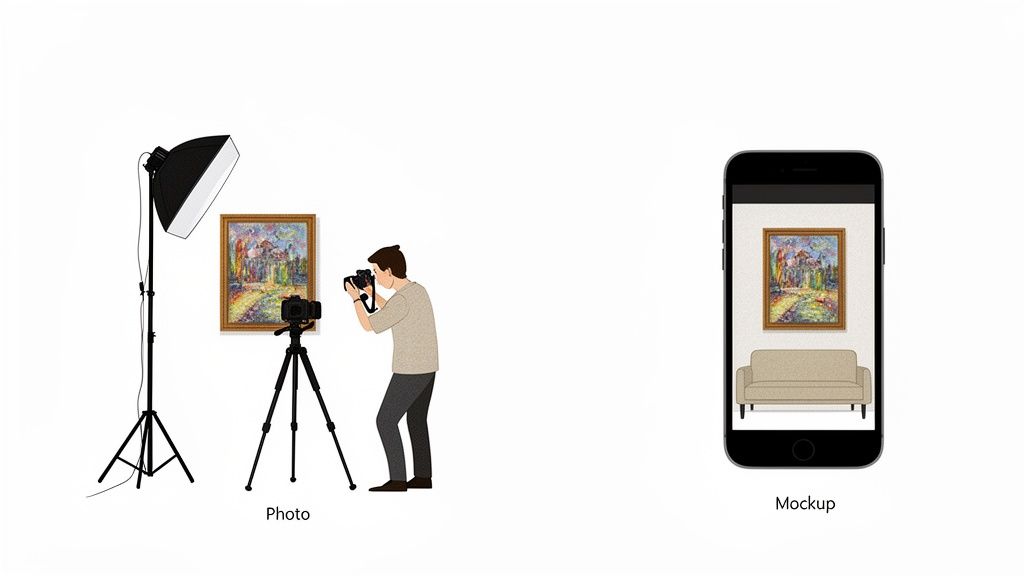
Long before anyone reads a single word you've written, they're judging your art by its photos. Your camera is your most important sales tool, but you don’t need a fancy studio to get professional results. The secret is light.
Natural, indirect daylight is your absolute best friend here. Try setting up your artwork near a large window, preferably on a slightly overcast day. This gives you soft, even lighting that won't cast harsh shadows or create a distracting glare, capturing the true colors and textures of your work.
But don’t stop at just one straight-on shot. Your job is to give the buyer a complete picture, almost as if they were holding it in their hands.
- The Full Shot: Get a clean, perfectly centered image of the entire piece against a simple, neutral background. No distractions.
- The Detail Shot: Move in close. Capture the texture of the canvas, your unique brushstrokes, or the intricate linework. This is where buyers feel the craftsmanship.
- The Scale Shot: Place a common object like a coffee mug or a plant next to the art, or even hold it yourself. This gives people an instant, intuitive sense of its actual size.
A common mistake is relying solely on that main "hero" image. I've seen conversion rates jump when artists simply add a shot of the painting hanging over a sofa. It instantly answers the buyer's biggest unspoken question: "How would this actually look in my space?"
Bring Your Art to Life with Mockups
This is where you bridge the gap between their screen and their living room. A good mockup helps a potential buyer visualize your art on their own wall, which makes the purchase feel less like a risk and more like a reality.
You don't need to be a Photoshop wizard. There are tons of user-friendly apps and sites out there—Canva and Placeit are great places to start—with pre-made interior scenes. Just upload a high-res photo of your art, and you can drop it into a stylish living room, a minimalist office, or a cozy bedroom in seconds.
Write Descriptions That Tell a Story
Okay, your stunning visuals have captured their attention. Now your words need to seal the deal.
The absolute worst art descriptions are just a list of cold facts: "Acrylic on canvas, 24x36 inches." That tells them nothing and inspires no one. Your description is your chance to share the story behind the art.
As you write, think about these questions:
- What was the inspiration? A specific memory, a song, a feeling you couldn't shake?
- What ideas or emotions were you exploring as you created it?
- Are there any interesting techniques or materials you used that aren't obvious?
Let people into your process. Instead of just "Abstract landscape," try something like: "This piece was inspired by those quiet, electric moments just after a thunderstorm on the coast. I wanted to capture that feeling of calm and clean air with layers of soft blues and hazy grays." This narrative creates a powerful connection and immediately adds to the perceived value of your work.
Of course, a strong narrative is just one part of a great presentation; it's also worth exploring the principles of visual hierarchy in web design to organize your entire shop page effectively.
Sprinkle in a Little SEO Magic
Finally, you need to help people find your art in the first place. This means thinking like a buyer. What words would they be typing into Google or Etsy to find a piece just like yours?
Jot down a list of keywords that relate to your art. Think in categories:
- Style: "minimalist abstract painting," "colorful pop art print," "moody landscape photography"
- Subject: "ocean wave art," "botanical illustration," "cityscape oil painting"
- Colors: "blue and gold wall art," "neutral earth tone decor"
- Use Case: "large art for living room," "artwork for home office"
Now, weave these keywords naturally into your product title and the first paragraph of your description. A title like "'Coastal Calm' - Large Blue and Gold Abstract Ocean Painting for Living Room Wall" is infinitely more discoverable than just "Coastal Calm." This simple tweak is fundamental to getting seen and is a cornerstone of learning how to sell art online.
Master Your Art Marketing and Promotion
Making incredible art is only half the battle. The other half—the part that actually turns your passion into a sustainable business—is all about connecting that art with the right people. This is where you learn to find your collectors and build a real community around your work.
Forget the old gallery model. The digital world has completely changed how art is discovered and sold, and this isn't some fleeting trend. Online art sales are now a massive, undeniable force in the industry.
Dominate on Visual-First Platforms
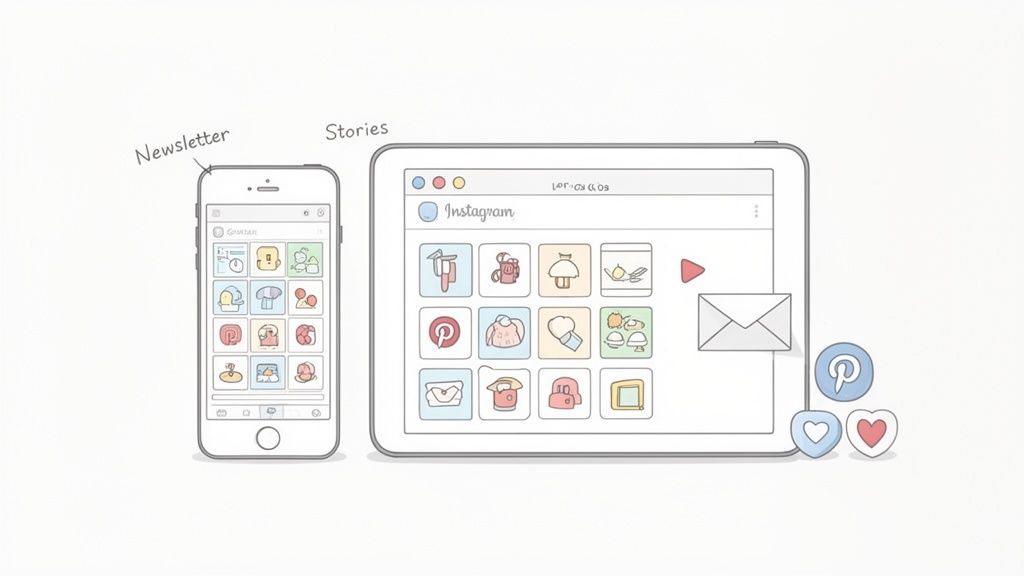
For any artist today, platforms like Instagram and Pinterest are more than just social media—they're your digital galleries. This is where your visual storytelling comes alive and where you can grow a dedicated following that genuinely wants to see you succeed.
The trick is to think beyond just posting a slick photo of a finished piece. Your audience is looking for a connection; they want to see the person and the process behind the art. To keep your feed dynamic and pull people in, you need to mix it up.
Here are a few content ideas that I've seen work time and time again:
- Mesmerizing Process Videos: There's something hypnotic about watching a piece come to life. Time-lapses or Reels showing your process are incredibly satisfying for viewers and almost always get high engagement. They’re a powerful way to show off the skill and hours that go into your work.
- Authentic Studio Tours: Pull back the curtain! A quick video of your workspace, your favorite brushes, or how you organize your supplies makes you instantly more relatable and human.
- Storytelling Carousels: Use a series of images or short clips to unpack the story behind a collection or even a single piece. Talk about your inspiration, the challenges you faced, and what it means to you.
Remember, consistency beats perfection every single time. The real goal is to show up regularly and share your journey. That’s how you turn passive scrollers into an active, invested community. Our guide on social media marketing tools for small business can help you find ways to make this easier.
The Power of Behind-the-Scenes Content
Here’s a hard-won truth: people don't just buy art; they buy a piece of the artist's story. Your behind-the-scenes content is what builds that crucial emotional bridge. It elevates a simple transaction into a meaningful connection.
When you share the "making of," you’re not just showing a product. You’re revealing your passion, your expertise, and your unique point of view. That vulnerability is magnetic. It showcases the human element behind your brand and makes your art feel that much more valuable and personal.
I’ve seen artists double their engagement just by sharing short, unpolished clips of them mixing paints or sketching out a new idea. It’s not about creating a perfect documentary; it’s about sharing authentic moments that make followers feel like they’re part of your creative world.
This approach demystifies what you do and invites people into your journey, making them far more likely to become collectors the next time you announce a new piece is for sale.
Build Collector Relationships with Email Marketing
Social media is fantastic for discovery, but your email list is where you turn followers into buyers. It's your single most direct and reliable way to communicate with your biggest fans, far from the chaos of changing algorithms.
Think of it this way: your email list is an asset you truly own. It’s a curated audience of people who have explicitly raised their hand and said, "Yes, I want to hear from you." Don't take that for granted.
To grow your list, you need to offer something genuinely valuable in exchange for that email. Ditch the generic "10% off" offers. Try these instead:
- Exclusive Digital Downloads: Offer a free, high-resolution phone wallpaper or a printable art piece that subscribers can't get anywhere else.
- Early Access to New Work: Give your email list a 24-hour head start on new collections before you announce them publicly. This creates a powerful sense of exclusivity and urgency.
- Behind-the-Scenes Insights: Share the deeper stories and studio updates that you don’t post on social media. Make your newsletter feel like an insider’s look into your creative life.
This direct line of communication is absolutely critical now that so much of the art world has moved online. In 2024, online art sales captured a massive 18% of the total global market, hitting $10.5 billion. That number is double what it was pre-pandemic in 2019, which tells you everything you need to know: digital channels are no longer optional.
With the US leading global sales, a smart online strategy is essential. By nurturing your email list, you are building direct relationships that will fuel significant and repeatable sales for years to come.
Turn Your Link-in-Bio Into a Sales Hub
Your social media bio is easily the most valuable piece of digital real estate you own as an artist. Think about it: every follower, every curious click, every potential collector lands there first. Just treating it as a simple menu of links is a huge missed opportunity.
It’s time to stop sending traffic away from your profile and start converting it right where it lands. Instead of a static list, imagine a dynamic, visually stunning hub that does more than just direct people—it immerses them in your world from the very first glance.
This is where a modern link-in-bio tool like Taap.bio completely changes the game. It’s about turning a functional necessity into a powerful sales and portfolio tool.
From a Boring List to a Visual Gallery
Let's be honest, traditional link-in-bio pages are functional but completely forgettable. They present your online world as a boring, vertical list of text, forcing visitors to read and click away just to figure out who you are and what you create. It’s a passive experience that puts all the work on the potential buyer.
A modular, grid-based approach flips this on its head. With a tool like Taap.bio, you can build a page that actually reflects the aesthetic of your art. Each link, social profile, and piece of content becomes a visual block you can drag, drop, and resize on a canvas.
This creates a "bento-box" style layout that’s not just organized, but genuinely beautiful and engaging. You can arrange elements in an asymmetric composition, creating a visual flow that draws the eye straight to your most important links—like your shop or your commission inquiry form.
Showcase Your Art with Smart Widgets
The real magic happens when you move beyond static links. Smart widgets pull live data from the platforms you already use, creating a real-time, interactive gallery right there in your bio. Instead of just linking to your Instagram, you can embed your latest posts directly.
Imagine a collector visits your page and immediately sees:
- An Instagram Grid: A widget showing your six most recent photos, your current follower count, and a follow button.
- Your Behance Portfolio: A showcase of your latest projects, complete with live stats like view and appreciation counts from your Behance profile.
- YouTube Video Previews: Embedded thumbnails of your newest studio vlogs or process videos, right alongside your YouTube subscriber count.
- Music & Podcasts: If you have a podcast or a Spotify playlist that inspires your work, an embedded widget lets visitors listen without ever leaving your page.
These widgets transform your link-in-bio from a simple directory into a living, breathing portfolio. It’s a powerful way to provide social proof and show off your most current work, capturing a visitor's interest the moment they arrive. For more inspiration, check out our guide on creating an effective link-in-bio grid that stops the scroll.
Using Taap.bio Smart Widgets to Sell More Art
These widgets aren't just for show; they are strategic tools. By embedding live content, you create a dynamic, engaging experience that builds trust and encourages visitors to explore deeper. Here’s a quick guide to some of the most valuable widgets for artists.
| Widget | What It Displays | Strategic Use for Artists |
|---|---|---|
| Instagram Grid | Your latest posts, follower count, and a follow button. | Offers instant social proof and showcases your most recent work. It keeps your page fresh without you having to manually update it. |
| YouTube Video | Embeds a single video or a gallery of recent uploads. | Perfect for sharing studio tours, process timelapses, or tutorials. It keeps visitors engaged on your page for longer. |
| Behance Project | Live project covers, view counts, and appreciation stats. | Directly showcases your professional portfolio, building credibility with potential clients and commissioners. |
| Spotify | An embedded player for a song, album, or playlist. | Share the music that inspires your art, adding a personal layer to your brand and connecting with followers on a deeper level. |
| Image Gallery | A customizable slideshow or grid of your selected images. | Create a mini-portfolio of your best work, separate from your social feeds, to highlight specific collections or styles. |
By thoughtfully combining these widgets, you can build a comprehensive and interactive snapshot of your entire creative world, all in one place.
Curate the Collector’s Journey
With a fully customizable canvas, you are in the driver's seat. You get to control the narrative and guide a visitor's eye exactly where you want it to go.
By combining live social feeds with direct links to your shop and portfolio, you close the gap between discovery and purchase. A potential buyer can see your latest work, feel the buzz from your social stats, and click to buy, all from one seamless interface.
Use resizable blocks to make your "Shop New Prints" link the largest, most prominent element on the page. Tuck in a smaller text block with a glowing testimonial from a past client. Place an autoplaying GIF of your latest artwork right at the top to grab immediate attention.
This level of curation turns your bio link into a strategic landing page. You’re no longer just giving people a list of options; you’re building a deliberate path that leads them from being a casual follower to becoming your next collector. It’s a fundamental shift in how you present and sell your art online.
5. Navigate Shipping and Fulfillment Like a Pro
That "You've Made a Sale!" notification is pure magic. But what comes next is the real-world puzzle: getting your art safely into your new collector's hands. Nail this part, and you don’t just make a sale; you create a loyal fan.
First things first, protecting your work during transit is paramount. Shipping a one-of-a-kind piece isn't like sending a t-shirt. It requires a thoughtful, almost surgical approach to packaging. Your mission is to build a fortress around your art that can handle the inevitable bumps and tumbles of its journey.
Packing Originals for Safe Travels
For original canvases or framed pieces, think of yourself as an armorer preparing a knight for battle. Every layer counts.
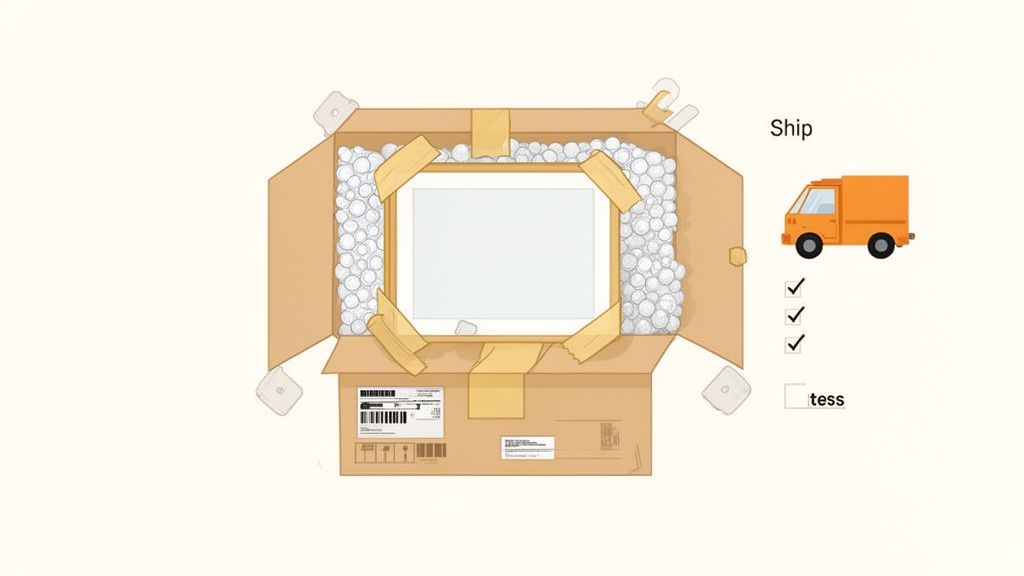
- Start with a Protective Skin: First, wrap the artwork in glassine paper or archival plastic. This is a crucial non-stick layer that protects the surface from moisture and prevents anything from adhering to the paint or varnish.
- Add Plenty of Cushioning: Bubble wrap is non-negotiable. Wrap the piece generously, and don't be shy. Pay special attention to the corners—they're the most vulnerable spots. You can even buy specialized cardboard or foam corner protectors for extra peace of mind.
- Find the Perfect Box: The box itself needs to be sturdy, preferably double-walled. Your artwork should fit snugly inside with at least two inches of clearance on all sides. Fill every inch of that empty space with packing peanuts, air pillows, or crumpled paper to completely immobilize the piece.
I once shipped a large canvas in a box that was just slightly too big. By the time it arrived, the constant shifting had rubbed one of the corners completely raw. A hard lesson learned: a snug, immobilized fit is everything.
Automating with Print-on-Demand
If you’re selling prints, the idea of packing and shipping dozens of orders yourself can quickly become a nightmare. This is where print-on-demand (POD) services like Printful or Printify are an absolute game-changer.
The process is beautiful in its simplicity. A customer buys a print from your store, and the order is automatically zapped over to your POD partner. They handle the printing, the professional packing, and the shipping directly to your customer. You never touch a single roll of tape or shipping label. This frees you up to do what you actually love: creating and promoting your work.
Calculating Costs and Handling Returns
Miscalculating shipping costs can eat your profits alive. Be meticulous here. Use the shipping calculators on the websites of carriers like UPS, FedEx, or USPS. Crucially, you need to weigh and measure your fully packaged artwork, not just the piece itself. For higher-value originals, always factor in the cost of shipping insurance. It's worth it.
It's also essential to understand the value of tracking and delivery confirmation. This isn't just for the customer's peace of mind; it's your proof that the package arrived, which is invaluable if a dispute ever arises.
Finally, you need a clear and fair return policy. This builds enormous trust with potential buyers. Decide on your terms ahead of time. Will you accept returns within 14 or 30 days? Who pays for return shipping? Make sure this policy is easy to find on your website. A little transparency goes a long way in giving someone the confidence to click "buy."
Got Questions About Selling Your Art Online? Let's Talk.
Jumping into the business side of your art can feel like a whole new world, and it's totally normal to have a few questions. Let's break down some of the most common ones I hear from artists.
How Much Does This Actually Cost?
This is the big one, right? Let's get real about the numbers. While throwing your work up on a marketplace like Etsy or Fine Art America might be free to start, don't forget about the platform fees. You should budget for them to take a cut of 10-15% from every single sale.
If you're building your own professional website—which I highly recommend for long-term brand building—you’re looking at around $20-50 a month for a solid platform like Shopify or Squarespace. And for marketing? A starting budget of even $100 can give you a nice little boost to get your first few eyeballs and hopefully, your first few sales.
Do I Really Need a Business License?
Ah, the legal stuff. It’s not the most creative part of the job, but it’s absolutely critical. The short answer is: it depends on where you live.
Generally speaking, if you’re making consistent sales and aiming for profit (and not just selling a few pieces to friends as a hobby), you'll likely need to register your art business. This also means you'll have to get a handle on collecting and remitting sales tax. It might seem like a headache, but getting this sorted out from the start saves you from much bigger headaches down the road.
What’s the Deal With Returns?
Sooner or later, it will happen. A buyer might want to return a piece. The key is to handle it with grace.
A clear, fair, and easy-to-find return policy on your site builds incredible trust with potential buyers. When a return request comes in, respond promptly and professionally. Offer a straightforward solution. Think of it less as a lost sale and more as an opportunity to show off your amazing customer service. A good experience, even during a return, can protect your reputation and even encourage that person to buy from you again.
Building that kind of trust is at the heart of what a good link in bio means for your art business. You can read more about what a good link in bio means for customer trust in our other guides.
Ready to pull all your links together and transform your social media bio into a sleek, professional storefront? A place where your followers can easily find your shop, portfolio, and latest work?
Get started with Taap.bio today. You can build a stunning, interactive page that turns curious followers into dedicated collectors.