You’re probably doing what most new solopreneurs do. You post on Instagram, dabble on TikTok, think about starting a blog, open Mailchimp, read three threads about SEO, and then freeze because every channel feels urgent.
That approach burns time and produces weak results. The problem isn’t effort. The problem is that your promotion is scattered. If you want to learn how to promote small business online, stop treating every platform like a separate job and start treating them like traffic sources feeding one place where people can buy, book, subscribe, or inquire.
Table of contents
Stop Chasing Trends and Start Building a System
Most online promotion advice is built for people with a team. You don’t have a team. You have limited hours, limited attention, and probably a limited budget. So stop trying to “show up everywhere.”
A better system is simple. Pick a few channels that fit your business. Use them to attract attention. Then send that attention to one central page that does the selling.
That central page matters because online presence is no longer optional. Over 73% of small businesses in major markets maintain a website, and 96% use social media, which means buyers already expect to find a polished digital storefront before they trust you enough to buy (small business website and social media stats).
Practical rule: Every post, ad, email, and profile should point to one conversion destination. Not five.
If your Instagram bio goes to one page, your email signature goes to another, your pinned post sends people to a marketplace, and your TikTok mentions a different offer, you’re making buyers work too hard. Confused people don’t convert.
The goal isn’t more visibility by itself. The goal is directed visibility. You want the right people landing on the right offer with the fewest possible clicks.
If you need help thinking through paid traffic without getting lost in jargon, this practical online advertising guide is worth reading because it keeps the focus on decision-making, not hype.
What a real promotion system looks like
A workable system usually has four parts:
- Attention source: Social media, search, partnerships, communities, or ads.
- Central hub: One page that explains who you help and what action to take next.
- Capture mechanism: Email signup, booking form, checkout, or inquiry form.
- Follow-up: Email nurture, retargeting, or direct outreach.
That’s the model. Everything else is a tactic.
Foundation First Define Your Goals and Audience
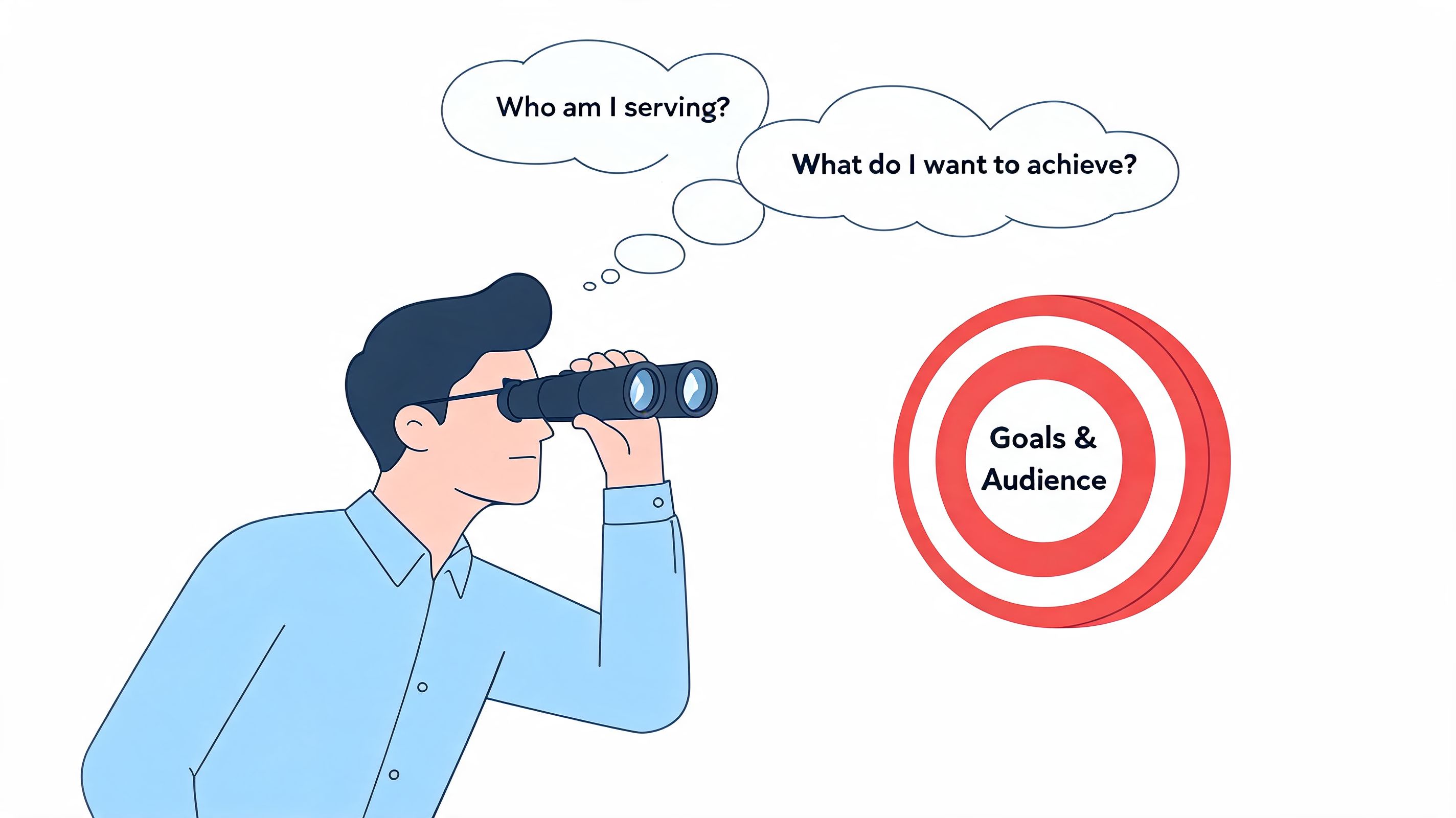
Before you write content or spend on ads, decide what success is. “Grow my brand” is not a goal. It’s a placeholder for not choosing.
Start with one business outcome
Pick the primary action you want from your traffic. For most creators and service businesses, it’s one of these:
- Book a call if you sell consulting, coaching, or freelance services.
- Join your email list if your sales cycle is longer or trust matters before purchase.
- Buy a digital product if you already have an audience and a clear low-friction offer.
- Apply or inquire if your service is premium and you need qualification first.
Don’t optimize for all four at once. One primary goal creates clear messaging. Clear messaging makes promotion cheaper and easier.
Build an audience profile you can actually use
Forget the fluffy avatar exercise. You need five concrete answers:
- What problem are they trying to solve right now
- What words do they use when they describe it
- Where do they already spend time online
- What would make them trust you faster
- What action are they most likely to take first
A fitness coach targeting busy parents won’t use the same message as a business coach targeting freelancers. A musician promoting new releases needs a different hub and content path than a consultant selling strategy calls. Promotion fails when the message and the buyer’s intent don’t match.
If you can’t finish the sentence “I help ___ do ___ without ___,” your audience definition is still sloppy.
Don’t ignore channel restrictions
This matters even more if you work in a regulated or restricted niche. A 2025 report found that 40% of small businesses face advertising restrictions on major platforms, while many guides ignore compliant alternatives like niche forums and SEO-focused microsites (restricted business promotion analysis).
That means your audience research can’t stop at demographics. You need to know which channels are available to you without getting blocked, rejected, or throttled.
For a cleaner process, map your audience and presence before you promote. This guide on building an online presence step by step is useful because it forces you to connect audience, platform choice, and conversion path instead of treating them as separate tasks.
A simple targeting worksheet
Write this down before you launch anything:
| Decision | Your answer |
|---|---|
| Core offer | |
| Primary conversion action | |
| Best-fit audience segment | |
| Top pain point | |
| Best acquisition channel | |
| Best proof asset | |
| Main objection |
If you can fill that table in one sitting, you’re ready to promote. If you can’t, your problem isn’t marketing. It’s positioning.
Choose Your Battlefield Selecting the Right Channels
You do not need every channel. You need the right channel mix for your offer, your strengths, and your timeline.
One mistake shows up constantly. Small businesses copy a platform because it’s popular, not because it fits their buyer. That’s lazy strategy. A better question is this: where can you reach intent, build trust, and move people to your hub without creating a second full-time job?
Compare the channels before you commit
Here’s the blunt version.
| Channel | Best For | Effort Level | Time to Results |
|---|---|---|---|
| Social media | Visual brands, creators, community-led offers | High | Fast to moderate |
| SEO | Search-driven demand, evergreen education, service pages | High upfront | Slow to moderate |
| Email marketing | Nurturing leads, selling repeatedly, launches | Moderate | Moderate |
| Paid search ads | High-intent buyers ready to act | Moderate | Fast |
Social media is good for attention. It is bad as your only sales system. Reach changes, algorithms shift, and followers don’t equal customers.
SEO is slow, but it compounds. It works best when buyers actively search for solutions and you can publish pages around specific intent.
Email is where trust matures. It’s the channel you own.
Paid search is the fastest path to intent if your offer is clear and your landing destination is strong.
When search ads make sense
Search ads are underused by small businesses. Only 40% use search ads, yet 65% of consumers say those ads influence purchase decisions, and 84% of businesses using them report positive experiences with an average cost-per-click around $4.66 (search advertising data for small businesses).
That matters because search ads don’t interrupt people the way broad social ads do. They catch buyers when the buyer is already looking.
A coach can bid on terms tied to booking intent. A freelancer can target service-specific searches. A digital creator can test commercial keywords tied to a product or workshop. If your page is built to convert, paid search can punch above its weight.
How to choose without overthinking it
Use this filter.
Pick social first if
- Your product is visual. Design, beauty, art, fashion, music, food, lifestyle.
- You’re comfortable on camera or in conversation. Personality-driven sales work here.
- Your audience already hangs out on one or two platforms. Not six.
Pick SEO first if
- People search for your solution by name or problem.
- You can create pages around specific use cases.
- You’re willing to publish consistently for months, not days.
Pick email first if
- You sell on trust. Coaching, consulting, premium freelance work.
- You need follow-up to close sales.
- You have a lead magnet, event, waitlist, or product launch cycle.
Pick ads first if
- You already know your offer converts.
- You need demand now, not eventually.
- You can send traffic to a page built for one clear action.
Don’t ask “Which channel is best?” Ask “Which channel can I execute well for the next 90 days?”
If you want help narrowing your channel stack around actual business size and capacity, these social media marketing tools for small business can help you simplify execution instead of adding more apps.
My recommendation for most solopreneurs
Start with one discovery channel and one retention channel.
That usually means one of these combinations:
- Social + email
- SEO + email
- Search ads + email
That setup is enough to attract, capture, and convert. Anything beyond that should be earned, not assumed.
Crafting Your Message Content and Offers That Convert
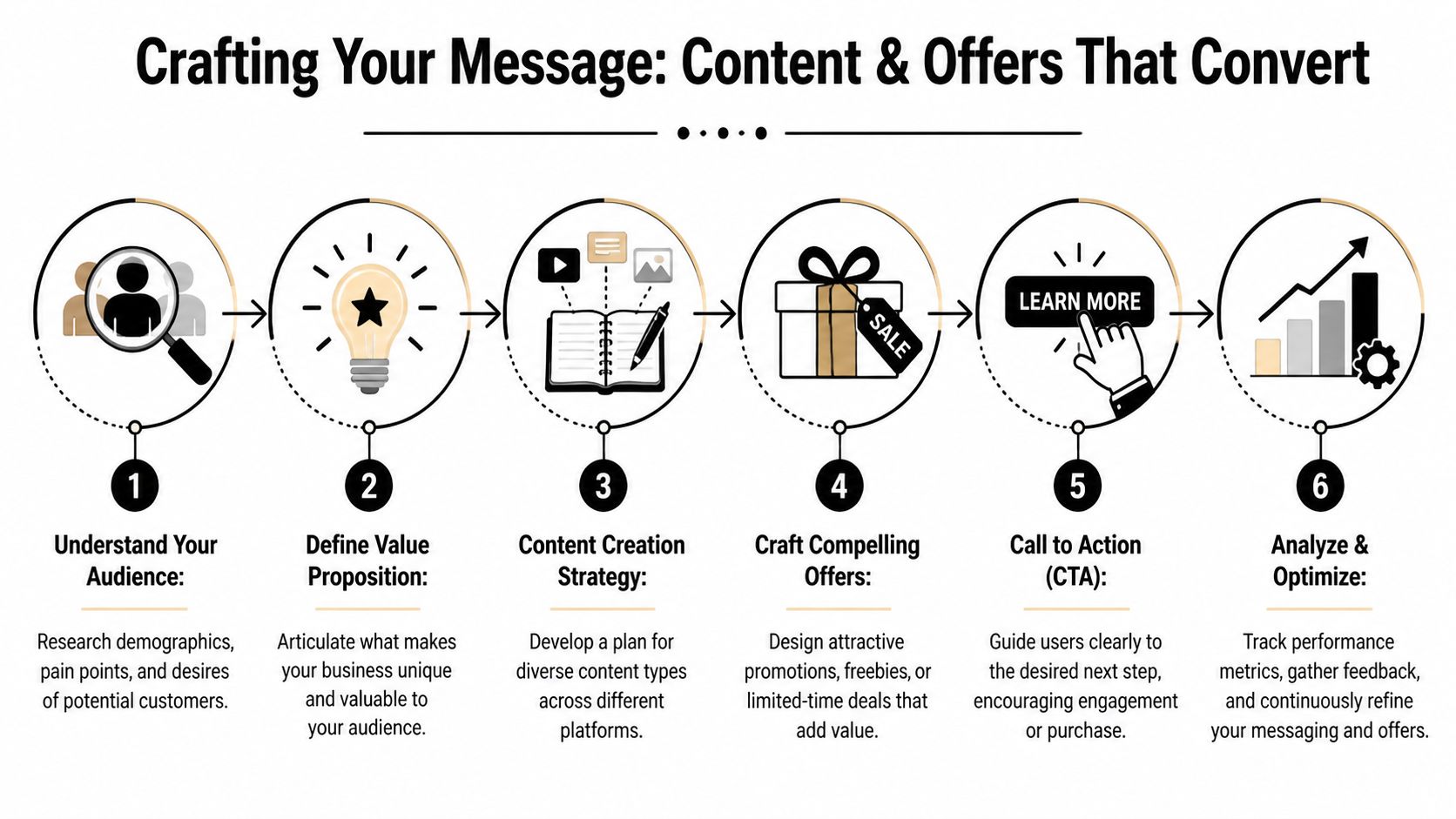
Promotion fails when the content is decent but the offer is vague. People don’t buy because you “posted consistently.” They buy because your message matches a problem they already want solved.
Build content around commercial intent
A lot of small businesses waste months writing generic tips that attract curious readers and weak buyers. That’s backwards.
Conversion-oriented SEO funnels can generate organic-traffic-to-lead conversion rates of 3% to 8%, which is 2x to 7x higher than generic blog posts without clear calls to action (SEO funnel conversion benchmarks).
That tells you what kind of content to create. Not random “top tips” posts. Content tied to a decision.
Here’s the structure I’d use for a coach, consultant, or creator:
- Pillar one: Problem-aware content. Address the pain clearly.
- Pillar two: Method content. Show your framework, process, or point of view.
- Pillar three: Offer-adjacent content. Explain outcomes, objections, and use cases.
- Pillar four: Proof content. Testimonials, before-and-after thinking, walkthroughs, demos.
One practical example
A career coach shouldn’t just post “5 mindset tips for professionals.” That gets polite engagement and weak buying intent.
A better path looks like this:
- Publish a short post on why talented people stall in job searches.
- Offer a downloadable interview prep checklist.
- Send subscribers a short email sequence with examples and common mistakes.
- Invite them to a paid workshop or 1:1 session.
That path works because every piece leads to the next. The free content does one job. It earns attention from the right person and moves them toward a more serious action.
Make your offers easier to say yes to
Most small businesses offer too much too early. Start with a value ladder:
| Offer type | Purpose |
|---|---|
| Free checklist, template, or guide | Capture email and prove relevance |
| Low-ticket digital product or workshop | Turn attention into first purchase |
| Core service or coaching offer | Drive revenue |
| Upsell or continuity offer | Increase repeat value |
If your words feel stiff or generic, clean them up before publishing. Buyers respond to specificity and natural language, not polished nonsense. A resource like Lumi Humanizer's ethical methods is useful for tightening robotic copy into something that reads like an actual person wrote it.
Your content should answer one question at a time and ask for one next step. Not three.
Write CTAs that match intent
Bad CTA: “Check out my links.”
Better CTA options:
- Book a discovery call
- Download the checklist
- Watch the workshop
- Browse the templates
- Join the email series
Every CTA should fit the stage of the buyer. Cold audiences shouldn’t get hit with premium offers first. Warm audiences shouldn’t be sent back to beginner content.
If your clicks are weak, the problem is often not reach. It’s friction. This guide on how to improve click-through rates is a good reminder that small wording and layout changes often move the needle more than posting more often.
The Engine Room Your Centralized Promotion Hub
All your promotion efforts need a destination. If that destination is a generic link list, you’re leaving money on the table.
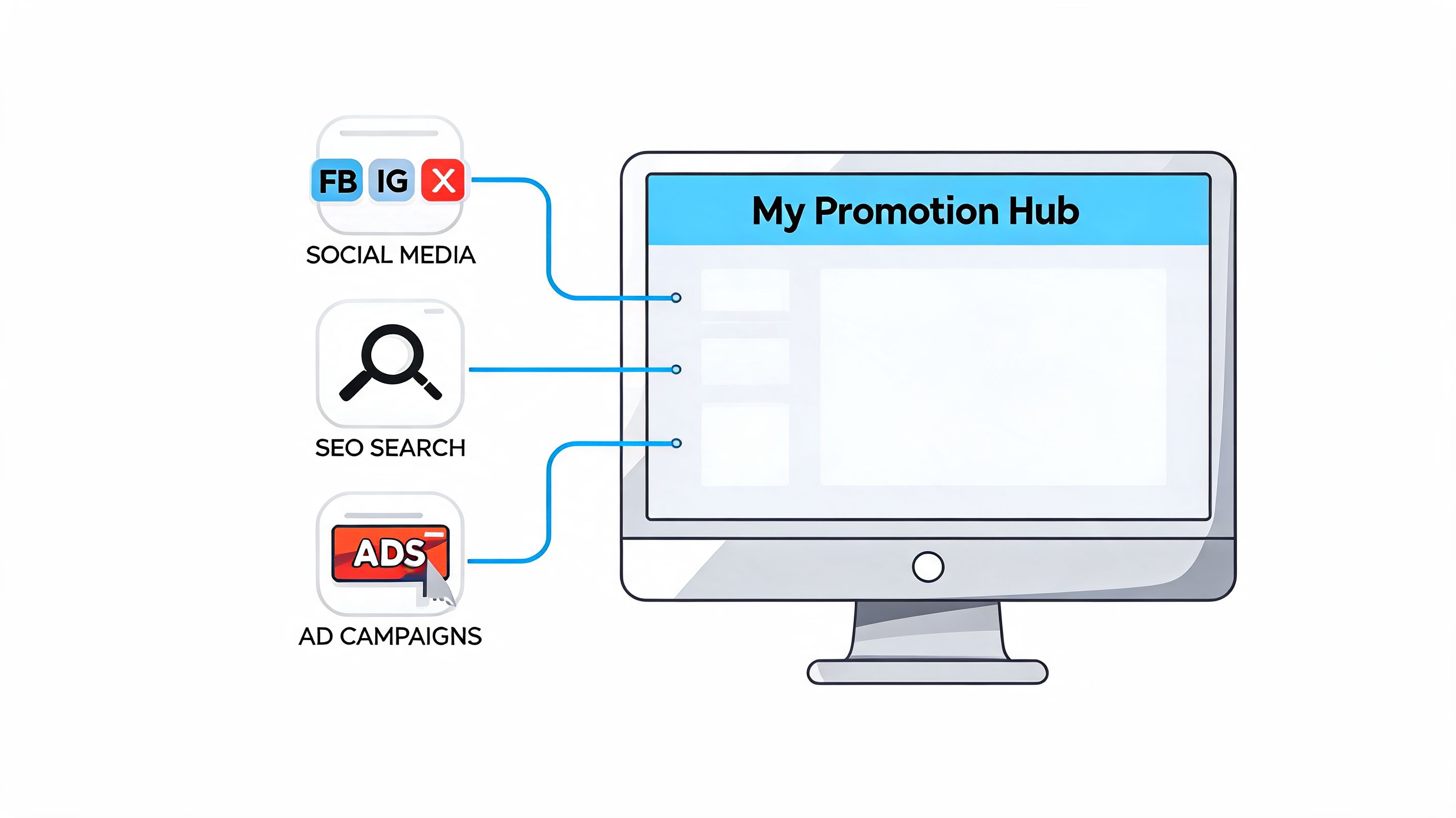
A strong hub doesn’t just “store links.” It sells. It shows what you do, proves that you’re active, presents your offers, and gives people an obvious next step. That’s how to promote small business online without scattering your audience across disconnected pages.
Why the old link list is weak
For personal brands, modular visual pages convert 47% higher than traditional vertical link lists, and searches for “custom bio page promotion” rose 28% in 2025 amid platform changes that reduced outbound link clicks (visual bio page conversion data).
That makes sense. A stacked list of plain links gives buyers no context, no hierarchy, and no momentum. It’s a menu without recommendations.
A visual hub solves that by combining content, proof, and commerce in one place. Someone can see your newest video, browse your portfolio, grab a freebie, and book or buy without hunting through separate platforms.
What your hub should include
Your central page should have these elements in this order:
- Clear promise at the top. What you do and who it’s for.
- One primary CTA. Book, buy, subscribe, or apply.
- Trust assets. Embedded content, proof, testimonials, featured work.
- Secondary offers. Lower-friction options for people not ready yet.
- Capture option. Email signup or lead magnet.
- Current activity. Recent posts, videos, tracks, or portfolio updates.
A homepage for a solopreneur should behave like a storefront. Not a filing cabinet.
This is also where your tools need to work together. If you’re building email follow-up after someone clicks from your hub, it helps to review solid options for list-building and automation. This roundup of top email marketing platforms for SMBs is a practical place to compare setup choices.
How the hub supports every channel
Social media gets attention, but your hub captures intent.
SEO brings search traffic, but your hub converts searchers into leads or buyers.
Ads generate clicks, but your hub determines whether those clicks become revenue.
Email keeps the relationship alive, but the hub gives subscribers a clean place to act.
For a stronger mental model of how all these assets fit together, this explanation of what a content hub is is useful. It helps you stop thinking in isolated posts and start thinking in systems.
A quick demo helps make the point clearer:
The standard I’d hold you to
If a new visitor lands on your main page, they should know within seconds:
- Who you help
- What you offer
- Why they should trust you
- What to do next
If any of those are unclear, your promotion has a destination problem. Fix that before you spend more time driving traffic.
Activate and Optimize Measuring What Matters
Once your system is live, stop staring at vanity metrics. Likes are not revenue. Views are not bookings. Follower growth is not proof that your business is working.
What matters is movement toward the sale.
Track the metrics tied to money
Start with these:
- Profile click-throughs from social platforms to your main hub
- Landing page conversions on your hub page
- Email signups from each traffic source
- Bookings, purchases, or inquiries
- Revenue by channel if your tools support it
These numbers tell you where the leak is. If social posts get engagement but no clicks, your message is entertaining but not compelling. If clicks are strong but conversions are weak, your hub or offer is the problem. If signups happen but sales don’t, your follow-up is weak.
Use segmentation, not blasts
Email is where many businesses sabotage themselves. They collect addresses, then send the same broad newsletter to everyone and wonder why nothing happens.
That’s the wrong move. Segmented, behavior-triggered email flows can achieve 2x to 3x higher click-through rates and 10% to 25% higher conversion rates for purchases, while lifting customer lifetime value by 30% to 45% (behavior-triggered email marketing benchmarks).
So build sequences based on behavior:
- New subscriber sequence for people who downloaded a lead magnet
- Viewed offer but didn’t buy follow-up
- Booked once nurture for upsells or repeat offers
- Inactive subscriber re-engagement sequence
Watch actions, not applause. Clicks, signups, bookings, and sales tell the truth.
Optimize one variable at a time
Don’t redesign everything every week. Test one thing, then read the result.
Try changes like:
- Headline swap on your hub page
- Different primary CTA above the fold
- Shorter signup form
- New proof block closer to the action button
- Different email subject line for the first nurture message
That’s enough to build momentum. If you need a cleaner view of where your traffic and engagement are coming from, these social media dashboard tools can help you spot patterns without drowning in reports.
Consistency beats complexity here. Small improvements compound when the system is built correctly.
Frequently Asked Questions
The practical questions matter because most small businesses don’t fail from lack of ideas. They fail from poor execution and unrealistic expectations.
Common Promotion Questions
| Question | Answer |
|---|---|
| How many channels should I use at the start? | One discovery channel and one follow-up channel is enough for most solopreneurs. More channels usually create more maintenance, not more revenue. |
| Do I need a blog? | Not always. If your audience searches for solutions and you can create intent-driven content, a blog helps. If your business is highly visual or community-led, social plus email may be a better starting point. |
| Should I run ads right away? | Only if your offer is clear and your central page is ready to convert. Ads amplify what already exists. They don’t fix weak positioning. |
| What if I’m in a restricted niche? | Focus on compliant channels first. SEO content, niche communities, partnerships, email, and direct audience building usually beat trying to force broad ad platforms to work. |
| How long before online promotion works? | Paid channels can move faster. SEO and audience building take longer. The real answer depends on whether your offer, message, and conversion path are already solid. |
| What should I post about? | Post around your audience’s actual problems, your method, proof of results, and objections that block the sale. Content should lead naturally to an offer, not exist for its own sake. |
| What if I don’t have many followers? | Followers matter less than clarity. A small audience with a strong offer and a clean conversion path can outperform a larger audience with weak positioning. |
| What’s the biggest mistake people make when learning how to promote small business online? | Sending traffic to the wrong place. If every platform points somewhere different, buyers lose momentum and drop off. |
A final opinion. Don’t wait until everything looks perfect. Promotion gets better when you publish, measure, and refine. But don’t confuse action with random activity. Build the hub first. Then drive focused traffic into it.
If you want one page that acts like a real storefront instead of a dead-end link list, taap.bio gives you a clean way to sell digital products, book calls, collect emails, and showcase your content from a single visual hub. It’s built for creators, coaches, and solopreneurs who want one link that converts.