Building a powerful online presence isn't about being everywhere at once. It’s about telling a clear, compelling story on the right platforms and bringing it all together in one central place. The goal is to cut through the noise, eliminate confusion, and forge a real connection with your audience.
Table of contents
Why Your Scattered Profiles Are Holding You Back
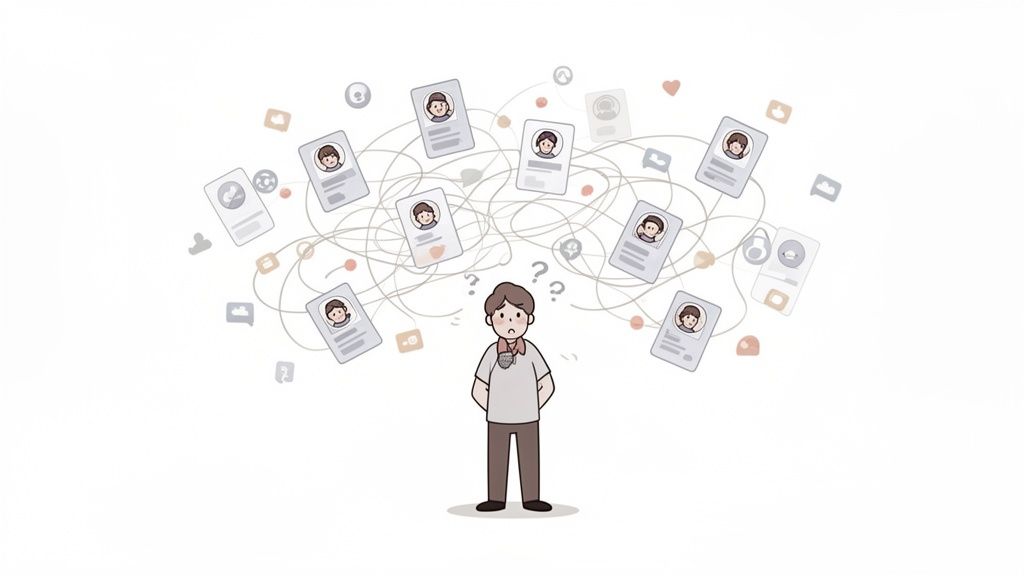
Let’s be real for a second. Trying to manage your digital identity can feel like juggling chainsaws. You’ve got your polished LinkedIn profile for the corporate crowd, an Instagram for visual flair, a personal website for your portfolio, and maybe a few other accounts that are just… out there. Each one tells a slightly different version of your story, leaving anyone trying to figure you out with a confusing, fragmented puzzle.
This isn’t just messy; it’s actively hurting your growth. When potential clients or collaborators have to hunt down clues across the internet to understand what you’re all about, most will just give up. It screams a lack of focus and makes it that much harder to build the trust you need. Considering that 97% of consumers now head online to research professionals and businesses, a confusing digital footprint is a massive red flag.
The Myth of Being Everywhere
You've probably heard the advice: "You have to be on every platform!" That's a one-way ticket to burnout. Spreading yourself too thin means your content becomes weak and generic, and your efforts get diluted.
A truly effective online presence isn't about the number of profiles you have. It’s about showing up with quality and consistency where it actually matters—where your people are. The modern, smarter approach is all about strategic consolidation. You create one central hub that ties your entire digital world together, transforming a chaotic web of links into a cohesive brand story that works for you around the clock.
A strong online presence is tied to your visibility, credibility, and reputation. Without it, you don't really have one at all. It's all or nothing in the noisy world of cyberspace.
Building a Cohesive Digital Narrative
Picture this: a potential client finds your Instagram, loves your work, and clicks the link in your bio. They land on a generic list of your other social media accounts. Each click is another step, another chance for them to get distracted and wander off before they ever get to what you really want them to see—your services, your latest project, or your contact form.
Now, imagine a different scenario. That same link in your bio takes them to a beautifully designed, all-in-one page. Instantly, they can see your best work, watch your latest YouTube video, read a glowing client testimonial, and find a direct link to book a call with you. See the difference? One is a passive, confusing roadmap; the other is an active, persuasive experience designed to get results.
That's exactly what this guide will help you build. We're skipping the vague theories and giving you a practical framework to:
- Pinpoint your unique value and get crystal clear on who your ideal audience is.
- Select the right platforms so you can focus your energy for the biggest return.
- Construct a central hub that turns your scattered profiles into a powerful, unified brand statement.
It's time to ditch the digital clutter for good. Let's build an online presence that’s intentional, strategic, and genuinely effective.
Finding Your Niche and Nailing Your Message
Before you post another thing online, stop. Seriously. The biggest mistake I see people make is jumping straight to creating content without a clear plan. A powerful online presence isn't built on random posts; it's built on a rock-solid foundation of purpose and direction.
This is where you figure out what you're all about and who you're actually talking to. Think of it as your brand's true north. Once you have it, every decision—from which platforms to use to how you write your captions—becomes ten times easier. Without it, you're just another voice in the crowd.
What Problem Do You Actually Solve?
This is the most critical question, and it's where most creators and freelancers get stuck. Your value isn't just your skill; it's the specific outcome you deliver.
A freelance photographer isn’t just "taking nice photos." They’re helping sustainable e-commerce brands increase sales by 25% with photography that tells an authentic story. A developer isn't just "writing code." They're building tools that save small businesses 10 hours a week on mind-numbing admin work.
See the difference? It requires getting specific about the tangible results you create for people.
The game changes the moment you stop describing what you do and start articulating what problem you solve. This single shift is the bedrock of an online presence that actually gets results.
To nail this down, ask yourself a few tough questions:
- Before they find me, my audience is struggling with... (e.g., making their video content look good, feeling clueless about their finances, finding decent vegan recipes).
- After they work with me or follow my content, they can... (e.g., edit professional-looking reels in under 10 minutes, finally feel in control of their retirement plan, cook healthy meals their family loves).
- What makes my way of doing things different? (e.g., I use humor and memes, I break down super complex topics into simple steps, I focus on solutions that don't break the bank).
The answers here combine to form your Unique Value Proposition (UVP). It’s your promise to your audience and the reason they should follow you instead of the thousands of others out there.
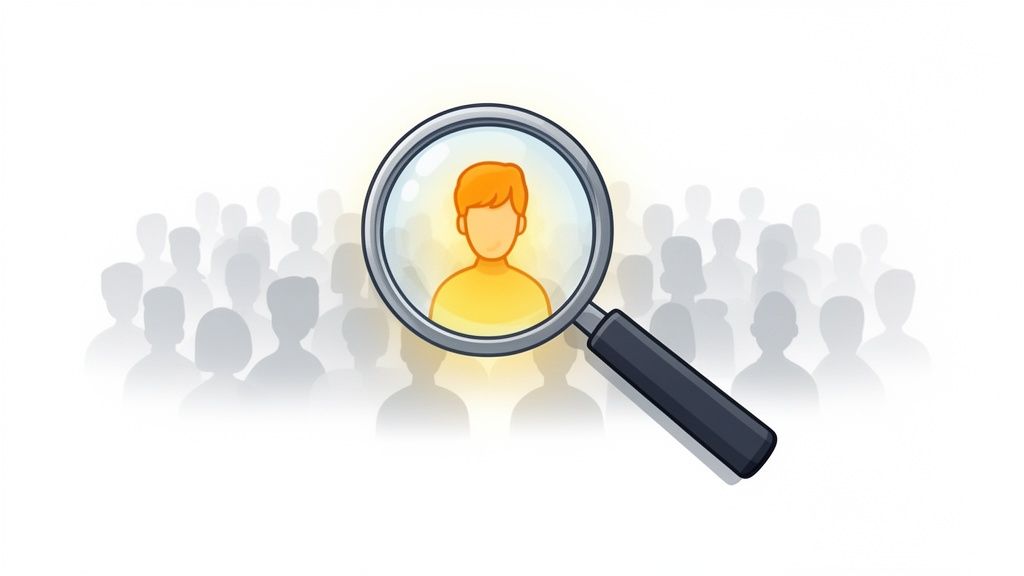
Who Are You Really Talking To?
Once you know the problem you solve, you have to figure out who feels that pain the most. Trying to be everything to everyone is a recipe for connecting with no one. The more specific your audience, the louder your message will ring.
Don't just target "small business owners." Get granular. Target "first-time founders of B2B SaaS startups who are still pre-seed." Forget "fitness enthusiasts" and focus on "busy working moms in their 30s who need effective 20-minute home workouts."
This isn’t about shutting people out; it’s about being precise. When you speak directly to someone's specific challenges and goals, they feel like you get them. That connection is something generic, catch-all content can never build.
Building Your Content Compass
With your value and audience locked in, you can create a simple "Content Compass" to guide everything you do. This little framework keeps you honest and ensures every piece of content you create is perfectly aligned with your core mission.
| Compass Point | Description | Example (Financial Coach for Millennials) |
|---|---|---|
| Core Problem | The pain point your audience feels most. | "Millennials are drowning in debt and completely overwhelmed." |
| Core Solution | The transformation you deliver. | "I give them a simple, step-by-step system to get out of debt for good." |
| Unique Angle | What makes your approach special? | "I make personal finance fun and relatable using pop culture and memes." |
| Target Action | The one thing you want them to do next. | "Download my free 'Get Out of Debt' budget template." |
This clarity is your secret weapon. It becomes the filter for every content idea, ensuring that your efforts are focused, consistent, and incredibly effective. Now that you know what to say and who to say it to, you're ready to pick the right places to share your message.
Choosing Where to Plant Your Digital Flags
So you know who you’re talking to and what you want to say. The next question is, where do you say it? It’s tempting to jump on every new app that pops up, driven by a nagging fear of missing out. But let me be frank: that’s a surefire recipe for burnout and a bunch of mediocre content that doesn’t land with anyone.
To build a presence that actually matters, you need to go deep, not wide. Focus is your superpower here. Instead of scattering your energy across a dozen platforms, the real goal is to master the two or three where your ideal audience is already hanging out and ready to engage.
Quality Over Quantity Always Wins
It’s so much better to have one or two vibrant, active communities than six digital ghost towns. Every platform has its own culture, its own unspoken rules, its own language. Trying to be everywhere at once means you master none of them.
Think of it this way: a comedian telling the same joke at a corporate keynote, a late-night comedy club, and a kid's birthday party is going to get wildly different results. The joke isn't the problem; the context is. It’s the exact same online. A polished, professional post that crushes it on LinkedIn will almost certainly die a quiet death on the fast, trend-heavy feed of TikTok.
A scattered presence dilutes your impact. A focused presence amplifies it. Choose your platforms based on their potential for genuine connection with your audience, not just on their overall popularity.
This means you have to get good at resisting "shiny object syndrome." When a new platform makes a splash, watch it for a bit. Ask yourself, "Are my people really here, or is this just where the industry cool kids are playing right now?" Real influence is built on consistency and depth on the right channels.
Define Your Content Pillars
Before you even think about hitting "post," you need a framework. This is where content pillars come in. These are the 3-5 core themes you'll talk about, time and time again. They form the bedrock of your content strategy, making sure everything you create is laser-focused on what you do best.
Let’s say you’re a freelance graphic designer who works with tech startups. Your pillars might look something like this:
- Design Breakdowns: Analyzing the branding of successful (and not-so-successful) startups.
- Founder Resources: Sharing practical design tips for founders who can't hire a designer yet.
- Behind the Scenes: Giving a peek into your creative process and recent client projects.
- Industry Commentary: Your hot takes on new design trends and tools in the tech world.
These pillars are your North Star. When you're stuck for ideas, you just look at your pillars and ask, "What can I create today that fits into one of these buckets?" This simple check keeps your content consistent, stops you from wandering off-topic, and, most importantly, teaches your audience exactly what they can expect from you. That’s how you build trust and become the go-to expert.
Matching Your Brand to the Right Platform
Choosing where to show up is a strategic decision, not a roll of the dice. It's about finding the perfect intersection of your goals, your audience, and your content style. It isn't about being on the biggest networks; it's about being on the most effective ones for you. And the stakes are high—after following a brand on social media, 91% of consumers will check out its website, and a whopping 89% will make a purchase.
To help you get this right, you need to understand the unique vibe of each major platform.
Platform and Content Strategy Matcher
This table is your cheat sheet for aligning your goals with the right online spaces. It’s designed to help you think strategically about where your content will not only live but thrive.
| Goal | Primary Audience | Ideal Platforms | Recommended Content Format |
|---|---|---|---|
| Establish Thought Leadership | Professionals, B2B clients, industry peers | LinkedIn, X (Twitter), Medium | In-depth articles, professional analysis, text-based threads, industry news |
| Build a Visual Brand | Creatives, e-commerce customers, lifestyle enthusiasts | Instagram, Pinterest, TikTok | High-quality images, short-form video (Reels), curated visual boards |
| Educate and Demonstrate Expertise | Learners, DIYers, niche hobbyists | YouTube, Skillshare, your own blog | Long-form tutorial videos, detailed "how-to" guides, educational series |
| Foster a Community | Superfans, loyal customers, niche interest groups | Facebook Groups, Discord, Reddit | Interactive discussions, user-generated content, Q&A sessions, exclusive content |
Think of this table as a starting point. The real magic happens when you dig deeper and find out where your specific audience—that persona you worked on earlier—is actually spending their time. Don’t just assume they’re all scrolling Instagram. They could be deep in a niche subreddit or chatting away in a private Discord server.
Ultimately, building an online presence that lasts comes down to making smart, intentional choices. When you select a few key platforms and anchor your entire strategy in solid content pillars, you create a sustainable system for growth—one that respects your time and energy while delivering the biggest possible impact.
Making Sure People Can Actually Find You
Look, creating incredible content is only half the job. You could have the most insightful blog, the most entertaining videos, or the most stunning portfolio, but it means nothing if it’s a ghost town. If the right people can't find you, you're essentially shouting into the void.
We need to stop relying on the whims of social media algorithms and start building a real, lasting foundation for discoverability. Every single thing you create—a YouTube video title, a blog post, even a caption—is a breadcrumb leading your ideal audience back to you. The trick is to lay those breadcrumbs intentionally.
Why Being Searchable Is Everything
Think about your own behavior. When you need to solve a problem, what's the first thing you do? You search for it. And you're not alone—a massive 97% of consumers hop online to find and research businesses, professionals, and creators just like you. If you’re not popping up when they search, you’re invisible to a massive pool of people who are actively looking for what you offer.
This is where Search Engine Optimization (SEO) comes into play. Don't let the acronym scare you. It’s not some mystical dark art; it's simply the practice of making your content easy for search engines to understand and serve up to the right people.
A viral TikTok might give you a sugar rush of attention, but good SEO is the engine that brings a steady, reliable stream of your ideal audience to your doorstep for years to come. It’s the difference between a flash in the pan and sustainable growth.
Speaking Your Audience's Language with Keywords
The bedrock of solid SEO is figuring out the exact words and phrases your audience is typing into that search bar. This isn’t a guessing game; it’s about doing a little detective work to uncover their language.
Start by getting inside their heads. What problems are they trying to solve? If you're a financial coach for freelancers, your people are probably searching for things like:
- "how to manage freelance income"
- "quarterly tax tips for self-employed"
- "best budgeting app for freelancers"
Boom. Those are your keywords. You can use free tools to find out how popular these search terms are and discover a bunch of related ones you hadn't even thought of. Once you have your list, you start weaving them naturally into your content.
For a blog post, that means sprinkling your main keyword into:
- The title of your post—make it obvious what it's about.
- Your headings and subheadings to break up the text and guide the reader.
- The very first paragraph to hook both your reader and the search engine.
- Image file names and alt text, an often-overlooked spot that helps with accessibility and image search.
Doing this consistently turns your content from a simple diary entry into a powerful magnet for your target audience.
Get Found Beyond Your Own Turf
A strong online presence isn't built in a silo. True visibility comes when you start showing up in places where your audience already hangs out and trusts the source. It’s about borrowing a little bit of that credibility and tapping into pre-built communities.
Instead of just waiting for people to stumble upon your corner of the internet, go to them.
- Jump on Podcasts as a Guest: Find podcasts your ideal audience loves and pitch the host on having you as a guest expert. You get to put your voice, ideas, and personality directly into the ears of hundreds or even thousands of highly engaged listeners.
- Become a Fixture in Niche Communities: Dive into relevant subreddits, Facebook Groups, or Discord servers. Don't just drop links and run. Genuinely answer questions, offer helpful advice, and become a trusted, familiar face. The relationships you build are worth their weight in gold.
- Team Up with Your Peers: Reach out to other creators in your space for a collaboration. You could co-host an Instagram Live, write a guide together, or do a "takeover" on each other's channels. Cross-promotion like this is a win-win, introducing both of you to a new, perfectly-matched audience.
Every guest appearance, every genuinely helpful comment, and every collaboration is another doorway into your world. By strategically showing up elsewhere, you make it exponentially easier for the right people to discover all the incredible value you have to share.
Creating a Central Hub for Your Digital World
So, you’ve done the hard work. You’ve nailed down your message, figured out who you’re talking to, and started building outposts for your brand across different platforms. You’ve got killer content on Instagram, sharp insights on X, and maybe some great long-form videos on YouTube.
The problem? Your audience only sees one piece of the puzzle at a time. Sending them on a digital scavenger hunt with a pocketful of links is a surefire way to lose their attention. What you need is a command center—a single, unified destination that ties it all together.
The Evolution of the Bio Link
The whole "link-in-bio" thing isn't exactly new, but its purpose has completely transformed. It used to be a simple, static list of URLs. Now, it's an interactive, dynamic personal dashboard. It's less of a directory and more of a destination, designed to create a rich, cohesive experience for anyone who clicks.
This shift really mirrors a bigger change in how we build a presence online. It's no longer about funneling everyone to a single website. Instead, it's about orchestrating a multi-platform identity where everything is connected through one central hub. With audiences spread thin across so many apps, consolidating your digital world isn't just a nice-to-have; it's essential.
The market backs this up. The link-in-bio industry is now a serious business, valued at an estimated USD 1.62 billion in 2024 and projected to rocket to USD 4.24 billion by 2033. This explosion proves that a single, memorable URL has gone mainstream, becoming a core tool for anyone serious about building their brand.
From a List of Links to an Interactive Experience
The real goal here is to create an experience that showcases the full scope of your brand without forcing visitors to click away. Modern tools are built for exactly this, turning your bio link from a passive list into an active, engaging hub.
Instead of just linking out to your YouTube channel, why not embed your latest video right on the page? Rather than sending someone over to Spotify, let them play your new single or podcast episode right then and there. Your bio link suddenly becomes a micro-version of your entire digital world.
This flowchart shows how a central hub acts as the final destination where all your audience-building efforts come together.
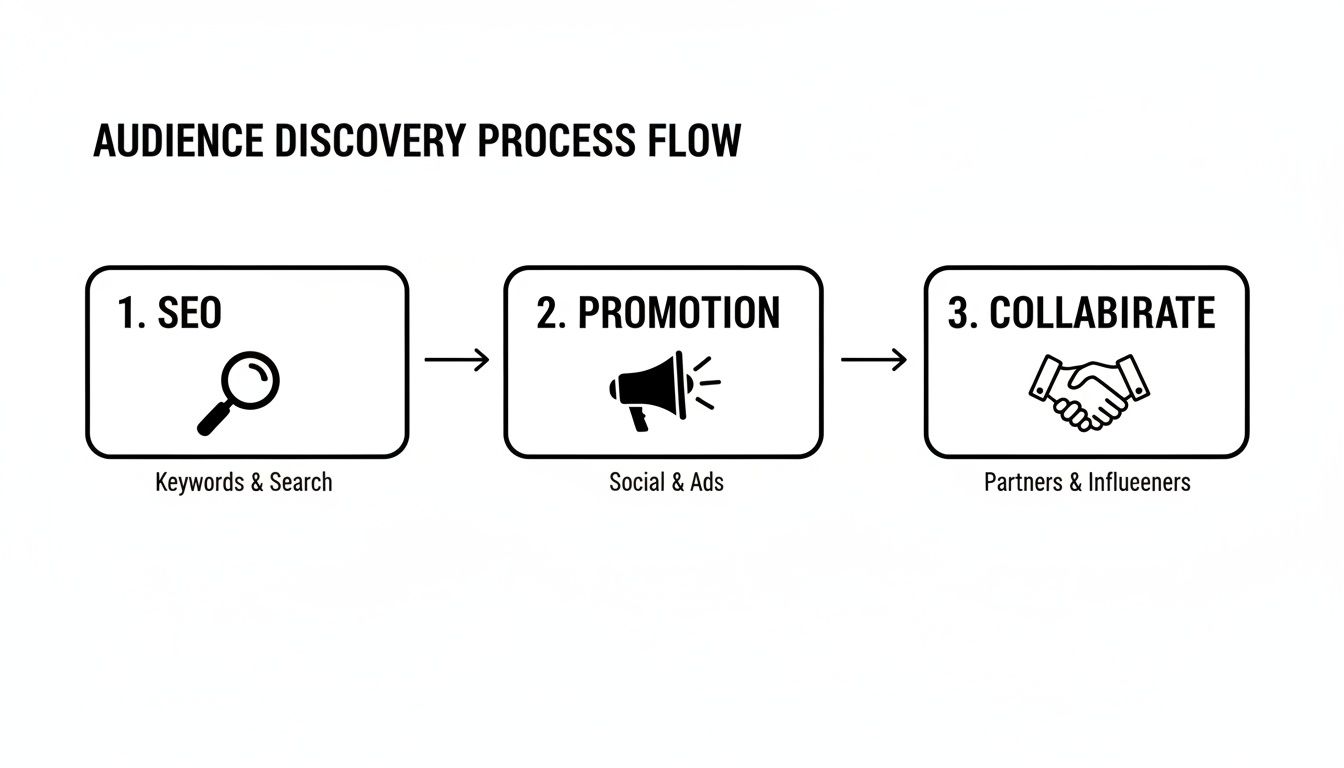
As you can see, all roads—from SEO to collaborations—should lead back to this one spot, giving your audience a clear, unified place to connect with you.
Your bio link shouldn't be a boring exit ramp off your social profiles. It should be a vibrant, curated showcase of your best work, designed to capture attention and guide visitors to your most important content.
Building Your Hub with Modular Tools
To pull off this kind of interactive experience, you need a tool that thinks beyond basic link lists. This is where platforms like Taap.bio come in. They use a modular, grid-based approach that lets you build a visually stunning page with smart "widgets."
Think of it like designing a custom dashboard. Every piece of your online identity—your latest Instagram posts, a GitHub contribution graph, a glowing client testimonial—becomes a block you can place, resize, and arrange on a canvas.
This method gives you some serious advantages:
- Visual Hierarchy: You can make your most important content bigger and bolder, telling visitors exactly where to look first.
- Dynamic Content: Smart widgets automatically pull in your latest content. Your page stays fresh and up-to-date without you having to lift a finger.
- Direct Engagement: By embedding media players for music or video, you eliminate friction and keep people on your page longer. This dramatically increases the chances they’ll explore more of what you have to offer.
This level of control lets you build a hub that truly reflects your brand's personality and goals. It’s the final, crucial piece of the puzzle, turning your scattered online efforts into a powerful and cohesive presence.
Designing Your Hub to Drive Action
Alright, you’ve got your central hub set up. Now for the fun part: making it work for you. Simply dumping all your links onto a page is a missed opportunity. Your goal is to design a visual story that steers visitors exactly where you want them to go.
Think of your page less like a static directory and more like a high-performance landing page. It's an active tool designed to turn casual browsers into dedicated followers, clients, or fans. This is where smart design meets solid strategy—controlling the user’s eye and drawing their attention to your most important calls to action.
Forget the Boring List, Think "Bento Box"
The days of a single, scrolling list of links are over. The most effective link-in-bio pages today are using a much more dynamic, grid-based layout often called a "bento box." This is exactly the kind of setup you can build with a tool like Taap.bio. It lets you arrange your content into modular blocks of different sizes and shapes, creating a design that’s both visually interesting and incredibly strategic.
Imagine giving your latest YouTube video a massive, can't-miss block at the top, while a secondary social link sits quietly in a smaller box. This isn't just about aesthetics; it’s a powerful psychological cue. You're essentially telling visitors, "Hey, this is the most important thing right now!" without having to spell it out.
Your link-in-bio page should be a curated journey, not a chaotic list. Use size, color, and placement to create a visual roadmap that leads visitors directly to the actions you want them to take.
And this approach genuinely pays off. From a performance perspective, a well-designed hub can smoke a traditional website homepage. We see typical link-in-bio pages converting at around 3–4%, but creators who get strategic with their layouts and calls-to-action can easily push that to 5–8%.
In fact, a thoughtfully designed page can see 25–40% higher conversion rates than a basic list, simply because you're guiding the user instead of just giving them options. For a deeper dive, check out these insights on creator tool performance.
Crafting a Layout That Fits You
There's no single "best" design. The right layout depends entirely on who you are and what you're trying to achieve. The secret to how to build an online presence that actually converts is tailoring your hub to your specific goals.
Let's break down a few real-world examples:
You're a Musician: Your mission is to get people to stream your new single and buy concert tickets. Your layout needs to be all about the music.
- Top Priority: A large, embedded Spotify widget for your latest track so they can listen instantly.
- Secondary: A prominent block linking directly to your tour dates or ticket portal.
- Tertiary: Smaller blocks for your merch store, Instagram, and the official music video on YouTube.
You're a Freelance Consultant: You need to book calls and land clients. Your hub is your digital business card and lead-gen machine.
- Top Priority: A huge, eye-catching block with a direct link to your Calendly or booking form. Make it impossible to miss.
- Secondary: A visually clean text block featuring a glowing client testimonial to build instant trust.
- Tertiary: Smaller modules linking to your portfolio, a downloadable case study, and your professional LinkedIn profile.
You're a Content Creator: The goal is growth. You need to drive traffic to monetized content and grow your audience across platforms.
- Top Priority: An embedded widget that automatically pulls in your latest YouTube video or TikTok.
- Secondary: A clear call-to-action to subscribe to your newsletter, maybe sweetened with a freebie.
- Tertiary: A grid showcasing your recent Instagram posts and links to things like your Patreon or affiliate partnerships.
Put Smart Widgets to Work
This is where modern link-in-bio tools really shine. Instead of a static link that just says "Follow me on Instagram," a smart widget can show your latest posts, your follower count, and a follow button directly on the page.
This is a game-changer for engagement. You're giving visitors a real taste of your content without forcing them to click away, which reduces friction and keeps them locked into your ecosystem.
Here’s how you can use different widgets strategically:
| Widget Type | Strategic Use Case | Why It Works |
|---|---|---|
| Media Player | Embed a Spotify track or podcast episode. | Lets people consume your core content instantly, with zero effort. |
| Social Feed | Display your latest YouTube or Instagram posts. | Keeps your page feeling fresh and proves you're active without manual updates. |
| Text/Quote Block | Showcase a powerful testimonial or your mission. | Builds social proof and communicates your value proposition in a heartbeat. |
| Image/GIF Block | Add your brand logo or a looping GIF of your work. | Reinforces your brand identity and injects some much-needed personality. |
When you combine a smart layout with these powerful tools, your hub transforms. It’s no longer just a list of links—it's an interactive dashboard that truly represents your brand. It becomes the ultimate destination, a one-stop shop that not only tells people who you are but shows them what to do next.
Ready to build a hub that actually drives action? With Taap.bio’s drag-and-drop grid and smart widgets, you can design a stunning, interactive page in minutes. Start building your ultimate link-in-bio for free today.