An online coaching platform should be a single web destination where people can see what you offer, book and pay, join your email list, and move forward without getting bounced across five tools. If you're choosing one in 2026, optimize for conversion mechanics first: one-field email forms convert about 25.5%, three-field forms about 25%, and broader website conversion rates often sit around 1% to 4%, so the winning setup is the one that keeps booking, checkout, and signup on one page.
That's the decision most coaches get backwards.
They shop for software the way people shop for gym equipment. More features, more tabs, more dashboards. Then six months later they're buried in Calendly links, Stripe notifications, Zoom invites, form builders, landing pages, and an email tool they barely use. The stack looks professional from the inside. From the buyer's side, it feels like work.
The market is big enough now that this is no longer a side-category. One market estimate values the global online coaching platforms market at USD 4.16 billion in 2026 and projects USD 17.33 billion by 2035 with a 14% CAGR, while another puts it at USD 3.8 billion in 2025 and USD 12.2 billion by 2036 with an 11.2% CAGR according to online coaching platform market projections. That matters for one reason. Coaches now have plenty of software options, but more choice hasn't fixed bad revenue design.
My advice is simple. Stop picking tools as if you're assembling a tech stack. Start building a single-page revenue engine.
Table of contents
Why Coaches Lose Clients to Fragmented Tools
A coach posts on LinkedIn or Instagram. A prospect clicks the bio link, lands on a link list, taps “work with me,” hits a booking page, leaves to read package details on a separate site, comes back, gets sent to checkout, then receives a different confirmation flow through another app. Somewhere in that sequence, attention dies.
That's not a marketing problem. It's a systems problem.
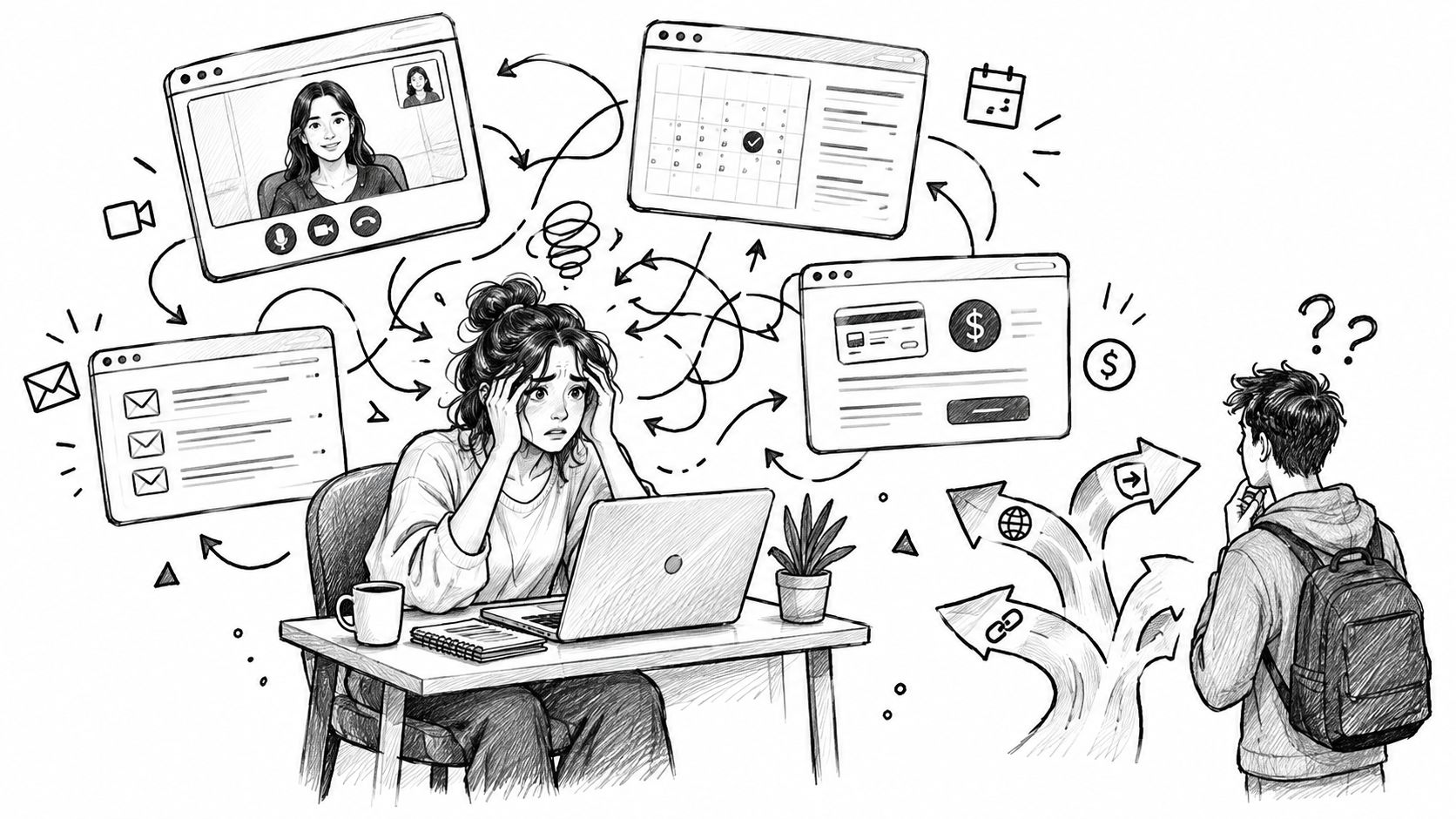
Most coaches don't notice the leak because the process is familiar to them. They know where the calendar lives. They know which Stripe product matches which offer. They know the intake form comes after payment. A new visitor knows none of that.
What an online coaching platform should actually do
A real online coaching platform isn't just a scheduling app with a coaching label. In practice, it should do four jobs on one page:
- Present the offer clearly: Session type, outcome, price, and next step should sit in one visible flow.
- Take payment before admin starts: Paid bookings filter out people who want free consulting disguised as “quick questions.”
- Capture email without friction: Not everyone buys on the first visit. You still need a way to keep the lead.
- Show what's working: If you can't see which block gets clicks, bookings, or signups, you can't improve it.
This is why I push coaches to think in terms of conversion architecture, not software categories.
Practical rule: Every redirect is a chance for a buyer to change their mind.
Why one page changes the economics
A unified page protects momentum. Someone reads your positioning, watches a short video, sees your offer, books a slot, pays, and gets the invite. No scavenger hunt. No “go check your inbox and then come back.” No weak handoff between tools.
It also cuts maintenance. One page is easier to revise than a booking app, a website, a checkout tool, and an email form spread across different dashboards. Coaches who simplify their stack usually find that their real bottleneck wasn't traffic. It was friction.
If your current setup needs a tutorial, it's too complicated. If you want a deeper look at what happens when too many tools are stitched together, read this breakdown of integration management problems.
Core Features That Actually Move Coach Revenue
Feature lists are where platform buying goes off the rails. Coaches get sold on AI summaries, community spaces, course portals, and polished dashboards before they've fixed the basic revenue path.
The order should be the reverse. Start with the mechanics that produce money.
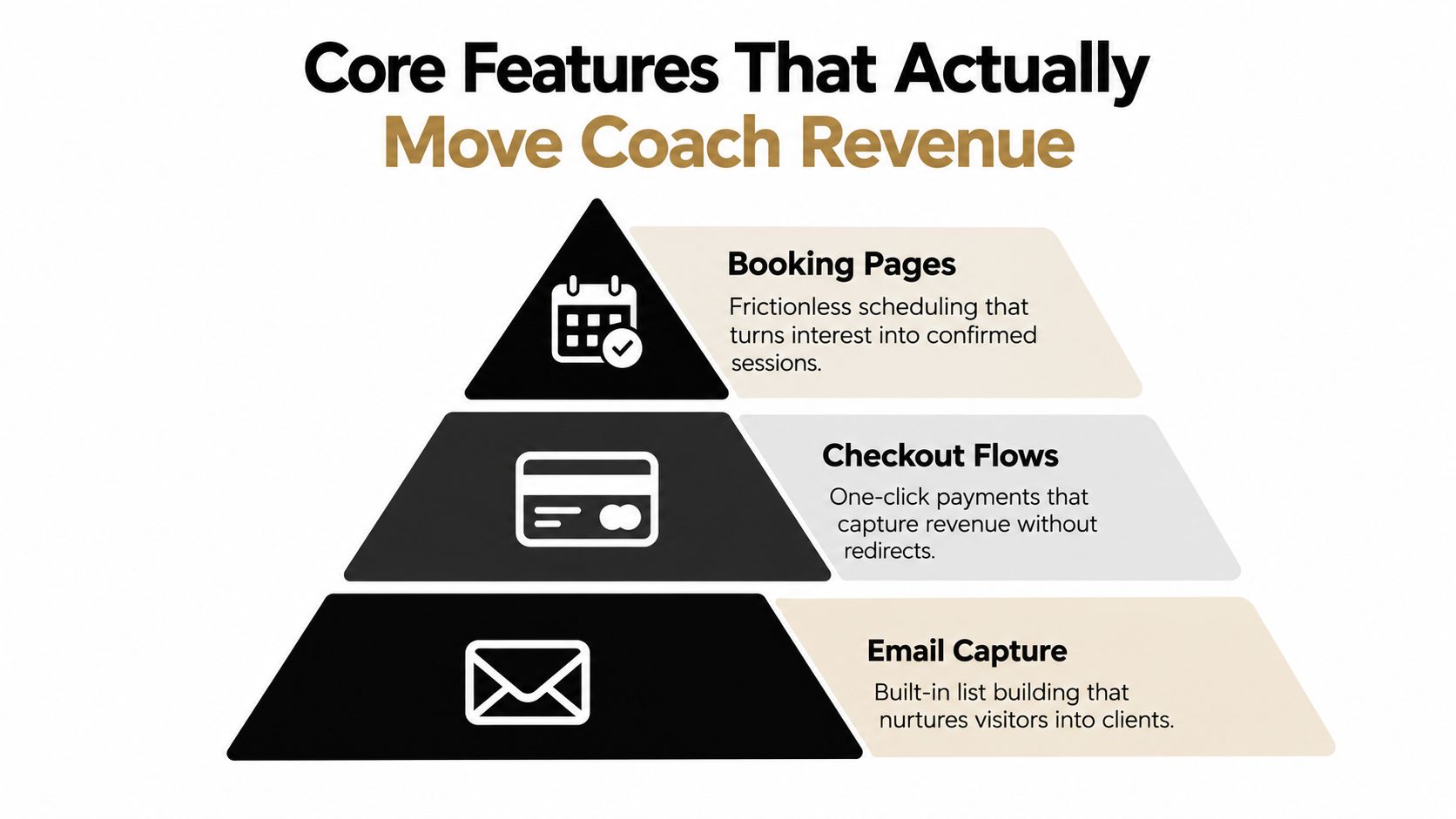
Booking pages come first
For most coaches, the first serious conversion event is the booking itself. Not the follower. Not the profile visit. Not the “I'm interested” DM.
A booking page works when it answers three questions fast. What is this session? Who is it for? What happens next? If your page hides price, makes people message first, or sends them into a back-and-forth email thread, you're inviting delay.
Paid booking beats inquiry forms for one reason. It forces intent. You stop spending time with people who want reassurance but not commitment.
Checkout is not a support feature
A lot of coaches treat checkout like plumbing. It isn't. Checkout is where revenue is either captured or lost.
When checkout sits on the same page as the offer and calendar, people keep moving. When it sends them elsewhere, you create a pause. Pauses kill momentum. Especially on mobile.
Use this filter when comparing platforms:
| Feature | What it should do | What to avoid |
|---|---|---|
| Calendar | Lets buyers pick and confirm a slot quickly | Separate scheduling link with no payment |
| Checkout | Collects payment immediately in the flow | Redirect-heavy payment path |
| Confirmation | Sends invite and next steps automatically | Manual follow-up after purchase |
Email capture matters more than most coaches think
Some visitors aren't ready to buy, but they might subscribe if you make it easy. Coaches sabotage themselves with long forms and premature data collection.
Benchmark data from form conversion rate benchmarks for 2026 shows one-field email signup forms convert about 25.5%, while three-field forms convert roughly 25%. Performance drops once forms get longer or more commitment-heavy, and free-trial or self-serve signup forms usually land in the 5% to 20% range, while newsletter or email-only forms commonly convert in the 20% to 30% range.
That gives you a clear instruction set:
- Ask for email first: Name, phone, niche, goals, and company can wait.
- Delay enrichment: Collect profile details after opt-in or after payment.
- Match the form to the offer: A newsletter form should not feel like a client intake packet.
Long forms don't make leads better. They usually just make fewer leads.
If you're comparing software through a creator-business lens instead of a traditional coaching-software lens, this guide to creator tools that affect monetization is the right framing.
Tool Sprawl Versus a Single Conversion Stack
Here's the common stack. Linktree for links. Gumroad for a digital product. Mailchimp for email. Calendly for scheduling. Squarespace for the site. Plausible for analytics. Stripe in the middle. A form tool somewhere off to the side.
Each tool seems cheap in isolation. Together, they create drag.
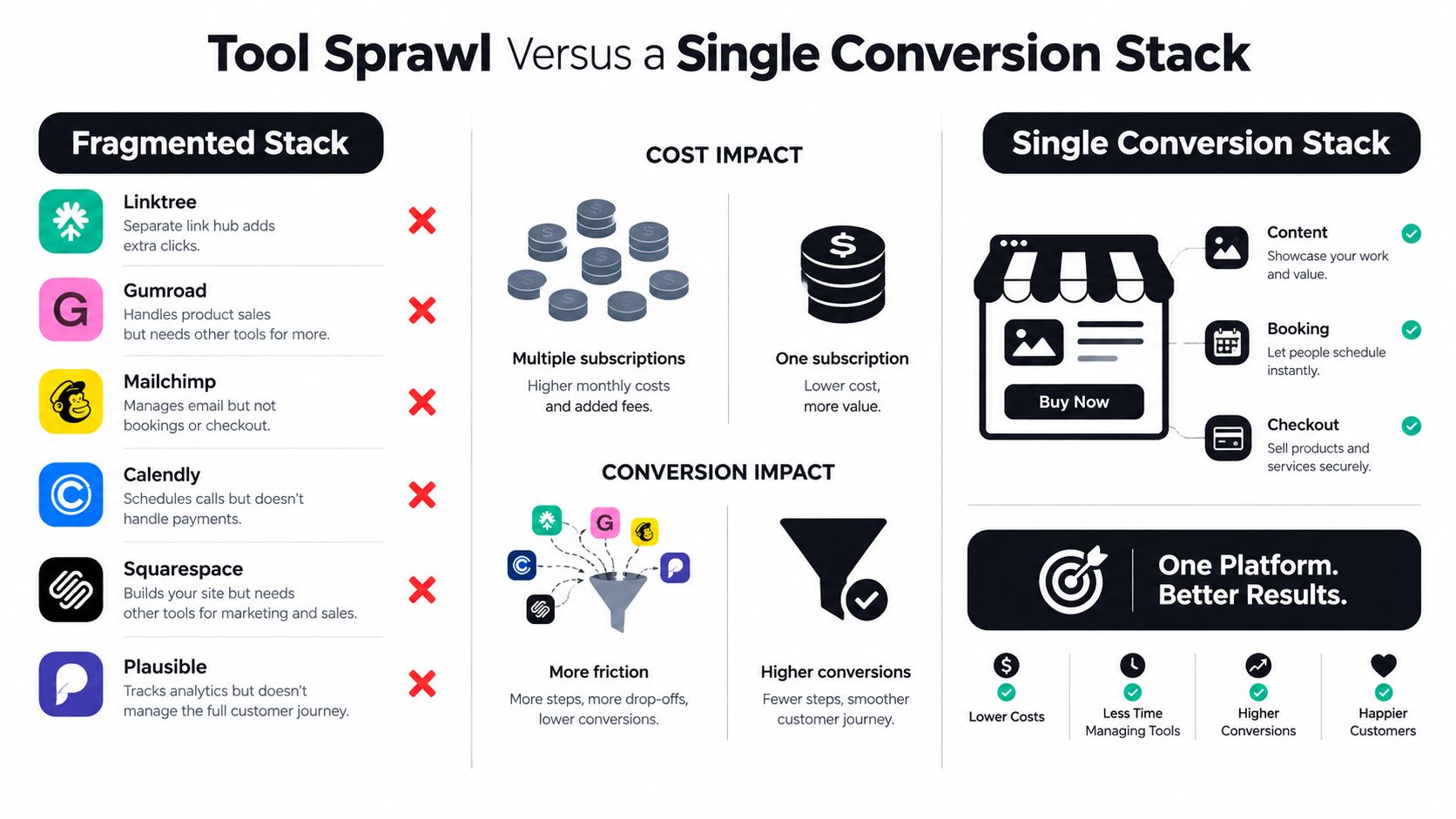
What fragmented stacks really cost
The first cost is obvious. Monthly subscriptions. The second cost is worse. Setup and maintenance time. Every tool needs branding, testing, troubleshooting, and periodic cleanup.
The third cost is the one coaches miss. Conversion leakage from redirects.
A visitor who lands on a single page and acts there has fewer chances to drift away than a visitor who keeps opening new tabs. That sounds basic because it is basic. Yet many coaches still buy tools as if each task exists in isolation.
When a dedicated coaching platform is the wrong choice
A lot of software reviews fail the reader. They assume you need a dedicated coaching platform first.
Sometimes you do. But many independent coaches also sell templates, workshops, digital downloads, or mini-offers. In that case, a broader creator stack with bookings and checkout in one place can make more sense than a coaching-only tool with scattered monetization features.
Industry commentary summarized in coaching technology trends for 2026 points to platform consolidation and digital-first client experience as defining themes, while the market still remains fragmented across coaching, mentoring, LMS, CRM, and analytics categories. That's exactly why feature checklists are weak decision tools. They don't tell you whether your business model needs one platform or six.
A better comparison question
Ask this instead:
- Do you sell only coaching sessions? A narrow coaching platform may fit.
- Do you sell coaching plus products and list growth? A single conversion stack usually wins.
- Do your buyers come from social traffic? Keep them on one page as long as possible.
If your current setup feels like taped-together software, compare it against an all-in-one business platform model before you buy anything else.
How Coaches Turn Visitors Into Paid Bookings
A practical booking flow should feel boring. That's a compliment. The buyer shouldn't need to think hard.
Start with one page. Put your positioning at the top, your offer in the middle, and the booking action where it's impossible to miss. Add proof through content, not clutter. A short intro video, a clear session title, a short sentence on outcome, and the price is enough for most coaches.
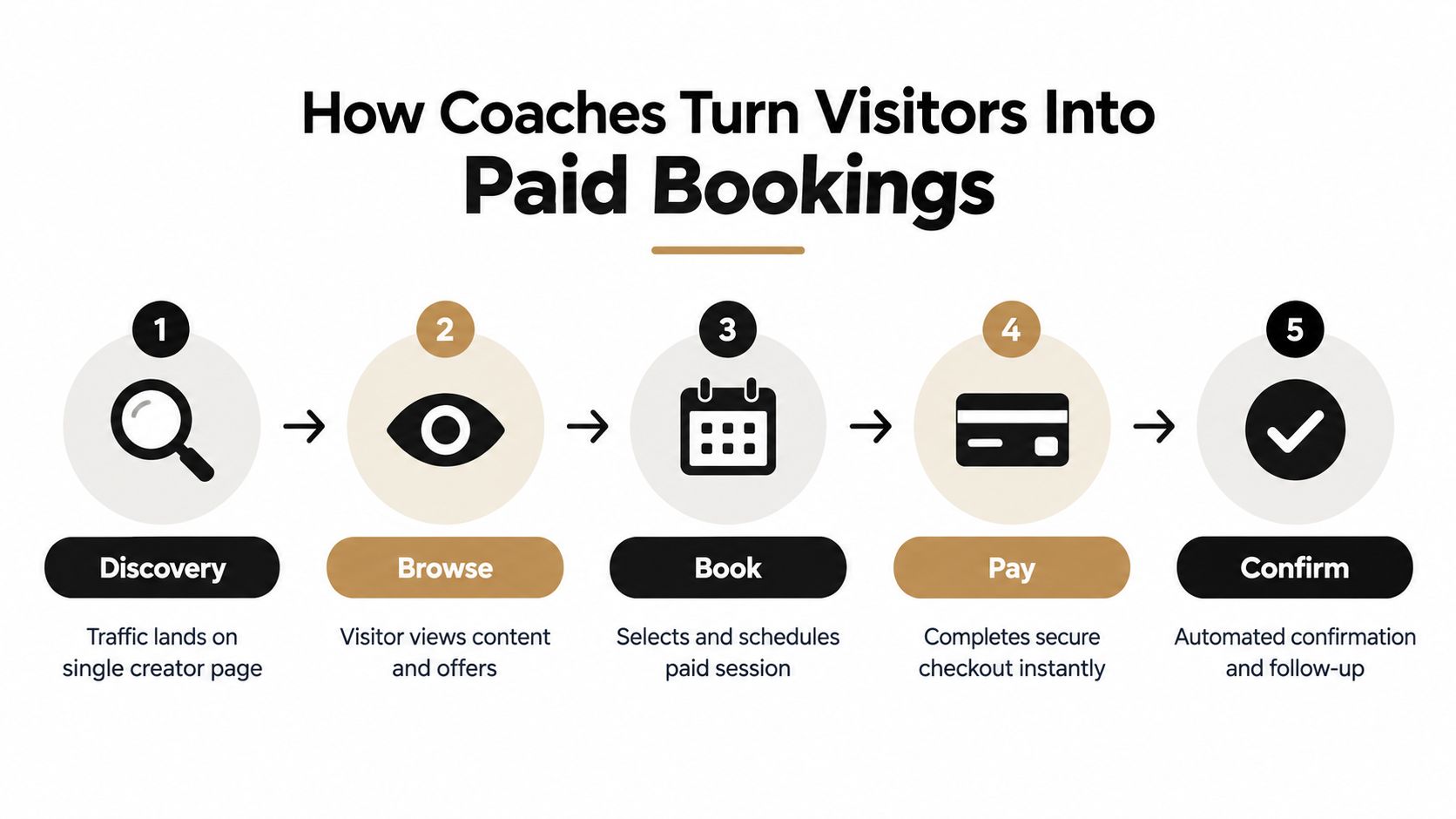
The five-step booking path
Discovery
Someone finds you through social, search, email, or a referral and lands on one page.Browse
They scan your content and offer without leaving the page.Book
They pick the relevant session from an on-page calendar.Pay
They complete checkout immediately, before motivation fades.Confirm
They get the invite and follow-up automatically.
That structure matters because checkout abandonment is a standard failure point in digital funnels. Research discussed in abandoned online transaction analysis defines abandonment as a user starting checkout and leaving before completion. The same source context notes that broad website conversion rates often sit around 1% to 4% overall, while signup paths usually convert only a few percent unless the audience is already warm. Coaches should read that as a design warning. Don't stretch the path.
Here's the video version of that single-flow idea in action:
What this looks like in real coach workflows
A career coach might offer a paid strategy session. A fitness coach might sell an onboarding consult plus a starter guide. A business coach might offer a diagnostic call and a workshop replay on the same page. Different offers, same principle. Collapse the path.
If you want a good supplemental read on how coaches convert leads into high ticket clients, study the funnel logic but tighten it for your own page. Don't make people “apply” when a clean paid session would do the job better.
The strongest coaching funnel is often the shortest one.
For a more tactical walkthrough of booking from a creator page, this guide on how to book clients online is useful.
Selection Criteria for Coaches Choosing a Platform
Don't choose an online coaching platform by asking which one has the longest feature list. Choose it by asking which one protects margin, trust, and conversion.
Use these five criteria
Conversion efficiency
Your first question is simple. Can a visitor move from interest to payment without getting redirected all over the internet?
If booking, checkout, and email capture live in separate tools, conversion efficiency is weaker by design. You're asking attention to survive too many handoffs. Pick the platform that shortens the path.
Pricing transparency
A platform's monthly price matters less than how it takes its cut. Hidden transaction fees can wreck lower-priced coaching offers and small digital add-ons.
Look for plain pricing, clear payout logic, and no surprises buried in plan comparisons. If you need a spreadsheet to understand what you'll owe, skip it.
Privacy posture
Trust matters in coaching because clients often share personal, financial, or career details. If your market includes EU clients, GDPR-friendly hosting and cookie-light analytics aren't niche concerns. They affect confidence.
A platform that avoids unnecessary tracking and handles data cleanly gives you fewer headaches later.
Analytics clarity
You don't need a giant enterprise dashboard. You need answers to practical questions.
- Which offer gets clicks
- Which block gets signups
- Which booking option gets paid
- Where visitors stop
If the analytics are bloated, you won't use them. If they're too thin, you can't improve.
Integration depth
Some integrations are useful. Too many are a warning sign.
Buy the fewest moving parts that still let you sell properly.
If your platform only works well after connecting four other services, you don't really have a platform. You have a project.
How taap.bio Solves Real Coach Friction Points
A creator-store model makes practical sense for coaches who are tired of juggling tools. taap.bio combines storefront blocks, paid bookings, email capture, checkout, and analytics on a single page. That matters when your business is driven by social traffic and short attention spans.
What that looks like in day-to-day use
A coach can build a drag-and-drop bento layout with an intro video, a paid session block, a downloadable resource, and an email signup on one screen. The buyer doesn't need to open a separate site to understand the offer. They can act where they land.
For bookings, the platform supports an on-page calendar with upfront payment and automatically sent invites. That solves a common annoyance for coaches. Unpaid message requests and “can I pick your brain?” conversations eat time and rarely turn into good clients.
Why this setup fits the revenue-first model
The useful part isn't that everything exists. The useful part is that it exists in one flow.
The email signup widget supports one-tap subscribe and CSV export, which means your audience is portable. Built-in checkout handles payments and can deliver digital files instantly after purchase. Real-time analytics per widget show what people click. Optional custom domain mapping helps coaches who want a branded public URL instead of another generic profile link.
There are also business-model details that matter. taap.bio states 0% platform fees on every sale, transparent pricing at $19/month after a 14-day trial, and GDPR-friendly hosting in France with zero cookies by default, based on the publisher information provided for this article. For coaches selling lower-priced sessions, paid downloads, or lead magnets, that structure is easier to reason about than a stack with multiple cuts and scripts.
If your current setup still splits content, booking, and payment across different services, compare it against a custom landing page builder approach before adding more software.
What to Prioritize Before Scaling Your Coaching Business
Most coaches try to scale too late in the process. They add automation before they've cleaned up the offer. They add AI before they've fixed conversion. They add more traffic before they've made the page easy to buy from.
Do this in the right order.
Fix these first
- A single-page offer: One clear destination for content, booking, and payment.
- Simple email capture: Ask for the minimum, then build the relationship after opt-in.
- Paid booking flows: Protect your calendar from free-consulting behavior.
- Basic analytics: Track what gets clicks and what gets paid.
That foundation does more for most coaching businesses than another shiny tool.
Be careful with AI hype
The market is pushing AI hard. Some of that is useful for admin. Less of it is proven where coaches care, which is trust, retention, completion, and willingness to pay.
One 2026 market source highlights AI-assisted practice as a differentiator and says more than 70% of enterprise buyers prioritize analytics-driven performance tracking, while mobile-first access exceeds 65% of sessions and asynchronous coaching remains a small but growing segment, according to online coaching platform market commentary. That's interesting, but independent coaches shouldn't confuse enterprise buying preferences with what their own business needs next.
The smarter scaling question
Don't ask, “Does this platform have AI?”
Ask these instead:
- Does it help me monetize directly
- Does it preserve client trust
- Does it keep my audience portable
- Does it reduce dependency on five other tools
- Does it make buying easier on mobile
The coaches who build durable businesses usually own their audience, charge upfront, keep their flow simple, and respect privacy. They don't win because they assembled the fanciest dashboard. They win because clients can understand the offer and buy it without friction.
If you clean up that part first, scaling gets much less dramatic and much more profitable.
If you want one page to handle paid bookings, digital sales, email capture, and analytics without stitching together half a dozen apps, taap.bio is built for that model. It gives coaches a drag-and-drop creator store with built-in checkout and on-page scheduling, so you can spend less time managing tools and more time selling and delivering your work.