An online course sells when you validate one learner outcome before recording a single lesson, then use a focused page to capture emails, take payment, deliver the product, and collect proof. The practical sequence is simple: define the transformation, pre-sell or pilot it, design for completion, and let measured results improve the offer.
You may already have the familiar creator problem. Your camera is ready, your notes are overflowing, and a dozen tools promise to handle checkout, email, scheduling, hosting, analytics, and delivery. Yet the sales page is still vague, the course promise covers too much, and nobody can tell what a student will be able to do after finishing.
I learned to distrust that order after moving from free workshops toward paid digital products. Recording more lessons didn't solve weak demand. Adding another marketing tool didn't create trust. The useful question is narrower: what observable change will a specific learner achieve, and what evidence will show that it happened?
Selling an online course is therefore less about publishing a library and more about engineering a reliable path from problem to result. Traffic matters, but completion data and outcome evidence become stronger sales assets than vanity metrics. A single-page creator store can support that path by keeping the offer, email capture, checkout, delivery, bookings, and measurement close together instead of scattering the buyer across disconnected tools.
Table of contents
Why most courses fail before they sell
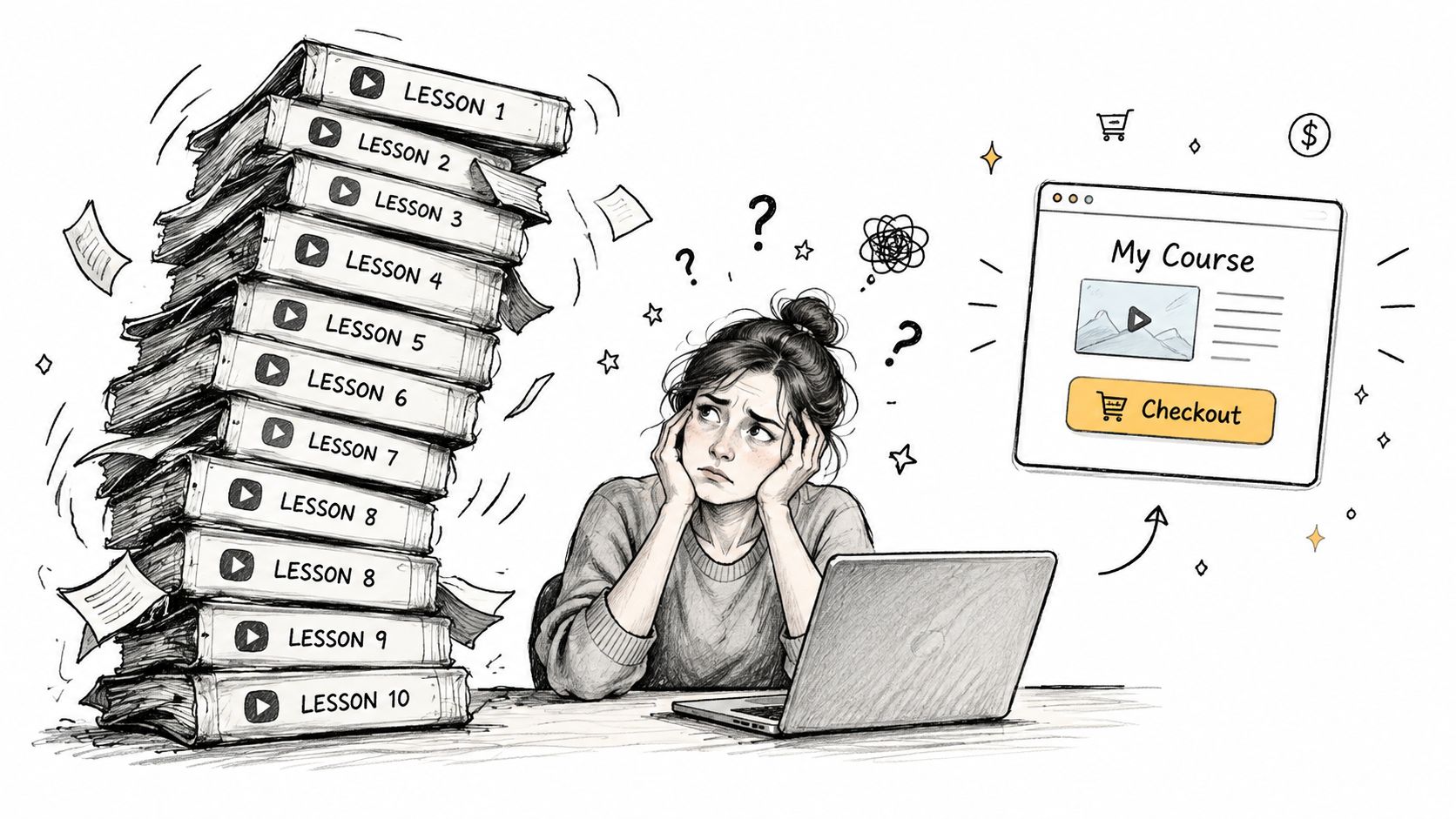
The most expensive course mistake happens before production. Creators choose a broad topic, outline a large curriculum, record every lesson, and only then ask whether anyone will pay for the promised result. That sequence feels productive because files accumulate quickly, but it hides the commercial risk until the creator has already invested heavily.
The global opportunity is real. One industry estimate values the online-courses market at approximately $250 billion in 2025 and projects it to reach $567.2 billion by 2034, at a 9.5 percent compound annual growth rate (Dataintelo's online-courses market estimate). Those figures describe a broad market, not a guarantee that a general course idea will sell. The reports may define online courses differently, so the useful lesson isn't the headline size. It's that demand has become mainstream, which raises the standard for positioning.
Start with the learner's finish line
Define the audience narrowly enough to recognize their situation. “People who want to improve their marketing” is a topic audience. “Independent consultants who need to turn one service into a clear paid offer” is closer to a buying audience.
Then write one outcome that a learner can demonstrate. Avoid “understand,” “learn,” and “get better at” unless you attach a visible action. Stronger outcomes describe something the student can produce, complete, diagnose, or implement.
Use this validation sequence before filming:
- Interview the problem: Ask potential learners what they currently do, where they get stuck, and what a successful result would look like in their work.
- Offer a small test: Run a workshop, preview lesson, paid consultation, or pilot around one part of the transformation.
- Ask for commitment: Interest is useful, but payment, a booking, or a serious sign-up reveals stronger intent.
- Measure the result: Record the baseline situation, the action taken, and the learner's post-course state.
Practical rule: If you can't describe the learner's starting point and finished state in one sentence each, you aren't ready to build the full curriculum.
A course isn't valuable because it contains many modules. It's valuable when the learner can cross a meaningful gap with less confusion, wasted effort, or dependence on the instructor. That shift changes your production decisions. You record only what supports the outcome, add exercises where behavior must change, and remove material that merely proves how much you know.
Selling begins with empathy and evidence, not uploads. Validate the transformation first, then build the smallest learning experience capable of delivering it.
Understanding the online learning market and conversion math
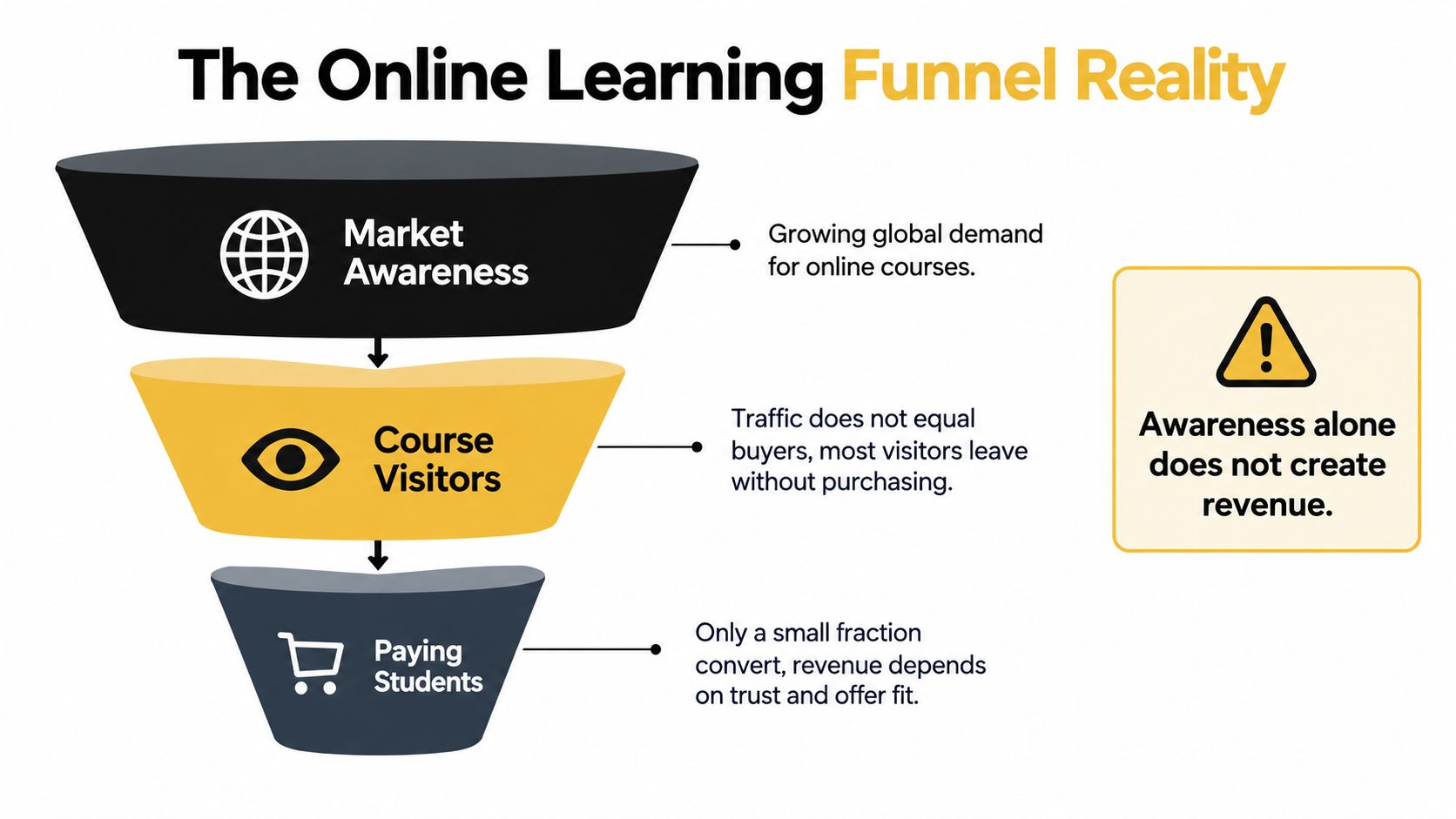
Large audience demand doesn't automatically become course revenue. More than 220 million students enrolled in at least one MOOC in 2021, according to an industry summary of MOOC data (Whop's course statistics overview). That figure demonstrates the reach of structured online learning, but enrollment includes free and subsidized education, so it can't be treated as a paid-sales forecast.
The commercial funnel has separate jobs. A visitor must first recognize the problem, then believe your approach fits, then trust the promised result, and finally complete payment. Treating followers, page visitors, email subscribers, and buyers as one audience makes it impossible to identify the actual constraint.
Track the journey, not the applause
A useful dashboard separates each stage:
| Funnel stage | Question to answer | What to improve |
|---|---|---|
| Visitor to lead | Did the page offer a relevant next step? | Headline, lead magnet, preview |
| Lead to sales-page visit | Did follow-up build enough interest? | Email sequence and education |
| Checkout initiation | Did the offer feel clear and credible? | Proof, curriculum, objections |
| Purchase | Did the checkout remove friction? | Payment flow and reassurance |
| Completion and outcome | Did learners achieve the promise? | Course design and support |
Landing-page benchmarks give you a testing reference, not a promise. Education landing pages show a median conversion rate of 8.4 percent, while online-course pages average 18.3 percent, with top-quartile performance at 20 percent or higher (Unbounce's landing-page conversion analysis). Traffic intent, price, trust, device mix, geography, and denominator all change the result.
Start testing the message before the decoration. An outcome-led headline and a specific audience usually deserve attention before colors, animations, or elaborate page layouts. Add proof and curriculum clarity next, then test price and guarantee. Design refinements come later.
For creators who need to compare page performance and visualize funnel behavior, Chartsy's use cases can help organize course-specific reporting. You can also use this practical guide to understand what makes a good landing-page conversion rate without mistaking a benchmark for a forecast.
The central math is straightforward. If qualified visitors don't become leads, improve relevance. If leads don't reach the offer, improve nurturing. If checkout starts but purchases lag, investigate trust, clarity, price, and friction. Proof of transformation gives every stage a reason to move forward.
Validating demand and designing for completion
A pilot is the bridge between an idea and a finished course. Instead of recording a large curriculum in private, sell access to a small, clearly defined learning experience and use real learner behavior to shape the final product.
Start with a one-page offer containing four elements: the learner profile, the current problem, the observable result, and the delivery format. Invite prospects to join a pilot, submit an email for a preview, or book a paid diagnostic. The objective isn't to manufacture hype. It's to find out whether the promise is specific enough to attract the right people and practical enough to deliver.
Build the smallest useful sequence
Design the pilot around actions rather than topics. A module titled “Email Marketing Fundamentals” gives the learner a subject. A module titled “Write and send your first welcome email” gives them a finish line.
A compact learning sequence often works better when each unit contains:
- A short explanation: Teach only the concept needed for the next action.
- A worked example: Show the decision or process in context.
- A concrete task: Require the learner to create, change, submit, or test something.
- A checkpoint: Ask what happened and provide feedback or a correction.
A peer-reviewed MOOC analysis found completion rates ranging from 0.7 percent to 52.1 percent, with a median of 12.6 percent, and linked completion with course length, start date, and assessment type (the peer-reviewed MOOC analysis). Those results shouldn't become a universal promise for your course. They do show why course length and assessment design deserve commercial attention, not just educational attention.
Design for evidence
Give learners an immediate first win, set reminders, and create a reason to return. A live review, feedback checkpoint, peer discussion, or assignment deadline can turn passive consumption into progress. Self-paced delivery can remain flexible while still using suggested pacing and visible milestones.
Track activation soon after purchase, lesson-level drop-off, assignment submission, completion, outcome attainment, refunds, and permission to use testimonials. The best testimonial isn't “great content.” It explains the starting problem, the action the learner took, and the change that followed.
Use buyer persona development to sharpen the learner profile before you write the curriculum. Then connect each lesson to the profile's actual constraints, language, and desired result.
A completed pilot teaches you more than an unfinished flagship course, because learners reveal where the promise, pacing, and support either work or fail.
Completion is not the only measure of value, but it is an important operating signal. When learners abandon the experience, you lose outcome evidence, referrals, future case material, and sometimes revenue through refunds. Sell a smaller promise, deliver it fully, and expand only when the evidence supports expansion.
Choosing between self-paced courses and cohort offers
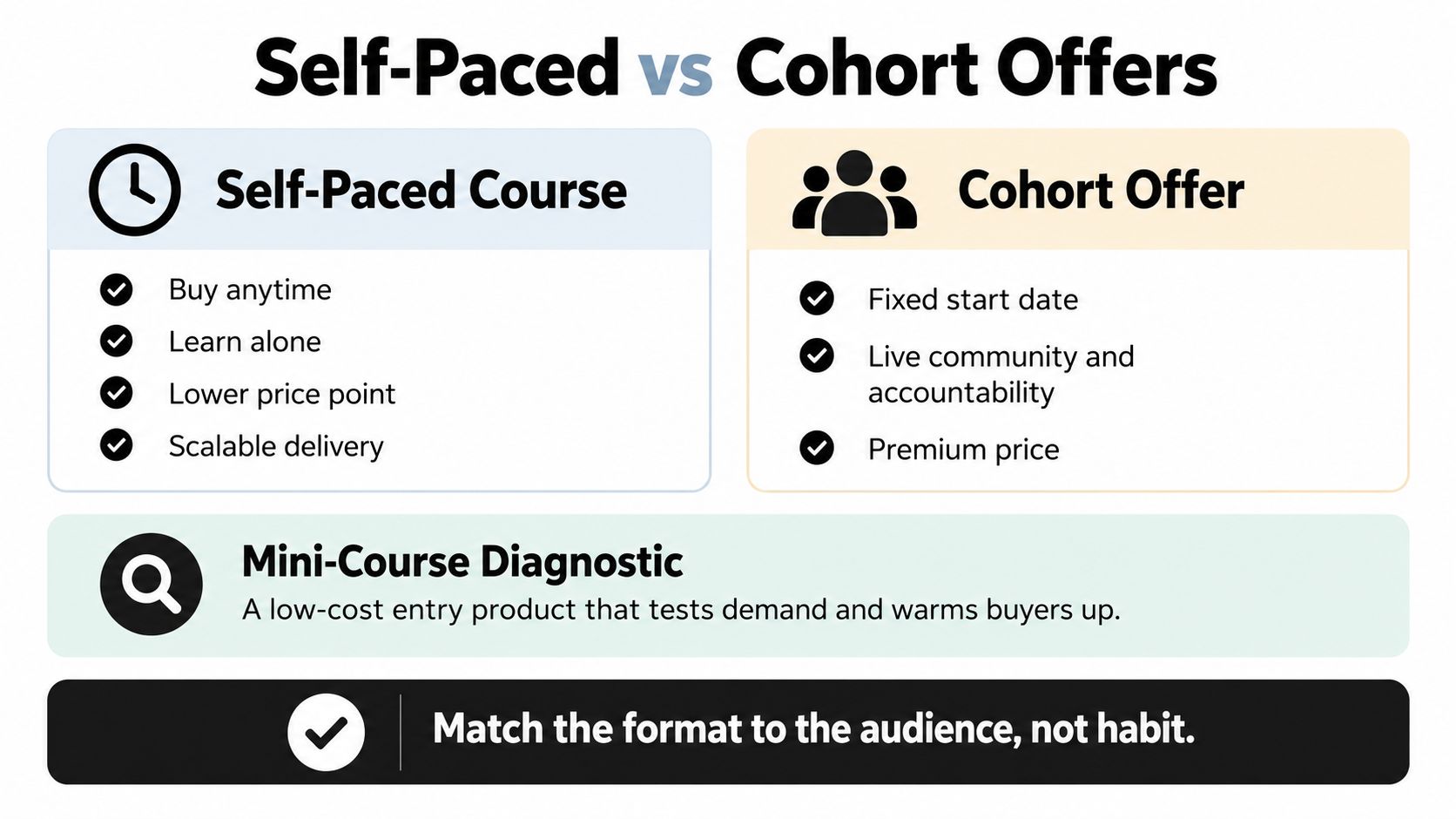
A self-paced course and a cohort offer solve different commitment problems. The self-paced model gives buyers flexible access and gives the creator scalable delivery. A cohort adds deadlines, social accountability, live feedback, and a shared start, but it also requires scheduling and active facilitation.
The mistake is choosing self-paced delivery because it seems easier to produce. If learners need feedback to complete the transformation, removing interaction may reduce the product's value. If the outcome is procedural and repeatable, a well-structured self-paced course may be the better fit.
Match commitment to learner intent
Evidence from Harvard and MIT MOOCs illustrates the difference commitment can make. Analysis found that 3.13 percent of all participants completed courses in 2017–18, compared with 46 percent of fee-paying verified students (the Harvard and MIT MOOC analysis). The comparison doesn't prove that payment alone causes completion. Paid learners may already be more motivated, but the gap supports a practical conclusion: free reach and paid implementation should not share the same success benchmark.
Use a progression when the audience has mixed needs:
| Offer | Best use | Creator responsibility |
|---|---|---|
| Mini-course or diagnostic | Test demand and clarify the problem | Deliver a quick, useful result |
| Paid self-paced course | Teach a repeatable implementation process | Provide structure, exercises, and support |
| Cohort program | Help learners apply complex work with accountability | Facilitate feedback, deadlines, and community |
| Paid consultation | Learn the problem before productizing it | Solve a narrow issue and capture patterns |
A consultation can be the right first product when you have expertise but lack outcome evidence. It exposes objections, vocabulary, edge cases, and the moments where learners need help. Those observations can later become modules, exercises, or a stronger promise.
Avoid the fragmented stack
Creators often combine a link page, a course host, a payment processor, an email platform, a scheduling app, and several analytics scripts. That stack can work, but every redirect creates another place for a buyer to hesitate, and every integration creates another system to maintain. You also need to decide where customer records live and how consistently each tool reports the journey.
A consolidated creator store trades some specialist depth for lower operational complexity. A focused page can present the preview, offer, booking option, and checkout in one flow. That doesn't replace thoughtful curriculum design, but it keeps the buying path aligned with the learning promise.
Choose the format that supports the outcome, not the format you happen to know how to upload. The product isn't “videos.” The product is a level of commitment that helps the learner finish.
Setting up a single-page creator store for checkout and delivery
A sales page should answer the buyer's questions without sending them on a tour of your technology stack. The page needs to explain who the course is for, what changes, what the learner receives, why you can teach it, and what happens after payment.
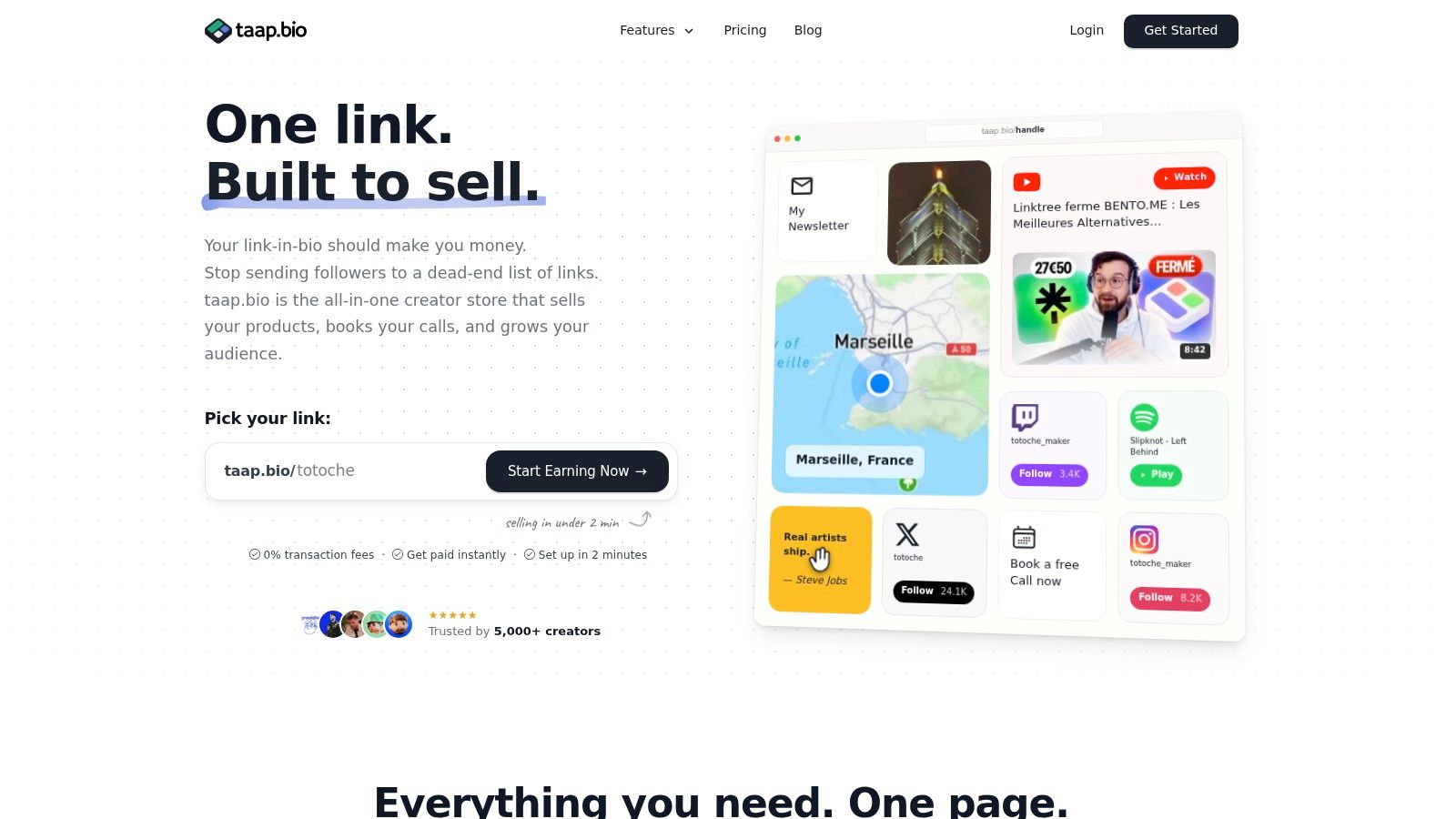
A single-page creator store can combine the public offer with email capture, digital delivery, paid bookings, and analytics. For course creators, the benefit is operational: fewer redirects, fewer disconnected records, and a clearer view of which page element produces an action.
Assemble the page in buyer order
Build the page from the learner's questions rather than from the widgets available:
- State the outcome: Put the specific learner and observable result above the fold.
- Show the path: Explain the modules, assignments, pacing, and support in plain language.
- Add a preview: Use a short lesson, sample worksheet, or useful email sequence to demonstrate your teaching.
- Make credibility concrete: Include relevant experience, learner feedback, or verified outcome evidence.
- Capture the non-buyer: Offer a relevant lead magnet or preview for visitors who aren't ready to purchase.
- Place checkout nearby: Let a qualified visitor buy without opening several new pages.
- Deliver immediately: Send access instructions and the first action as soon as payment succeeds.
The page can also include a paid booking widget when the course needs a diagnostic call, implementation review, or private support. That creates a second path for visitors who need more context before committing to a full program.
Keep margin and ownership visible
Tool consolidation matters because recurring costs, platform commissions, maintenance, and data handling can erode the strength of a small offer. A creator store such as taap.bio provides built-in checkout, instant digital file delivery, paid bookings, email signup with CSV export, per-widget analytics, optional custom domains, and GDPR-friendly hosting in France. Its stated pricing includes 0% platform fees on sales and a $19 monthly price after a 14-day trial, so verify current terms before choosing it.
The trade-off is that a single platform may offer less specialized functionality than a dedicated learning management system or email service. If your course needs advanced assessment logic, complex community features, or elaborate automation, a specialist stack may be justified. If your immediate priority is validating one offer with a simple buying path, reducing setup can be more valuable than collecting features.
You can review the broader logic behind building a one-page online store. Keep the page focused, label every action clearly, and make the first post-purchase step obvious. Delivery is part of conversion because a confused new customer starts the relationship with doubt.
Launching with social, email capture, and proof-based marketing
A launch should move people from useful public education to a specific next step. Publish content that demonstrates the problem and part of the method, then direct interested people to a preview, checklist, workshop, or waitlist. Social reach creates discovery, while consent-based email gives you a reliable channel for explanation and follow-up.
The audience for online learning is broad, but broad reach isn't a paid-sales strategy. The MOOC enrollment benchmark cited earlier shows appetite for structured education, not guaranteed buying intent. Your launch needs to identify people with the right problem, at the right moment, who believe your course can help.
Use a short evidence-led sequence
A practical launch sequence looks like this:
- Teach the problem: Show a common mistake and a useful correction.
- Invite the next step: Offer a preview lesson, diagnostic, or relevant worksheet.
- Explain the method: Use email to connect the problem, process, expected effort, and limitations.
- Show learner evidence: Share anonymized results, submitted work, milestones, or carefully worded testimonials.
- Make the offer: State the audience, outcome, format, support, price, and refund terms without artificial pressure.
- Review the data: Compare sources, creative variants, sign-ups, checkouts, purchases, and post-purchase activation.
For ideas on presenting testimonials and other credibility signals without resorting to fabricated urgency, explore proven social proof strategies for X. Proof should clarify what happened, not imply that every learner will receive an identical result.
Use the page's email widget to collect permission-based subscribers and export contacts in CSV format where appropriate. A list you can access and move is more durable than an audience you can only reach through an algorithm. Keep consent records, identify the sender, and make unsubscribing straightforward.
Email list building becomes more effective when the lead magnet matches the paid course. A generic free download attracts curiosity. A diagnostic, template, or preview that prepares the buyer for the paid outcome attracts relevance.
Tracking results, staying compliant, and iterating sustainably
A course business becomes sustainable when the creator treats delivery as part of marketing. Every learner who achieves the stated result can strengthen the next launch. Every unexplained dropout signals a lesson, promise, onboarding step, or support process that needs attention.
Track the full journey after launch:
- Activation: Did the buyer open the course and take the first action soon after purchase?
- Lesson drop-off: Which lesson loses momentum, and what task or explanation appears there?
- Assignment submission: Are learners applying the material or only consuming it?
- Completion: Who reaches the intended finish line?
- Outcome attainment: What evidence shows the promised change occurred?
- Refund rate: Do refunds cluster around a particular expectation or delivery issue?
- Revenue per visitor: Which sources bring economically useful traffic rather than empty attention?
A 2025 survey of course businesses found that three of eleven sellers didn't track completion, four of eleven didn't track whether students achieved the stated outcome, and five of eleven didn't track time to completion (the 2025 course-business survey). That gap is an opportunity. Outcome tracking can improve the product and give future buyers a more credible reason to trust it.
Make compliance part of the workflow
Use clear consent language for email capture, explain what subscribers will receive, and provide an easy unsubscribe route. Publish refund conditions before payment, describe access and delivery accurately, and avoid promising results you haven't measured. If you sell across regions, review your obligations with a qualified legal professional rather than treating a platform setting as legal advice.
For privacy-conscious measurement, GDPR-compliant analytics can help you think through what data you collect, why you collect it, and how long you retain it. Keep analytics tied to decisions. If a metric won't change your page, onboarding, curriculum, or offer, it probably doesn't deserve priority.
Run iterations in a deliberate order. Fix a vague outcome before redesigning the page. Fix a weak first action before increasing traffic. Fix a confusing checkout before adding another acquisition channel. Then compare cohorts, not just totals, because learners who activate, intend to finish, or receive support may behave differently from casual visitors.
The roadmap is disciplined but not complicated: validate one transformation, sell a pilot, design for completion, choose the format that matches commitment, consolidate the buying path where it helps, capture consent-based email, and publish only the evidence you can support. Revenue follows a course that reliably helps the right learner finish, not a course that merely attracts attention.
taap.bio gives course creators a single-page storefront for presenting an offer, capturing email subscribers, taking payment, delivering digital products, and adding paid bookings without forcing every buyer through disconnected tools. Visit taap.bio to build a focused sales path around your learner outcome and start collecting the evidence your next launch can use.