You've probably got the same problem most new Etsy sellers have. You can make a decent printable in Canva, maybe even a few, but the jump from “nice file” to real Etsy product business feels messy, especially when fees, mockups, search, and delivery all start mattering at once.
The good news is that how to sell printables on Etsy is less about guessing trends and more about building a simple system that shoppers can understand fast. Etsy is big enough that digital goods aren't niche anymore, and printables sit inside a marketplace where buyer intent, presentation, and unit economics all matter.
A good starting point is understanding what a printable is in practice. It's usually a PDF, sometimes a ZIP with PDFs, JPGs, or PNGs, that the buyer downloads after purchase and prints themselves. That umbrella covers wall art, planners, checklists, invitations, worksheets, SVGs, and craft files, but each subcategory behaves differently in search and conversion.
The opportunity is real because Etsy's marketplace reached a level where digital downloads crossed into serious commercial territory in 2024, with printables and digital downloads estimated at over $1.2 billion in annual Etsy sales and the wider platform at $12.72 billion in gross merchandise sales that year. Etsy's app has also been downloaded over 200 million times overall, and the buyer app recorded 24.4 million downloads in 2023, up from 21.1 million in 2022 and 15.1 million in 2021, which helps explain why instant-download listings keep finding an audience in mobile search and app browsing (marketplace analysis, Business of Apps data).
Practical rule: don't treat printables like a hobby upload. Treat them like a catalog business where one file can keep selling, but only if the listing earns attention and the economics work.
If you want a deeper view of how a creator store can support digital products beyond Etsy, this overview on digital products business is a useful companion. For now, the path is straightforward. Pick a niche, design the first file, bundle it intelligently, price it with fee drag in mind, write a listing that matches search intent, set up delivery and basic compliance, and then drive traffic from outside Etsy too.
Table of contents
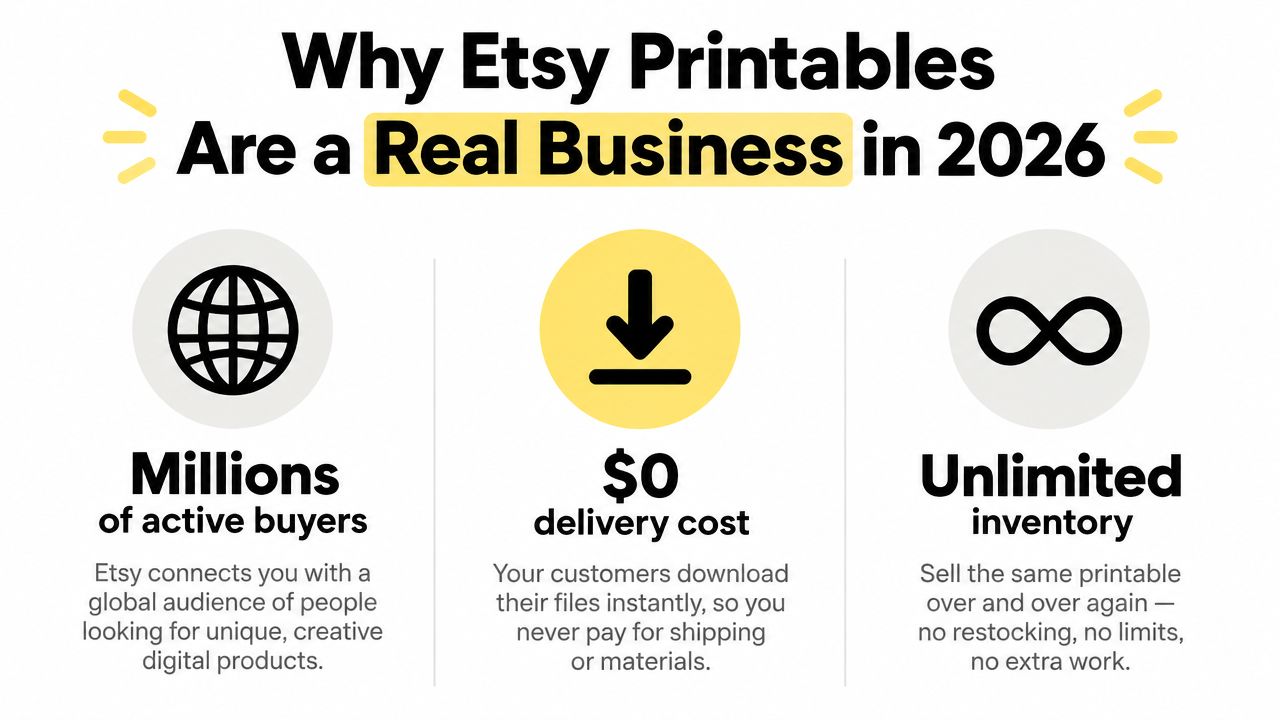
Why Etsy Printables Are a Real Business in 2026
A first Etsy sale for a printable often looks small. The file is digital, the buyer gets it instantly, and the production work happened before the order ever arrived. That is exactly why printables work as a real business, if you manage them like a catalog of products instead of a stream of one-off designs.
The economics are simple, but they are not free. A $5 listing can get squeezed fast once fees, ad spend, and time spent making mockups enter the picture, so the goal is not just to sell. The goal is to sell a file that can carry enough margin after Etsy takes its cut and after the listing earns a click. That is why sellers keep an eye on category demand through marketplace analysis and then design around what can survive the fee drag.
What buyers are actually buying
A printable is a digital answer to a specific task. Sometimes that task is decorating a wall. Sometimes it is organizing a household, planning a wedding, or making a classroom worksheet. The product type matters because the buyer is not evaluating every listing the same way.
Wall art is usually judged in a split second on style and mockup quality. Planners and worksheets are judged on structure, clarity, and whether the file feels complete. Editable templates bring another layer of friction, because buyers want to know the file opens cleanly and does not turn into a support headache.
That is why I treat mockups as part of the product, not decoration. A clean mockup helps a shopper understand scale, use, and style before they read a word of the description. A weak mockup can make a good file look generic, and a crowded niche can hide a better product if the thumbnail does not communicate the use case fast enough. This is also where a separate storefront can help, because sellers who publish digital products business content and route buyers through a link-in-bio store like taap.bio have another place to capture attention outside Etsy.
The seven steps ahead
A practical workflow keeps the business grounded. Pick a niche. Make one product that solves one problem. Design it cleanly and bundle it in a way that raises perceived value. Price it so fees do not eat the sale. Write a listing Etsy can read clearly. Set up delivery, messages, and tax basics. Then promote it outside Etsy so you are not relying on search alone.
Printables also reward sellers who think beyond the marketplace itself. Etsy can bring the first click, but owned-audience channels give you a place to send repeat buyers, test new offers, and keep traffic from depending on one listing page. For sellers who also want that kind of control, a link-in-bio store can sit beside Etsy, but the Etsy product still has to stand on its own. If your file, mockup, and price point do not work together, the marketplace will make that obvious fast.
Picking a Printable Niche and Your First Product
Good printable shops usually start with a narrow search phrase, not a broad design idea. If you open Etsy and type a candidate keyword into search, the autocomplete suggestions tell you what shoppers already want in their own words. That's much more useful than brainstorming in a vacuum.
Read Etsy like a shopper, not a designer
Search a phrase you could sell against. Then scan the first two pages and look for three things, review counts, listing style, and whether the products feel generic or highly specific. If the top results all look the same, that can mean the niche is saturated or just lazy. If you see a gap in style, language, format, or occasion, that gap is worth exploring.
For extra validation, check the built-in trend graphs in tools like eRank or Marmalead before you spend hours designing. You're not looking for perfection. You're looking for evidence that people search for the phrase often enough to justify making the file.
The best first products usually solve one specific occasion. A birthday invitation, a classroom reward chart, a meal planner, or a bridal shower game are easier to sell than a vague “modern printable set.” The more precise the use case, the easier it is to write the title, mock up the listing, and understand what the buyer is buying.
Practical rule: if you can't explain the buyer's moment in one sentence, the niche is probably too broad for a first listing.
Narrow to one product you can finish
Your first product should also fit your actual skill set. If you already design in Canva, start there. If you're comfortable in Illustrator, SVGs may make more sense. If you're strongest at page layout, planners or workbooks are a cleaner entry point. Don't choose a format because someone else said it's “easy.” Choose the one you can make well and repeat without friction.
A simple shortlist method helps. Pick three niche ideas, score each one for search intent, confidence in production, and likely bundle potential, then choose the highest combined fit. That gets you to one product instead of a folder full of half-finished ideas.
This aligns with the practical niche research process outlined in how to find your niche. The point isn't to find the perfect market. It's to find a clear buyer, a clear task, and a product you can ship without dragging the process out for weeks.
Niche validation snapshot example Etsy keyword research
| Keyword | Est. Monthly Searches | Avg. Reviews of Top 10 | Observed Gap |
|---|---|---|---|
| Wedding seating chart printable | Not provided | Not provided | Style consistency and editability |
| Minimal weekly planner | Not provided | Not provided | Better bundle framing |
| Classroom reward chart | Not provided | Not provided | Age-specific versions |
| Bridal shower games | Not provided | Not provided | Stronger mockups and theme fit |
Designing, Bundling, and Mocking Up Your Files
The production stage is where a lot of beginner shops lose time. They design one file, export it once, and assume the job is done. In practice, you need a workflow that protects editability, supports future variations, and makes the listing look like a finished product, not a desktop screenshot.
Build files you can reuse
Design at 300 DPI for print-oriented PDFs so the file holds up when someone prints it at home or through a local shop. Keep a master version editable, because buyers sometimes ask for small changes, and because you'll want to create related products later without rebuilding everything from scratch.
Export with the use case in mind. PDFs are the most common for print files, JPGs and PNGs work for digital use or preview assets, and SVGs are the format craft-machine buyers usually expect. If you make one product in multiple formats, you're not just adding value, you're also reducing support friction later.
Bundling should happen before design work gets too far along. A bundle feels more complete because the buyer sees an outcome, not a single page. That's why a planner kit, a wedding bundle, or a classroom pack usually looks stronger than a lone page with one function.
Make the listing look expensive, not busy
Mockups matter because Etsy is visual first. A styled living-room scene can make wall art feel finished. An iPad or laptop mockup makes digital templates feel usable. Room mockups help the buyer imagine the art in a home, while device mockups help buyers imagine opening the file and using it immediately.
If you need quick mockup sources, Smartmockups, Mockup World, and Canva are all common starting points. The trap is using the same mockup style for every listing until your shop looks copied and flat. Buyers notice repetition, even if they don't consciously call it out.
Buyers don't buy a file preview. They buy the result they think the file will create.
A strong bundle also helps with perceived value because the buyer sees more than one page or asset in a single purchase. That matters even more when fee drag is considered, because a small isolated listing has much less room to work with than a bundled one.
If you're making Canva-based products, this guide on how to sell Canva templates is a helpful parallel. The workflow is similar, but printables need cleaner print logic and stronger file presentation.
Pricing, Fees, and Why Bundles Beat Singles
Pricing printables like they're pure profit is one of the fastest ways to misunderstand the business. Etsy still takes its normal fee stack on digital downloads, so a cheap listing can look attractive and still leave very little room after platform costs.
Small-ticket listings get squeezed fast
A recent 2026 fee analysis shows that a $5 sale can lose about $0.93 in core Etsy fees, while a $10 sale can lose about $1.40 before ads or seller costs (fee analysis). The problem isn't just the percentage, it's that flat charges hit low prices harder. That's why many beginner shops underprice the first listing and then wonder why volume doesn't feel worth the effort.
The economics improve when you sell a bundle instead of a single file. A single-page printable has to carry the full burden of listing fee, transaction fee, processing fee, and any ad exposure. A starter kit spreads those costs across more assets and gives the buyer a stronger reason to click.
Use the price anchor the buyer expects
Shoppers on Etsy already have a rough mental model. A single template usually feels like a low-ticket purchase, while a starter kit or larger bundle supports a higher anchor. That doesn't mean every niche should be expensive. It means the price should match the amount of problem solving in the file.
A useful rule is to separate single-use utility from repeat-use value. A one-page checklist usually belongs at the low end. A complete planner set, a multi-page classroom kit, or a wedding bundle can sit higher because the buyer is getting more than one outcome.
The common pricing mistake is selling every variation as a separate listing. That fragments your offer, weakens perceived value, and forces every item to carry the same fee drag alone. Bundles usually convert better because buyers can see more substance in one listing, and every purchase sends a stronger engagement signal than a tiny isolated file.
The related bundle-first logic is covered well in bundle pricing strategy. On Etsy, bundling isn't just a merchandising choice. It's a unit economics choice.
Etsy fee math at a glance
| Scenario | Price | Listing Fee % | Etsy Transaction + Payment (9.5%) | Offsite Ads (est. 12%) | Net Before Costs |
|---|---|---|---|---|---|
| Single listing | $5 | 4.0% | 9.5% | 12% | Lower |
| Bundle | $15 | Lower | 9.5% | 12% | Better |
| Ultimate bundle | $29 | Lowest spread | 9.5% | 12% | Best spread |
Writing Listings That Actually Rank on Etsy Search
Etsy search is not Google. Etsy cares about shopper intent, click behavior, and conversion inside the marketplace, so the listing has to feel relevant before it ever feels clever. A beautiful product that reads vaguely will usually lose to a plainer one with tighter keyword alignment.
Start with the title and tags
The title should front-load the highest-intent phrase. If the buyer is searching for a wedding seating chart printable, that phrase needs to appear early and naturally. Don't stuff the title with five near-synonyms that all mean almost the same thing. That usually makes the listing look weaker, not broader.
Use all 13 tag slots with real phrases, not single words. Long-tail variations, occasion modifiers, and audience-specific terms all help Etsy understand who the file is for. A tag like “bridal shower game” is more useful than a generic tag like “party printable,” because it tells the platform what problem the listing solves.
Category and attributes matter too. Size, occasion, holiday, and format help narrow search matching. If the product is a Christmas worksheet, don't bury that under generic stationery categories just because it sounds cleaner.
Write for conversion, not just indexing
The description is where you sell the file to the buyer. On Etsy, it's a conversion tool, even if it isn't your main search lever. A strong description usually opens with the promise, then lists what's included, how to use it, file specs, and exactly what the buyer gets after purchase.
Use the space to reduce hesitation. Mention whether the product is editable, what software is needed if any, and what sizes are included. If buyers don't need to message you for basics, your shop looks more trustworthy and your support load stays lighter.
The listing that wins is usually the one that answers the buyer's next question before they ask it.
Keep testing the visual and keyword mix
Rotate main images every few months so the shop doesn't stagnate visually. Test title variants with EtsyRank or eRank, then keep an eye on which tags pull impressions. Search optimization is not a one-time task, it's a maintenance habit.
If the title is clear, the tags are specific, and the images show the result rather than the file, the listing has a much better chance of matching shopper intent. That's the difference between being found and being skipped.
Delivery, Customer Care, and the Basics of Legal and Tax
The sale doesn't end when someone clicks buy. For digital products, the post-purchase experience is part of the product itself, because a confused buyer can create support work that didn't need to exist.
Make the download experience boring in a good way
Test Etsy's instant download flow yourself before you rely on it. Buy your own file if you need to, then open it on mobile and desktop. Check that the PDF opens correctly, the file names make sense, and any instructions are easy to follow.
Include a short guide PDF with the download. That guide should tell buyers how to print, what size options they're likely to use, and where to find help if their printer defaults to the wrong paper setting. Most support messages on printables come from unclear setup, not from a broken product.
A few canned responses will save you time. Keep one for a broken link, one for print size questions, and one for customization requests. If the answer is consistently framed, buyers feel taken care of without you improvising policy every time.
Practical rule: every support reply should protect the refund policy and move the buyer toward a solution, not a debate.
Handle the legal and tax basics early
Digital download sellers still need basic business discipline. Depending on where you operate, that can mean registering a small business, tracking sales tax where required, and understanding VAT or GST rules for international buyers. Etsy's Tax Dashboard helps centralize part of that work, but it doesn't replace your own records.
A separate bank account makes bookkeeping cleaner, and quarterly estimated taxes keep surprises smaller. For sellers who want a practical accounting reference, UK ecommerce accounting tips can help frame the recordkeeping side without turning it into a full-time admin project.
Refund expectations deserve a policy, too. Digital products often follow a no-refunds norm, but the way you word that policy matters. Be clear, be polite, and leave room for genuine errors when needed.
Same-day checklist
- Test the download: Make sure the file opens cleanly on your own device.
- Attach a guide PDF: Include printing basics and common fixes.
- Save canned replies: Cover broken links, sizing, and customization.
- Set up tax tracking: Keep records from the first sale.
- Separate business money: Don't mix shop income with personal spending.
Promoting Beyond Etsy With an Owned Audience Channel
Relying only on Etsy search is fragile because the platform controls discovery, ranking shifts, and buyer traffic patterns. That doesn't mean Etsy is weak, it means your shop shouldn't be the only place people can reach your products.
Build one destination for social traffic
Pinterest pins, TikTok bios, and Instagram captions work better when they point to one branded URL instead of a different link for every product. A link-in-bio page keeps the traffic focused, and for sellers with a small catalog, a lightweight storefront can be enough to show the product, capture email signups, and send buyers where they need to go.
taap.bio is one option in that category, because it lets creators present products, collect email subscribers, and take checkout from a single page without rebuilding a full ecommerce site. That matters if you're still under a modest SKU count and don't want the overhead of a bigger stack before the product line proves itself.
For some creators, a full Shopify setup makes sense later. It gives more control and a more traditional storefront feel. But if you're selling a handful of printables, the setup burden can easily outrun the benefit. A compact link-in-bio page is often easier to maintain, easier to update, and easier to tie to one content stream.
Use the same file in more than one job
The printable itself can do double duty. It can be sold on Etsy, offered as a free lead magnet, or used in a content funnel that points back to your shop. That's where owned audience building starts to matter, because you're not just waiting for algorithmic traffic, you're building a contact list and a repeatable path back to your offers.
If you want to make email capture a real part of the business, this guide on how to grow an email list fast fits well with a printable shop. A simple download or checklist can bring people into your list, and then future launches don't depend on one search result.
There's also room to turn static assets into short content. If you create a printable, you can show it as a process clip, a mockup carousel, or even repurpose it into a quick video walkthrough. For sellers looking into that format, the AI guide for pdf video is a relevant creative angle.
Keep the cadence repeatable
A workable routine is better than sporadic bursts. Post one product-focused pin, one short-form video, and one email or story update each week, then send every piece to the same destination. Track which channel drives clicks and which one drives actual sales, because impressions alone won't tell you what's earning.
If you build that habit early, Etsy becomes one sales channel instead of your entire business model. That makes the shop sturdier, the audience more portable, and the product line easier to grow without starting from zero every time the algorithm shifts.
If you want a cleaner way to sell printables, collect emails, and keep buyers moving from one branded page instead of juggling a stack of tools, take a look at taap.bio. It's built for creators who want a simple storefront, checkout, and audience capture in one place. If you're serious about turning printables into a real digital product business, it's worth checking out today.