The surprising part of how to make money selling digital products in 2026 is that the money isn't in the product alone, it's in the stack. The creator economy has become a serious market, with digital products estimated at about $32 billion in early 2026, growing faster than the broader creator economy, and the category mix already shows where buyers spend: online courses at $12.8 billion, templates and digital assets at $7.7 billion, ebooks and written guides at $4.8 billion, software tools and SaaS at $4.2 billion, and paid communities and memberships at $2.5 billion (digital product market size). If you're still trying to glue together six tools and call that a business, you're making the wrong bet.
Table of contents
Why Digital Products Are a Real Business in 2026
Digital products are a real business because buyers already spend on digital access, digital convenience, and digital media. You are not forcing demand into existence. You are packaging what people already buy, then making the checkout path easier than the alternatives. One estimate puts internet users' annual spend on digital media at more than $560 billion, and another summary projects the global digital goods market at $124.32 billion in 2025, rising to $157.39 billion in 2026 and $511.43 billion by 2031 (digital goods market statistics). That is a customer habit, not a trend report.
The market already shows what sells.
Courses still sit in the high-ticket lane, but templates, assets, written guides, software, memberships, and paid access tiers all solve different buying intents. A buyer who wants a template wants speed. A buyer who wants a membership wants repetition and belonging. A buyer who books paid time wants direct access and accountability.
Build a price ladder instead of a vague “digital product business.” Use a low-friction download for entry, a mid-tier product for self-serve depth, and a premium service or cohort for buyers who want support. That gives you multiple ways to make money from the same audience, instead of depending on one product and one checkout event.
Practical rule: sell the format that matches the problem. If the buyer needs a shortcut, sell a template. If they need transformation, sell a course or booking.
Digital products work because delivery is instant and the marginal cost of one more sale is close to nothing. That means conversion is the constraint. Independent benchmark guidance puts cold traffic around 2% to 5%, email subscribers around 8% to 15%, and warm leads around 15% to 30% (digital product funnel benchmarks). Those ranges are exactly why a single-page commerce stack matters. Every extra click leaks buyers.
| Category | Price Band | Launch Effort | Conversion Rate |
|---|---|---|---|
| Downloadable templates and assets | Low to mid | Low to moderate | Highest on warm traffic |
| Ebooks and written guides | Low to mid | Low | Strong when bundled |
| Mini-courses and workshops | Mid | Moderate | Better with email nurture |
| Paid bookings and services | Mid to high | Moderate | Best with trust and intent |
| Memberships and communities | Recurring | High | Best after a first purchase |
The businesses winning in 2026 are collapsing the stack. One page, one checkout path, one email capture flow, one revenue system. That is the point of a single-page digital product business setup, and it beats stitching together a messy pile of tools.
Choosing a Product You Can Actually Sell
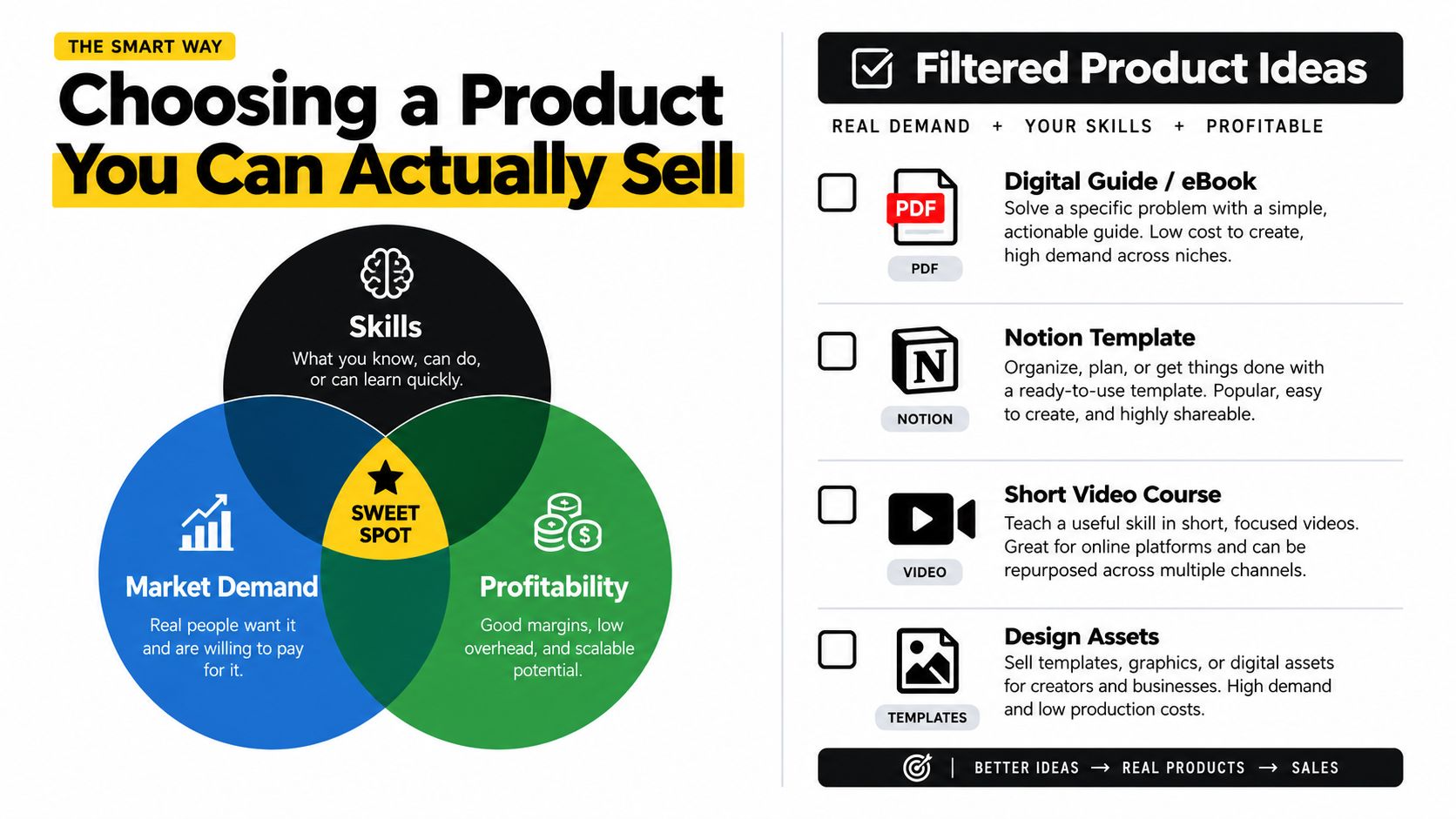
Start with overlap, not inspiration. You want one offer where your skills, real market demand, and a digital format all intersect. If one of those circles is missing, you don't have a product idea, you have a hobby with a sales page attached. The fastest path is to mine the stuff you've already made, then turn the repeated requests into an offer.
Audit what people already asked you for
Look at old client work, saved templates, recurring DMs, email replies, and the content that keeps getting the most questions. That's where product ideas hide. A designer who keeps getting asked for brand boards already has a template product. A coach whose workshop replay keeps getting shared already has a mini-course. A marketer whose audience asks for prompts and swipe files already has a library waiting to be packaged.
Use a hard filter. Ask four questions before you build anything.
- Will someone pay for this, or are they just curious? Interest doesn't pay invoices.
- Can this format support a real price ceiling? A one-page checklist is not a premium offer.
- Can you ship the first version fast? If it needs months, it's too big.
- What's the moat against free alternatives? Your angle, taste, speed, and curation need to matter.
That's the difference between a product and a recycled idea. A Figma kit for a niche audience works because it saves time in a specific workflow. A workshop replay sells because it preserves access to a live transformation. A prompt library works because the buyer wants fast output without thinking through the structure.
If you're stuck, don't brainstorm from zero. Pull from the work you've already done. The most reliable products are usually the least glamorous ones because they solve a boring, repeatable pain. Free alternatives exist for almost everything now, so the only products that survive are the ones with clear use, clear audience, and clear implementation.
A useful shortcut is to pick the idea you can validate fastest, not the one that feels most exciting. Excitement fades. Sales data doesn't.
See how taap.bio frames product selection for creators
Validating Demand Before You Build
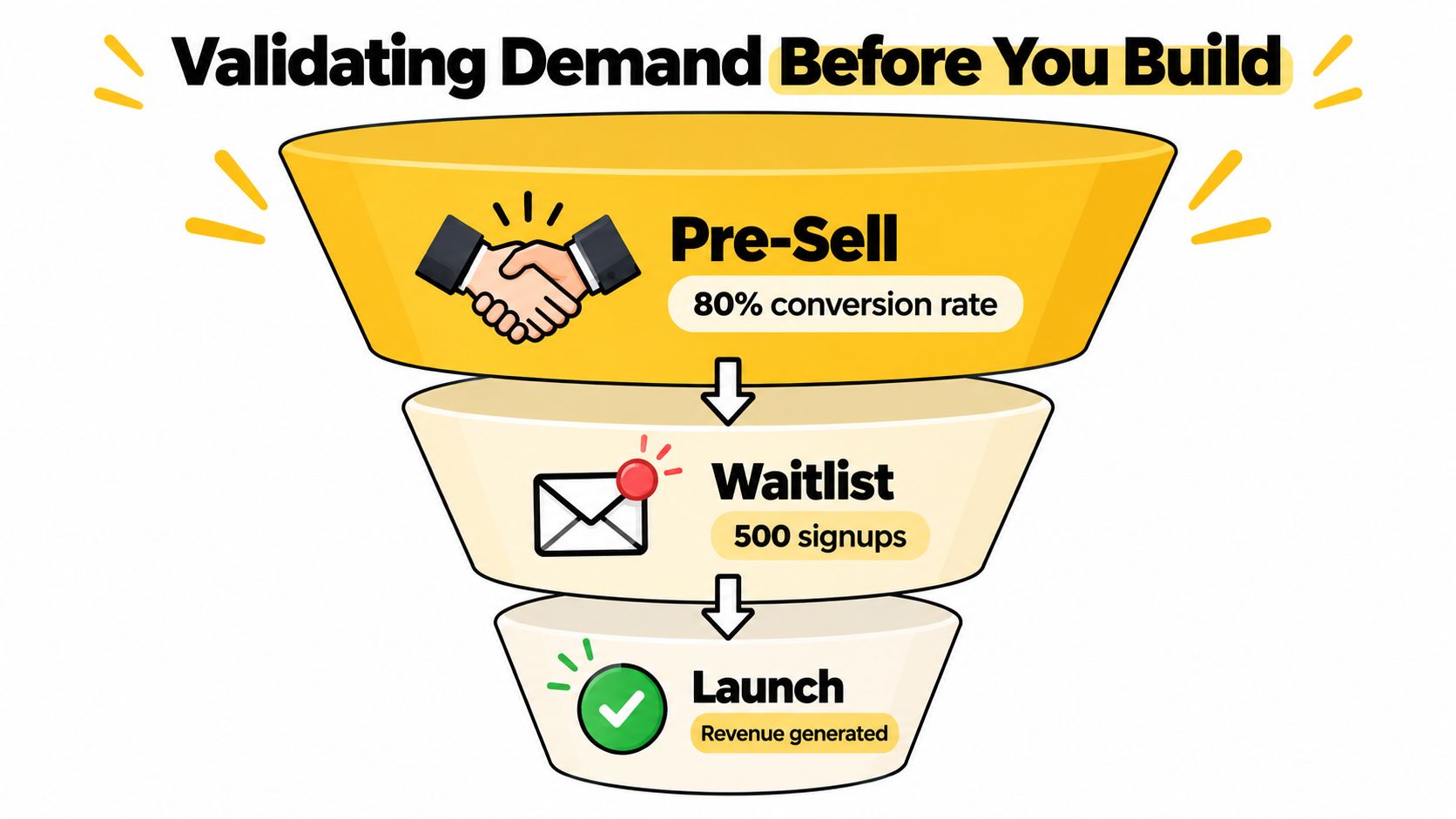
Pre-sell or pre-test. Never pre-build. That rule saves creators months of wasted work because the market tells you whether the idea is worth your time before you've recorded a lesson or designed a cover. If people won't click, sign up, or put money down, the offer isn't ready.
Use a validation ladder, not a gut feeling
Start with free signals. Read comments, DMs, replies, and repeated questions. If the same pain shows up more than once, you've got a candidate. Then put up a simple waitlist page and see whether people will raise their hand with an email address. After that, show a presale page with a clear promise and a refund guarantee. If you're confident, run a small paid beta.
A good validation path looks like this:
- Mine demand signals from your existing audience.
- Collect emails on a waitlist page.
- Show the offer visually with a mockup or simple sales page.
- Ask for payment before full production.
- Ship a beta to a small group and refine from there.
If the audience won't commit at the presale stage, the product isn't ready for full buildout.
The point of the presale is not perfection, it's proof. A product that gets attention but no payments is usually too vague, too broad, or too disconnected from a real buying trigger. A product that gets payment with minimal explanation has a real angle.
A single-page storefront helps here. If your page can capture email, present the offer, and take payment in one flow, you move from idea to revenue much faster than if you route people through separate forms and checkout tools. That speed matters because validation should feel like a quick test, not a launch campaign.
The cleanest signal is money. When people move from interest to payment, you have a business signal, not just a content signal.
Producing and Packaging Your First Offer
Build the smallest version that can still solve the problem. For most creators, that means one of four formats, an ebook, a template pack, a mini-course, or a paid booking. Anything else is usually just scope creep wearing a strategy hat.
Match the format to the promise
A 25 to 50 page PDF ebook works when the buyer wants clarity and a guided path. A Notion or Figma template pack works when the buyer wants a done-for-you structure. A 5 to 8 module mini-course works when the buyer needs demonstration plus explanation. A paid 30-minute booking works when the buyer wants direct input, diagnosis, or setup help.
Your production sequence should be boring and fast. Outline first, build second, beta test with a handful of people, polish what breaks, then export the deliverable as a clean ZIP plus a short usage guide. Don't overdesign the first version. Buyers usually care more about whether the thing works than whether the cover looks cinematic.
A packaging mistake kills conversions faster than weak content does. Raw files feel unfinished. A strong cover, clear file naming, and a simple contents page make the product feel legitimate. The offer is the product, but the packaging is the proof.
- Ebook: make the promise obvious on page one, then keep the structure tight.
- Template pack: label every asset clearly so buyers don't waste time guessing.
- Mini-course: record the smallest set of lessons that leads to one outcome.
- Paid booking: define the deliverable, prep rules, and post-call follow-up in advance.
If you already sell services, a booking is still a digital product when it's sold and delivered through a digital flow. You're productizing your time, not pretending time doesn't matter. That's a better business than endless custom quotes.
Operational rule: ship version one in 14 days or you're overbuilding.
Read the delivery setup details for digital offers on taap.bio
Pricing Your Product for Profit, Not Vanity
Most creators undercharge because they want approval, not margin. That's a mistake. If your price doesn't leave room for payment costs, refunds, and reinvestment, the product may sell and still fail as a business. Price should support the system, not flatter your ego.
Build a ladder, not a single number
The most practical structure is one-time purchase, bundle, and recurring access. A low-price entry product gets the first buyer. A mid-tier offer creates better unit economics. A premium tier captures the people who want access, feedback, or implementation help.
A pricing sample helps. A creator might sell a $27 template pack, a $97 course, and a $247 annual membership. Those three tiers serve different buyers, and each one qualifies intent differently. The cheap product proves demand. The middle product funds growth. The recurring product rewards retention.
The numbers from pricing samples matter because they show how low the floor can be and how much room there is above it. A sample of 2,201 digital products shows a median price of $8.90 and a mean of $29.94, with 25.1% priced between $5 and $10 (digital product pricing sample). That's useful, but it doesn't mean you should race to the bottom. It means you need a ladder.
| Product Format | Low Price | Mid Price | Premium Price | Margin Target |
|---|---|---|---|---|
| Templates and assets | Entry priced | Mid bundle | Niche bundle plus support | High enough to fund acquisition |
| Ebooks and guides | Low friction | Strong standalone | Guide plus bonus calls | Room for upsells |
| Mini-courses | Entry workshop | Core course | Course plus community | Enough to support delivery |
| Paid bookings | Intro call | Deep dive | Package or cohort | Covers your time and follow-up |
The two mistakes that kill revenue are easy to spot. First, creators undercharge and then can't afford traffic or support. Second, they raise the price without adding a new deliverable, which creates resistance without improving value. Buyers notice that instantly.
Review pricing structure ideas for digital offers on taap.bio
Setting Up a Storefront That Converts
A storefront should make buying feel obvious. If someone has to jump from your link page to a scheduler, then to a checkout, then to a delivery email, you've already lost too many people. The fix is consolidation. Put the action on one page and let the page do the work.
Collapse the path to purchase
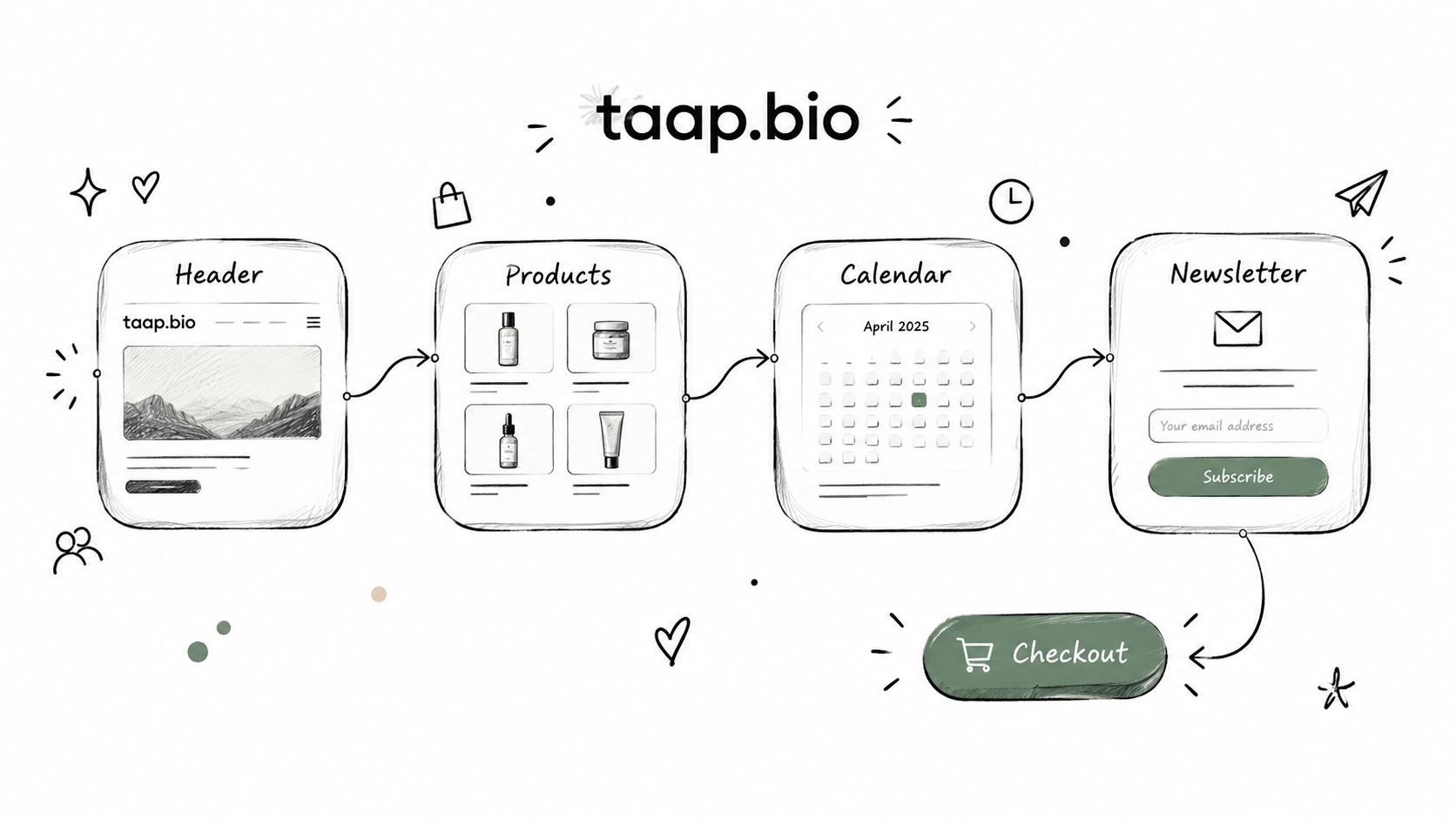
taap.bio is one option for creators who want a link-in-bio page that also handles product sales, paid bookings, and email capture in one place. The practical setup is simple, a header with your avatar and bio, a clear hero line, a product block, a booking block if you sell services, and an email capture block above the fold. That replaces the usual stack of Linktree, checkout tools, scheduling tools, and email software with one editable page.
The conversion mechanics matter more than the visual polish. Checkout prefill reduces friction. Wallet support helps mobile buyers move faster. Abandoned-cart triggers recover people who bailed mid-step. Widget-level analytics tell you which block generates revenue instead of guessing from overall page traffic.
A single-page storefront also makes prioritization easier. Put the highest-revenue block where the user's thumb lands first, then stack the lower-intent actions below it. If email capture is your long game, it still belongs near the top because it keeps non-buyers in the system. If paid bookings drive the highest immediate value, they deserve visibility without forcing the visitor through a separate scheduler.
The difference between the old stack and the consolidated stack is obvious in the customer journey. The old version makes the buyer think. The new version makes the buyer choose. That's why simplification usually improves conversion, because every removed redirect removes friction.
A storefront should feel like one conversation, not five handoffs.
For perspective on platform choice, choosing a monetization platform is worth reading before you commit to a fragmented setup. The decision isn't just about fees, it's about how many steps your buyer has to survive.
Launching, Marketing, and Filling the Funnel
A launch succeeds when every piece points to one offer and one next step. Choose a clear CTA, warm the audience before asking for the sale, and send traffic to a focused storefront. Publishing across every platform without capturing interest only builds someone else's audience.
Run a short warm-up, then push one page
Use a three-day pre-launch sequence. Tease the offer to your email list, show the build process on social, and open a waitlist with a founder discount. On launch day, direct every channel to the storefront page instead of forcing prospects through a long sales letter.
Keep the post-launch path simple. Present a low-cost tripwire to cold visitors, follow with the core offer, then show a higher-value bundle to buyers who already trust you. A tight funnel and a clear offer matter more than inflated reach. Track landing-page conversion, opt-ins, and tripwire purchases so you can fix the weakest step instead of guessing.
Capture email addresses throughout the journey. Separate buyers from non-buyers in your follow-up. Buyers need reinforcement, product guidance, and relevant expansions. Non-buyers need stronger proof, a clearer explanation, or another reason to return.
Instagram rewards a reliable path from content to checkout, not a polished feed with no commercial route. Use AI strategy for Instagram sales to connect posts with clicks and owned attention. One consistently managed channel beats nine neglected profiles.
Build that path with a single-page commerce stack for product sales, bookings, and email capture. taap.bio puts those actions on one page, reducing the handoffs between a Linktree-style profile, scheduler, checkout, and email form. That structure keeps the buyer moving and gives you one place to improve.
If you are serious about how to make money selling digital products, stop stitching together separate tools and move the action into one storefront. Visit taap.bio and create a page that turns attention into sales.