You've got a folder full of half-finished ideas, a social audience that asks for “the template” or “the guide,” and no clear path from interest to payment. You know a digital product could create income beyond one-to-one work, but the practical questions get in the way: what should you build, how much should you charge, and which tools can deliver the product without consuming your margin?
The answer isn't to publish a massive course and hope people find it. The creators who build durable product businesses usually start with a narrow problem, validate it before investing heavily, package the solution in a format buyers can use immediately, and connect checkout, delivery, audience growth, and measurement into one manageable operating system.
Table of contents
Why Digital Products Are the Creator Economy's Sweet Spot
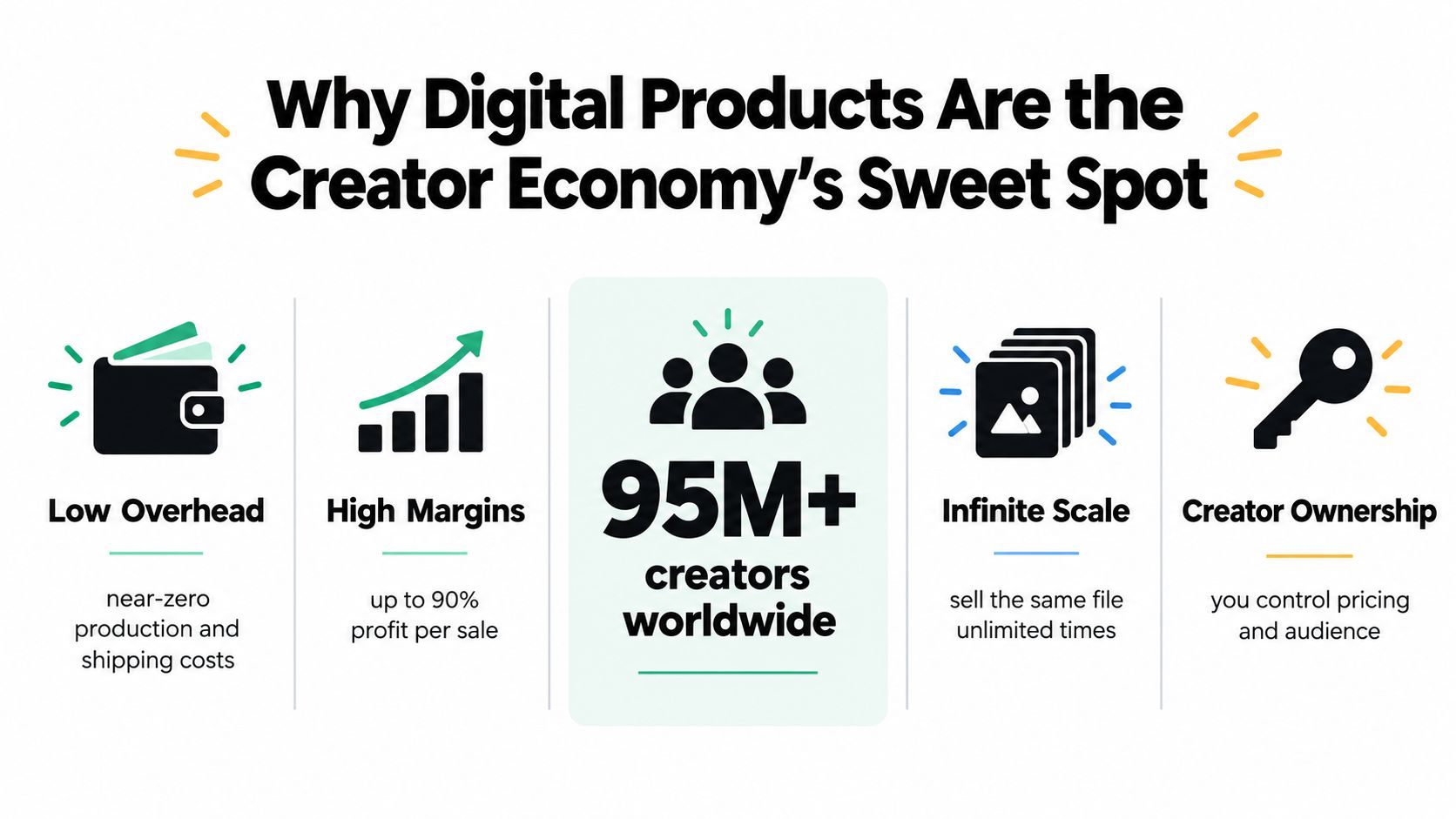
The financial case for digital products is straightforward. One industry roundup reports that 67% of successfully monetizing creators sell digital products, including courses, ebooks, templates, and guides. The same analysis puts typical digital-product profit margins at 70%–90%, compared with 10%–30% for merchandise. Those figures don't guarantee earnings, but they explain why a focused downloadable product can support a creator more effectively than inventory-heavy goods. (Behind the Scenes creator economy statistics)
Digital products also benefit from repeatable delivery. You create a template, workbook, audio file, or lesson once, then deliver it to new buyers without manufacturing, storage, or shipping for every order. The work doesn't disappear after launch, because marketing, support, updates, and refunds still require attention, but the cost structure gives a solo operator more room to experiment.
The demand is already familiar
The market isn't waiting for customers to learn how digital buying works. A 2026 market summary reports that the digital goods market was valued at $124.32 billion in 2025, projected to reach $157.39 billion in 2026 and $511.43 billion by 2031. That forecast carries a 26.6% compound annual growth rate, while the same source says 68% of internet users pay for digital content monthly and digital product transactions rose 70% between 2022 and 2024. (Digital product trends and statistics)
E-learning adds another large demand pool. The industry roundup projects the e-learning services market will expand from $299.7 billion in 2024 to $842.6 billion by 2030, implying a 31% compound annual growth rate. These projections are not a reason to build something broad. They're a reason to take a specific audience problem seriously.
Practical rule: The opportunity is not “sell anything online.” It's “remove one expensive, annoying, or time-consuming obstacle for a defined buyer.”
Creators often stall because they confuse product quality with product size. They write a hundred-page guide when buyers need a clear checklist, or record a sprawling course when a short implementation system would produce a faster result. Start with the smallest useful asset that proves someone will pay, then expand only when customer questions reveal a clear next product.
Validating Your Product Idea Before You Build It
Validation starts with a workflow, not a format. Don't begin with “I want to make an ebook.” Begin with “Which buyer is losing time, confidence, or money because a particular task is difficult?” A wedding photographer might need a client onboarding system. A wellness coach's audience might need a customizable habit planner. A consultant's prospects might need a repeatable audit framework.
Recent trend coverage points toward editable Canva templates, AI-assisted planners, and prompt packs, while static printables are losing share to more interactive formats. The useful implication is operational: buyers value products that reduce setup time and let them customize the result immediately. (Etsy digital product trend coverage)
Use a small validation scorecard
Score your idea against four questions before you design anything:
- Visible pain: Do people describe this problem in comments, direct messages, support requests, or community discussions?
- Existing spending: Are buyers already paying for an imperfect alternative, even if competitors serve the need poorly?
- Specific differentiation: Can you win through a narrower audience, a more usable format, better examples, or a stronger support layer?
- Purchase intent: Will real people join a waitlist, book a conversation, or place a pre-order at the proposed price?
A positive survey answer is weak evidence. A person who gives permission to email them is stronger. A paid pre-order is stronger still, because it tests the problem, the offer, and the price together.
For audience research, build a buyer profile around context rather than demographics alone. Document what the buyer is trying to complete, what tools they currently use, what causes them to abandon the task, and what a successful outcome looks like. This buyer persona development guide can help you turn vague audience descriptions into a usable profile.
Test before you commit
You can test demand with a simple landing page describing the product, its outcome, its format, and its price. If you don't want to build the full product page first, a fake door A/B test example shows how to measure interest in an offer before the underlying experience is complete. Be transparent with visitors and offer a clear next step when the product isn't available yet.
Red flags include enthusiastic comments with no willingness to join a list, a product that needs extensive education before buyers understand it, and a broad audience with no shared workflow. Pivot early. A smaller product for a recognizable buyer is easier to explain, produce, support, and improve.
Producing Digital Products That Buyers Actually Want
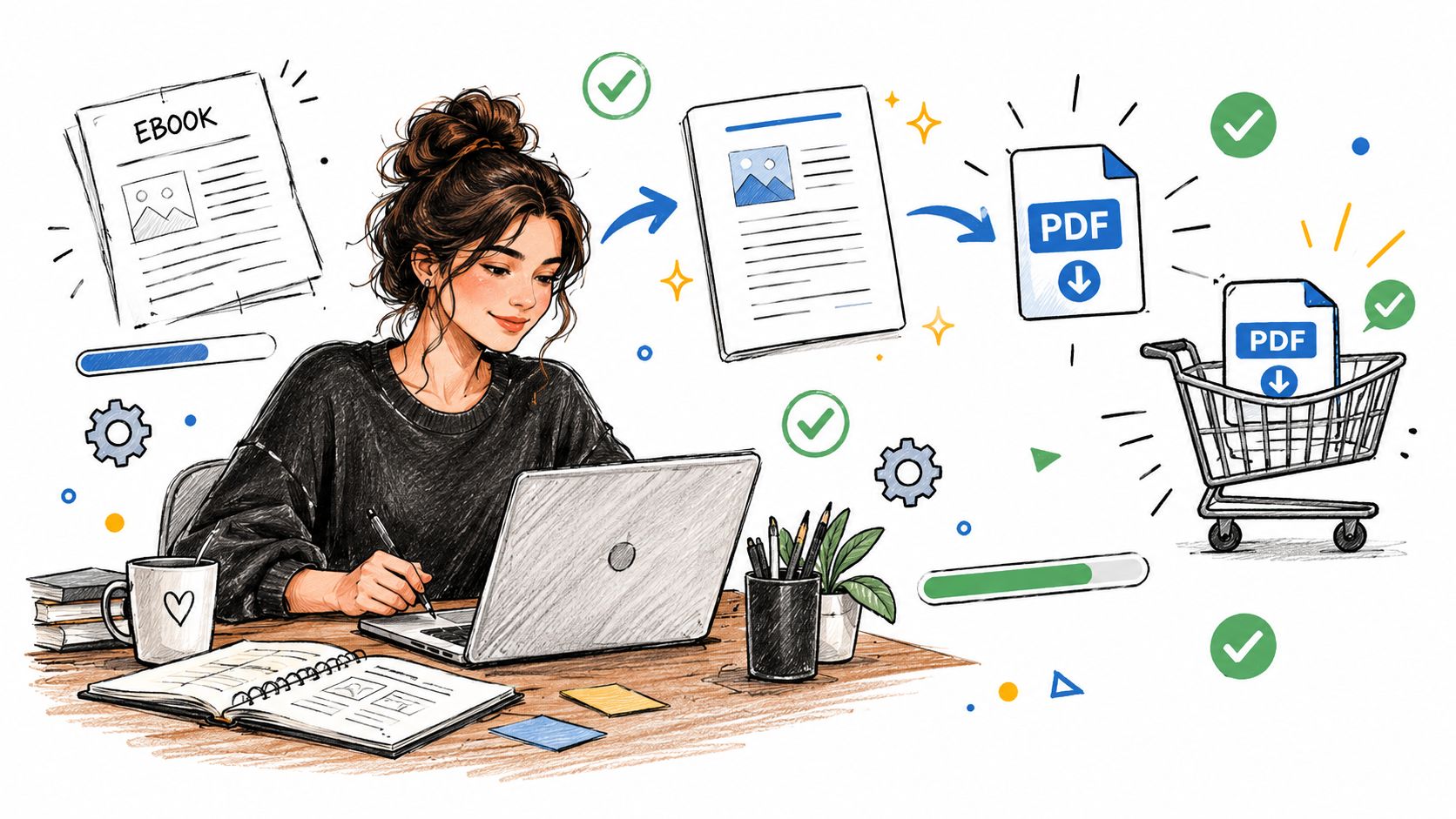
The first production decision is the delivery format. A PDF may be appropriate for a short reference guide, but it becomes frustrating when buyers need to customize layouts, copy information into another tool, or update the content regularly. Current buyer expectations favor products that are editable, AI-compatible, and fast to use, so format should eliminate work rather than add it.
Choose the smallest format that delivers the outcome
A productivity creator might sell a Notion workspace with a short setup video instead of a long productivity ebook. A wellness coach could create an editable meditation planner with prompts, weekly tracking, and a short audio library. A consultant could package a client onboarding template pack with email scripts, an intake form, and a handoff checklist.
The format should match the buyer's next action:
- Templates work when the customer needs a starting point they can adapt.
- Prompt libraries work when the customer repeatedly performs a task with an AI tool.
- Workbooks work when the customer needs guided decisions or exercises.
- Video lessons work when demonstration or sequencing matters.
- Audio files work when the customer consumes the product while moving, resting, or practicing.
Use the tools you already understand. Canva, Notion, Google Sheets, Figma, and a basic screen recorder can produce a credible first version without forcing you to learn an entirely new software stack. Early buyers care more about clarity, usability, and a visible result than elaborate production.
Build around one transformation
A strong product takes a buyer from a defined starting point to a defined outcome. It doesn't attempt to document everything you know. Write the product promise as a before-and-after statement, then remove every component that doesn't support that change.
Before delivery, run the product through a real-user test. Ask someone from the target audience to complete the setup without your help. Watch where they hesitate, which instructions they ignore, and what they expect to happen next. Improve the product based on observed friction, not your preference for additional features.
For a wider set of product formats and practical ideas, review this guide to digital products to sell. The important choice isn't the trendiest category. It's the format that lets your buyer reach the promised result with the fewest unnecessary steps.
Pricing and Packaging Strategies That Convert
Pricing is a unit-economics decision before it's a confidence decision. A low-priced download can attract impulse purchases, but every sale still carries payment processing, customer support, refunds, delivery, and acquisition costs. If the product requires a personal sales conversation, a low price creates a difficult business model. If it delivers instantly and needs little support, the same price may work as an entry offer.
The central packaging choice is whether you sell access once, continuously, or through a combination.
Digital product packaging models compared
| Model | Best For | Conversion Rate | Lifetime Value | Complexity |
|---|---|---|---|---|
| One-time download | Templates, guides, workbooks, prompt packs | Usually easiest to explain | Limited unless paired with follow-up offers | Low |
| Recurring subscription | Resource libraries, memberships, ongoing content | Requires a clear recurring reason to join | Potentially higher through continued value | Medium to high |
| Hybrid offer | Toolkit plus updates, community, bookings, or support | Balances immediate value with ongoing access | Stronger when retention is managed well | Medium |
Recent market coverage points to stronger momentum in recurring and hybrid revenue models, including subscriptions, memberships, and services bundled with digital products. It also emphasizes that narrow products can outperform broad catalogs when they solve a specific need. (Digital product trends and revenue models)
Match the offer to the support burden
A one-time download is sensible when the product is self-explanatory and the buyer can use it without ongoing assistance. Add an upsell such as a customization session, implementation review, or expanded template library only when it creates a meaningful next step.
A subscription needs a reason to renew. Monthly access to the same static file rarely provides one. Updates, new workflows, office hours, fresh examples, or a maintained resource library can justify continued payment, but they also create an operational obligation.
Hybrid packaging often works well for experts who want to sell a practical asset and preserve access to higher-value help. For example, a consultant might sell an onboarding toolkit with optional paid implementation sessions. Creators exploring audience-based income can also compare these structures with proven revenue models for TikTok, especially when social content is the discovery channel.
Use a premium tier as an anchor only when it contains real additional value. A higher-priced version might include implementation feedback, commercial licensing, or live access. Avoid fake scarcity. A genuinely time-limited bonus is clear; pretending that a permanent product is about to disappear damages trust.
For a more detailed framework, use this guide to digital product pricing strategy. Then calculate how many sales you need to cover production, support, promotion, and platform costs before you publish the price.
Building a Conversion-Optimized Store with taap.bio
A product page should let a visitor understand the offer, trust the seller, pay, and receive the product without a maze of redirects. A link-list page often forces people to leave the profile, open another page, locate checkout, and return to find the next action. Consolidating the journey keeps the product, proof, signup option, and booking path in one place.
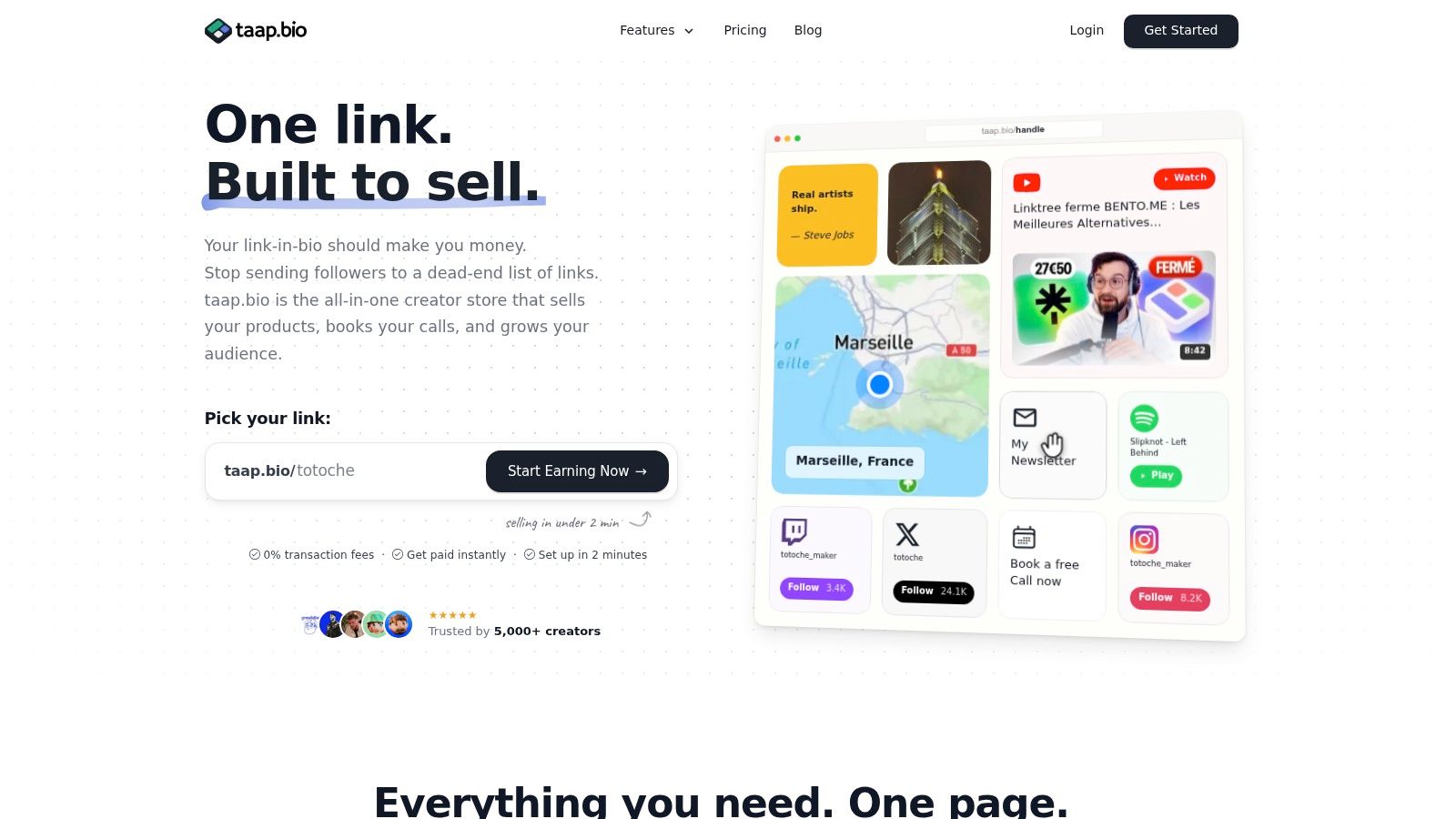
A bento-style page lets you arrange product blocks, media, email capture, and calls to action according to the buying journey. Put the core offer where a visitor can see it quickly, then use supporting widgets for a preview video, product images, testimonials, or an explanation of who the product is for.
Set up the buying path
Start with a clear product block. Name the result, identify the buyer, list what arrives after payment, and state any software requirements or usage limitations. Avoid vague promises such as “transform your workflow.” Say what the customer will be able to create, organize, or complete.
Built-in checkout can deliver the digital file immediately after payment. That matters because a delayed or confusing delivery experience creates support requests before the customer has used the product. For a service layer, paid bookings can use an on-page calendar, upfront payment, and automatically sent invitations.
After the product block, add an email signup for visitors who aren't ready to purchase. An exportable contact list gives you a portable audience rather than leaving every future interaction dependent on a social platform's reach. Segment subscribers according to the product they viewed or the problem they described, then send useful follow-up content instead of generic promotions.
Measure each action
Analytics should answer practical questions. Which widget receives attention? Where do visitors stop? Which product page produces purchases or signups? Real-time analytics per widget and live visitor counts can help you diagnose the page without adding multiple third-party scripts.
The platform combines storefront, scheduling, email capture, and analytics in a drag-and-drop page. Its published pricing states 0% platform fees on sales and $19 per month after a 14-day trial, with GDPR-friendly hosting in France. (Digital product store features)
Use the page to make the next action obvious, not to display every project you've ever made. A focused storefront with one primary offer usually gives visitors a clearer decision than a crowded catalog.
Launching, Promoting, and Optimizing Your Sales
A finished file isn't a launch. A launch connects the offer to people who have the problem, gives them enough evidence to trust the solution, and creates a feedback loop for improving the next version.
Start with owned channels. Email subscribers, existing clients, community members, and social followers already understand your expertise, so they usually need less education than cold traffic. Introduce the problem before the product, show the workflow it improves, demonstrate one useful part, and make the purchase path direct.
Organic discovery can follow. Build a landing page around the buyer's language, answer the questions that stop purchase decisions, and create useful content that links to the offer. Partnerships can work well when the partner serves the same audience without selling the same product. A photographer and a wedding planner, for example, may share an audience while offering different solutions.
Use a simple measurement loop
Track three signals consistently:
- Page conversion rate: If visitors understand the offer but don't buy, test the promise, price presentation, proof, preview, and checkout clarity.
- Email capture rate: If people read but don't subscribe, simplify the lead magnet and make its connection to the paid product more obvious.
- Refund rate: If refunds increase, inspect the sales copy, product preview, onboarding instructions, and the gap between expectation and delivery.
Don't change everything after one quiet day. Choose one variable, define what evidence would justify keeping the change, and review results after enough relevant traffic has passed through the page. Qualitative feedback matters too. Customer questions often reveal missing instructions, a better product name, or an opportunity for a higher-value bundle.
Personalization and privacy deserve attention as your list grows. Use consent-based email capture, store only the information you need, and segment messages by buyer problem or product interest. Trend coverage increasingly connects recurring revenue with personalization and privacy-first data practices, so a respectful data process supports both trust and retention. (Digital product business trends)
A practical 30-day launch rhythm
Days one through seven: Finish the minimum sellable version, write the delivery instructions, test checkout, and ask a small group of relevant users to complete the product without help.
Days eight through fourteen: Publish the sales page, prepare an email sequence, create demonstration content, and announce a clear launch window. Use customer language from validation conversations in the headline and product description.
Days fifteen through twenty-one: Launch to your owned audience, answer objections publicly, record every support question, and invite buyers to share specific feedback. If sales copy needs stronger examples, add them while the offer is active.
Days twenty-two through thirty: Review sales, signups, refunds, and questions. Improve the product and page before creating another product. The next release should come from an observed gap, not from the urge to add more inventory.
Your promotional copy doesn't need to sound aggressive. It needs to make the problem, outcome, format, and next step clear. For additional ideas on using prompts to improve sales messaging, see Writingmate's sales prompt tips.
Protect the business with accurate product descriptions, clear licensing terms, a refund policy suited to digital delivery, and consent-based marketing. If you sell to customers in the European Union, review your GDPR responsibilities and make sure your checkout and access process handles digital-content consent appropriately. Legal requirements vary by location and product type, so get qualified advice when the offer involves health, finance, legal documents, or commercial licensing.
Document your launch process as you go. Save the page copy, email sequence, objections, support answers, and post-launch findings. That record turns a one-off release into a repeatable system, where each product improves your research, packaging, delivery, and promotion.
For a complete launch workflow, use this digital product launch guide as a planning reference. The immediate goal isn't to build a huge catalog. It's to create one useful product, sell it to the right people, learn where the experience breaks, and make the next version easier to buy and easier to use.
taap.bio brings your digital storefront, checkout, file delivery, email capture, paid bookings, and analytics into one page, which can simplify the operating system behind a small product business. Visit taap.bio to explore the platform and build a focused path from audience attention to digital product purchase.