taap.bio is the strongest Stan Store alternative for creators who want products, paid bookings, email capture, analytics, and 0% platform fees on one page. Choose Beacons, Linktree, Gumroad, Payhip, Ko-fi, Sellfy, Podia, Teachable, or Topmate instead when your business is centered on courses, memberships, donations, merchandise, or session-led sales.
The popular advice is to pick the platform with the longest feature list or the most recognizable name. That approach misses the decision that affects your business most: what revenue action should happen after someone clicks your social profile?
A creator selling a template needs a fast checkout and instant delivery. A coach needs paid scheduling and calendar invitations. A course business needs structured content delivery. A musician or artist may need tips, memberships, commissions, or merchandise. Those are different operating models, even when every seller uses a link in bio.
This comparison evaluates each Stan Store alternative by the stack it can replace, the workflow it supports, the effect of platform fees alongside payment processing fees, privacy and security considerations, and the point where its limitations become expensive or operationally inconvenient. The goal isn't to reward feature volume. It's to match the tool to the offer you need to sell next.
That distinction matters in a creator economy where independent 2026 estimates place the market between roughly $205 billion and $323 billion, depending on scope, while another projection estimates $310.37 billion in 2026 and $1.35 trillion by 2033 at a 23.3% CAGR. The same source set describes more than 200 million content creators worldwide and around 50 million working professionally or semi-professionally, but creator income remains uneven, with about 48.7% earning under $10,000 annually and a median near $3,000. (Gigapay's 2026 creator economy report)
That combination creates a clear need for low-friction monetization. A good Stan Store alternative should help you convert attention into owned revenue without forcing you to assemble separate storefront, booking, email, and analytics tools.
Table of contents
1. taap.bio
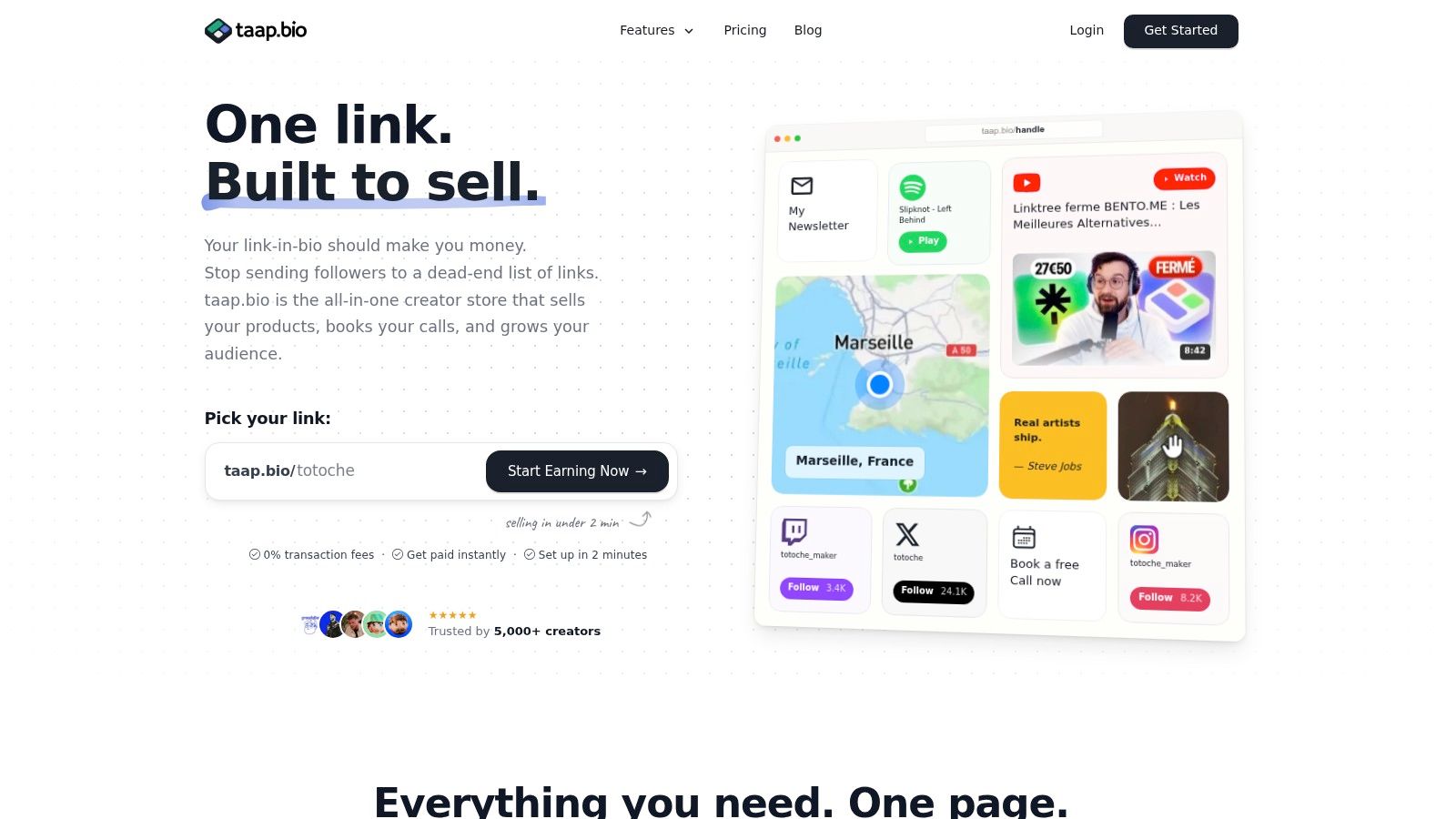
taap.bio is the best overall Stan Store alternative for creators who want a revenue-first, single-page operating system. Its drag-and-drop bento page combines a storefront, paid bookings, email capture, rich media, and analytics, so the visitor can watch, listen, subscribe, book, or buy without being sent through a chain of disconnected services.
The platform supports built-in checkout with instant digital delivery, paid bookings with upfront payment and calendar invitations, one-tap email signup with CSV export, and real-time analytics for individual widgets. Its page builder also includes 10+ smart widgets, including YouTube, Spotify, maps, video, images, and product blocks. For a creator whose social traffic already lands on one profile link, that keeps the path from click to transaction short.
Practical rule: Choose taap.bio when your next offer needs to sell, schedule, and capture an email address from the same page.
The stack it replaces
taap.bio can consolidate the roles commonly handled by Linktree, Gumroad, Mailchimp, Calendly, Squarespace, and Plausible. That doesn't mean it replaces a full multi-page e-commerce site or a large catalog system. It does mean a solo creator can avoid maintaining separate tools for a digital download, a paid consultation, a signup form, and page-level analytics.
The fee structure is a major reason to consider it. taap.bio charges 0% platform fees on every sale, while payment processor and card fees still apply. Instant payouts go to connected accounts, which can simplify cash-flow management. The listed starting price is $19 per month after a 14-day free trial, and regional pricing may differ, so check the live pricing page before subscribing. (taap.bio)
Privacy, security, and limitations
taap.bio is hosted in France with GDPR-by-default positioning. The platform states that it is ISO 27001 certified and aligned with SecNumCloud foundations. Its analytics work without third-party tracking scripts, and the page uses zero cookies by default, which can reduce privacy configuration work and avoid default cookie-banner complexity.
Setup is designed to be fast, with pages promoted as going live in around 2 minutes. The trade-off is structural: the bento page is excellent for a focused creator hub, but it isn't Shopify-level infrastructure for a complex catalog, advanced inventory, or a customized multi-page store. Payment processing fees still apply, and regional payout availability should be verified for your country.
2. Beacons
Beacons is the strongest alternative for creators who want a familiar bio profile with a broader mix of digital products, courses, memberships, bookings, email, and media-kit functions. It works well when your public page needs to serve both fans and brand partners, rather than acting only as a checkout page.
Its native store supports unlimited digital products, memberships, and courses. You can also offer paid appointments, send emails from the platform, create a media kit, connect a custom domain on paid plans, and review real-time analytics. That makes Beacons a practical fit for a creator who wants to keep a public-facing profile, partnership information, and monetization tools under one login.
Fee impact and workflow
The free plan carries a 9% seller fee, while Creator Plus and higher plans offer a path to 0% seller fees, according to the supplied product details. Payment processor fees remain a separate cost. That distinction matters because a platform fee is charged by Beacons for providing the commerce infrastructure, while Stripe or another processor charges for handling the payment itself.
Beacons becomes more attractive when you need course and membership support without immediately adopting a dedicated learning platform. It also suits creators who want a basic built-in email tool, though advanced automations and AI features are gated to higher tiers.
For a closer comparison of its page and commerce model, see this Beacons link-in-bio comparison.
Where it becomes costly
Beacons is less compelling when your priority is a simple, low-fee product-and-booking flow. The free-tier fee can take a meaningful share of low-priced sales, and upgrading to remove it adds a recurring subscription cost. The platform's breadth is useful, but creators who primarily need fast checkout, direct email export, privacy-focused analytics, and paid bookings may find taap.bio's tighter revenue workflow more efficient.
Start with Beacons if your business model combines a creator profile, media kit, courses, memberships, and appointments. Don't choose it just because it has many blocks. Choose it when those blocks support the way you earn.
3. Linktree
Linktree remains the best choice for creators who mainly need a trusted, fast-to-launch link hub and want to add light monetization. Its advantage is familiarity. Many audiences understand the Linktree format immediately, so the implementation effort is low when you're replacing a basic bio page rather than rebuilding a full revenue system.
The platform now supports digital product sales and payments through Stripe, along with the Linktree Shops affiliate program. Paid plans can connect with tools such as Mailchimp, Klaviyo, and Google Sheets, and paid tiers provide more detailed analytics. That makes Linktree a sensible option for creators whose primary workflow is directing visitors to multiple destinations, with occasional product sales layered on top.
The operational trade-off
Linktree is still a traffic-routing hub, not a complete creator operating stack. Native payments and digital downloads can cover straightforward offers, but advanced commerce and customer relationship management often require external tools. Each additional service creates another account, another data boundary, another workflow to maintain, and another place where a buyer can drop off.
The fee question needs careful attention. Linktree may apply its own transaction fee in addition to Stripe's payment processing fee. These are separate charges. Stripe processes the payment, while Linktree's platform fee pays for the commerce feature. Review the current plan and transaction terms before moving an established product catalog.
A familiar page isn't automatically the best conversion system. If the visitor must leave the page for the product, booking, and email steps, the operational cost shows up in more than the invoice.
Linktree is the right Stan Store alternative when your audience expects a conventional bio hub and your offers are simple. It becomes limiting when you want native courses, memberships, paid scheduling, and owned-audience capture in one on-page flow. For a direct comparison with another creator profile platform, read this Linktree versus Beacons guide, then visit Linktree to assess its current commerce plans.
4. Gumroad
Gumroad is the fastest fit for creators who want to sell digital downloads, memberships, licenses, and subscriptions without paying a monthly subscription. It gives each product a hosted page and supports embeddable checkout, so you can share a product link from a bio page, newsletter, website, or social post.
Its merchant-of-record model can simplify tax handling where applicable. That matters for independent sellers who don't want to build their own global tax workflow before validating a product. Gumroad also offers analytics, licensing, and an optional discovery marketplace, giving new sellers another route to reach buyers.
Why the fee model matters
Gumroad charges a platform fee for direct sales of 10% plus $0.50, and discovery marketplace sales carry a 30% flat fee, based on the supplied product details. Payment processing is a separate consideration, so your net proceeds depend on both Gumroad's platform charge and the applicable processor costs. The absence of a monthly subscription lowers upfront commitment, but percentage fees become more significant as sales volume and order value grow.
That structure suits a creator testing a new download or selling irregularly. It becomes less attractive when you have repeatable sales and want to preserve margin on every order. Site customization is also limited compared with a dedicated storefront or a bento-style creator page.
Privacy and ownership considerations
A merchant-of-record platform takes on parts of the transaction and tax relationship, which can reduce administrative work. The trade-off is less control than a setup where you own the payment processor relationship and build your own customer-data workflow. Export and portability should be part of your review before making Gumroad the only home for your audience.
Read this practical guide on whether Gumroad is safe before committing sensitive business operations to the platform. Choose Gumroad when speed, hosted delivery, and no monthly subscription matter more than storefront control and long-term fee efficiency.
5. Payhip
Payhip is a flexible hosted storefront for creators selling downloads, courses, memberships, coaching, and other digital offers. It sits between a simple product-link tool and a more structured online business platform. The dashboard lets you manage several offer types, while hosted pages, embeddable buy buttons, and checkout links give you multiple ways to reach buyers.
Its product mix makes Payhip a strong choice for creators whose catalog is growing beyond a single PDF or template. Coupons and affiliate support can help with promotion, and the platform supports Stripe and PayPal. Tax calculations are also part of the selling workflow, which reduces some setup burden for independent digital sellers.
Trading subscription cost for lower fees
Payhip's key decision is whether you want to pay a monthly plan to reduce per-sale platform fees. That gives you a clearer scaling path than a platform that permanently takes a large percentage of every transaction. However, Stripe or PayPal processing fees still apply on all plans, so a 0% or reduced platform fee does not mean payment processing is free.
The distinction is easy to miss:
- Platform fee: Payhip's charge for providing the storefront and commerce service.
- Payment processing fee: Stripe or PayPal's charge for authorization and payment handling.
- Subscription cost: The recurring amount you pay to access the selected Payhip tier and its fee structure.
Payhip's storefront-focused design is practical, but it doesn't provide the same single-page bento experience as taap.bio. That becomes costly when your main conversion path depends on combining media, product blocks, bookings, email capture, and per-widget analytics.
Visit Payhip if your priority is flexible digital product management with the ability to exchange a higher monthly commitment for lower platform fees. It isn't the first choice for a creator whose primary need is a social click converting into several on-page actions.
6. Ko-fi
Ko-fi is the best Stan Store alternative for creators whose income begins with tips, donations, memberships, commissions, and small digital items. Artists, streamers, freelancers, and community-supported creators can launch a support page quickly, connect Stripe or PayPal, and give followers several low-friction ways to contribute.
The platform combines one-time tips, monthly memberships, commissions, and a lightweight shop. You can manage membership tiers and perks, sell simple digital products, and review basic analytics. This model feels more like a support page with commerce attached than a structured storefront built around product funnels.
Where Ko-fi fits
Ko-fi works when the audience wants to support the creator directly. A fan can make a small contribution, join a membership, request a commission, or buy a lightweight digital item without navigating a complex catalog. That makes implementation simple for someone who doesn't yet need course delivery, advanced product variants, or extensive email automation.
The platform fee is generally around 5% on payments, in addition to payment processor fees, according to the supplied product details. Processor fees remain separate, so creators should calculate the combined cost rather than treating the platform percentage as the entire transaction expense. A paid plan can change the platform-fee calculation, but the right choice depends on whether the subscription cost is justified by your payment volume and required features.
Ko-fi is a support-first tool. If your main call to action is “buy my course,” “book my consulting session,” or “download my product,” use a platform designed around that transaction.
Its limitations become visible when your business needs a full course experience, complex store structure, advanced analytics, or a portable email audience. Ko-fi's lightweight format is a strength for tips and commissions, but it can force a migration later if your offer mix becomes more operationally demanding. Start with Ko-fi when direct audience support is the business model, not merely an extra payment option.
7. Sellfy
Sellfy is the clearest choice for creators combining digital products, subscriptions, print-on-demand, and merchandise in a branded storefront. It behaves more like a lightweight e-commerce store than a pure link-in-bio page, which gives physical-product sellers a more appropriate operating model than a digital-download-first platform.
The hosted storefront supports a custom domain, digital products, subscriptions, and built-in print-on-demand. Discount codes, upsells, and simple email marketing are included, so creators can promote products without immediately adding a separate marketing system. Sellfy also charges 0% platform transaction fees, leaving payment processor fees as the transaction cost described in the supplied details.
The merchandise advantage
Sellfy's main operational benefit is keeping digital offers and merchandise in one storefront. A musician could pair downloads with apparel. An artist could combine digital files with print-on-demand products. A personal brand could sell a subscription alongside physical items without maintaining entirely separate commerce systems.
The trade-off is predictable monthly commitment. Sellfy doesn't offer a free plan, so you pay for the subscription from the start. That can be sensible when you expect regular sales, but it's inefficient for a creator still validating an offer. Its email marketing is also basic compared with a dedicated email service provider, and its storefront format isn't as focused on the compact, social-first bento flow offered by taap.bio.
For a broader look at tools for digital product sales, read this creator platform guide for selling digital products.
Choose Sellfy when merchandise and predictable 0% platform fees matter more than an integrated booking calendar or widget-level audience analytics. If physical fulfillment isn't part of your business model, its extra storefront structure may add more than you need.
8. Podia
Podia is the best fit for creators building a course, membership, community, or coaching business rather than a simple link-in-bio store. Its dashboard brings products, content delivery, communities, coaching, checkout, and basic email capabilities together, giving educators a more structured environment for serving customers after purchase.
You can sell courses, downloads, memberships, communities, and paid coaching. Coaching workflows can connect to scheduling tools such as YouCanBookMe, while Stripe and PayPal handle payments. Podia also provides product pages and a clear upgrade path to plans without platform transaction fees at higher tiers.
When structured delivery beats a bio page
A course creator needs more than a product button. They need a place to organize lessons, manage access, support members, and present a coherent learning experience. Podia is designed for that post-purchase workflow, so it makes more sense than taap.bio when the product itself is an educational environment or a community.
The drawback is that its entry plan carries a transaction fee, while payment processing remains separate. Advanced automations may also require external integrations. That means you should price the full operating stack, including the Podia subscription, platform fees, processor fees, scheduling connections, and any email tools needed beyond its basic capabilities.
Podia is less suitable for a creator whose traffic arrives from social media and needs to convert immediately on a single page. Its structure is more website and course oriented, which can be a benefit for education businesses but unnecessary overhead for a coach selling a few paid calls and downloads.
Choose Podia when your next offer is a structured program, membership, or community. Choose taap.bio when the immediate priority is a compact revenue page that sells products, books appointments, captures emails, and measures each widget without adding a separate course environment.
9. Teachable
Teachable is the strongest course-first option for creators who need mature course delivery plus coaching, downloads, bundles, and order bumps. It supports structured course creation and delivery, coaching products with Calendly integration, and Teachable Payments with automated tax handling and buy-now-pay-later options.
That makes Teachable a better operational fit when the customer experience depends on lessons, modules, bundles, and post-purchase learning. A course business can keep its educational products and coaching offers under one branded site instead of forcing buyers to move between a bio page and a separate learning platform.
The cost of a course-first system
The starter plan carries a 7.5% transaction fee, according to the supplied product details. That is a platform fee, not the same as payment processing. Payment handling and any applicable processor costs should be evaluated separately, especially when you sell lower-priced products or depend on frequent transactions.
Teachable can also be heavier than necessary if you only sell a few downloads. A creator with a small product catalog may pay for course infrastructure that doesn't improve the primary checkout path. Conversely, a serious educator may consider that infrastructure essential because the platform's value sits in content delivery, student access, bundles, and coaching support.
Use a course platform because your customers need a learning environment, not because your sales page happens to include a course link.
Teachable's privacy and operational review should include payment ownership, tax handling, student-data policies, export options, and any external scheduling connection. Those details affect portability and compliance more than the landing-page design alone. Visit Teachable, and compare the full course workflow with this online course platform guide before choosing.
10. Topmate
Topmate is the best Stan Store alternative for creators whose revenue depends on paid sessions, webinars, cohorts, packages, digital products, and paid direct messages. It treats the creator profile as a menu of monetization formats, making it particularly useful for consultants, mentors, educators, and specialists who sell access to their time and expertise.
The platform supports automated booking for one-to-one sessions, live events and webinars, cohorts, packages, digital products with instant delivery, and paid DMs. It also supports global payments and instant payouts, while its fee messaging says creators can keep 90% of proceeds. That makes the platform's commission model explicit, but you still need to account for payment processor costs and verify how each offer type is charged.
Built around sessions, not just products
Topmate is more flexible than a basic booking page because it can bundle a session with a product, cohort, or event. A career advisor could sell a call and a preparation guide. A business educator could combine a webinar with a cohort. A specialist could charge for direct questions instead of letting unpaid requests consume the calendar.
The trade-off is the commission. The platform commission is typically around 10% on creator-driven sales, based on the supplied product details, and email marketing and automation remain lightweight compared with dedicated tools. That fee may be justified when Topmate replaces separate scheduling, payment, event, product-delivery, and paid-message tools. It becomes expensive when you already have those systems or when your sales volume makes percentage fees materially larger than a fixed subscription.
Topmate is less suitable for creators who need privacy-first analytics, extensive email ownership, or a highly branded storefront. Choose Topmate when your offer is a conversation, session, event, or expert interaction. Choose taap.bio when bookings are one part of a broader single-page store and you want 0% platform fees across sales.
Stan Store Alternatives: Features & Pricing
| Product | Core features ✨ | UX & Quality ★ | Value & Price 💰 | Target audience 👥 |
|---|---|---|---|---|
| taap.bio 🏆 | Bento drag‑drop; built‑in checkout + instant digital delivery; on‑page paid bookings; one‑tap email + CSV; 10+ widgets; realtime per‑widget analytics; GDPR‑by‑default (France); ISO27001 | ★★★★★, fast setup; no 3rd‑party scripts | 💰 $19/mo after 14‑day trial; 0% platform fees; instant payouts (processor fees apply) | 👥 Revenue‑focused creators & small teams who want a single‑page storefront, bookings & email capture |
| Beacons | Native store for unlimited digital products, memberships & courses; paid bookings; built‑in email; real‑time analytics | ★★★★☆, intuitive; some paid tiers gate advanced features | 💰 Free plan (9% fee); Creator Plus / higher → path to 0% seller fees | 👥 Creators selling digital goods, memberships & bookings |
| Linktree | Link hub with native payments (Stripe); Linktree Shops affiliate; integrations on paid plans; analytics | ★★★★☆, familiar, very fast to set up | 💰 Free + Linktree transaction fees + Stripe fees; paid plans add analytics | 👥 Users who want a simple, familiar bio hub with basic commerce |
| Gumroad | Hosted product pages & embeddable checkout; subscriptions & licensing; automated tax handling; optional marketplace | ★★★★☆, very quick launch for products | 💰 No monthly fee; pay‑per‑sale (e.g., ~10% + $0.50) | 👥 Solo creators selling digital downloads and subscriptions fast |
| Payhip | Sell downloads, courses, memberships & coaching; coupons & affiliates; hosted store + embeddable checkout | ★★★★☆, flexible storefront focused UX | 💰 Tiered plans to reduce per‑sale fees; Stripe/PayPal fees apply | 👥 Creators wanting flexible product types with storefront control |
| Ko‑fi | Tips/donations, memberships, commissions & lightweight shop; quick setup | ★★★☆☆, very simple & low friction | 💰 Free option; ~5% platform fee on payments + processor fees | 👥 Creators relying on donations, tips & small sales |
| Sellfy | Hosted storefront with custom domain; digital products, subscriptions & POD; discounts, upsells, basic email | ★★★★☆, predictable, easy branded store | 💰 Monthly subscription; 0% platform fee (only processor fees) | 👥 Creators who want branded stores and built‑in POD |
| Podia | Courses, downloads, memberships/communities, coaching; scheduler integrations; basic email | ★★★★☆, all‑in‑one creator dashboard | 💰 Subscription plans; entry tier has transaction fee; higher tiers reduce fees | 👥 Course creators + community builders and coaches |
| Teachable | Course‑first delivery with bundles, order bumps & coaching support; Teachable Payments | ★★★★☆, mature course features | 💰 Subscription tiers; starter plan carries ~7.5% transaction fee | 👥 Serious course creators and educators |
| Topmate | Paid 1:1 sessions, webinars & cohorts; digital products; paid DMs; instant payouts | ★★★★☆, modular monetization for services | 💰 Platform commission ~10% (public messaging "keep ~90%"); instant payouts | 👥 Creators focusing on paid sessions, bundles & mixed revenue streams |
Choose the Stack That Matches Your Next Offer
The right Stan Store alternative isn't the one with the most features. It's the platform that removes the most friction from your next revenue action while leaving you enough control over payments, customer data, privacy, and future migration.
For most social-first creators selling a combination of digital products and services, taap.bio is the direct recommendation. It combines a bento-style page, built-in checkout, instant digital delivery, paid bookings, calendar invitations, email capture with CSV export, real-time per-widget analytics, custom domain support, and privacy-oriented hosting in France. Its 0% platform fee applies to sales, while payment processing fees still apply. That makes the economics easier to understand than a platform that takes a percentage from each order and still requires separate tools for scheduling or email capture.
Choose taap.bio when you want a fast, single-page revenue hub and don't need a full multi-page store or complex catalog. Its GDPR-by-default positioning, ISO 27001 certification, SecNumCloud alignment, analytics without third-party scripts, and zero cookies by default also make privacy and security part of the product decision rather than an afterthought. Review the platform's live pricing and payment availability for your region before publishing.
Your business model may point elsewhere:
- Choose Beacons if you want a creator profile that combines digital products, courses, memberships, appointments, email, and a media kit.
- Choose Linktree if your priority is a familiar link-in-bio ecosystem with light commerce and broad integrations.
- Choose Gumroad if you need a hosted digital product page, merchant-of-record tax handling where applicable, and no monthly subscription.
- Choose Payhip if you want downloads, courses, memberships, and coaching in one storefront and prefer trading a paid plan for lower platform fees.
- Choose Ko-fi if tips, donations, commissions, memberships, and small digital items drive your income.
- Choose Sellfy if merchandise, print-on-demand, subscriptions, and digital products need to live in one branded store.
- Choose Podia if your core offer is a course, community, membership, or coaching program with structured content delivery.
- Choose Teachable if you need a mature course environment with bundles, order bumps, coaching, and automated tax handling.
- Choose Topmate if sessions, webinars, cohorts, packages, and paid DMs are the center of your revenue model.
Keep platform fees separate from payment processing fees when comparing plans. A platform may advertise 0% fees while Stripe or PayPal still charges for payment handling. Another platform may offer no monthly subscription but take a percentage and fixed amount from every direct sale. The cheapest entry point isn't necessarily the lowest total operating cost once sales become consistent.
Your audience ownership also matters. Creator-economy reporting describes sponsored content as 59% of creator revenue and platform payouts as 24.4%, with the remainder coming from affiliate marketing and other sources. Another 2026 data set states that only about 4% of creators earn more than $100,000 annually, while more than half earn under $15,000. Those figures explain why direct sales, email capture, and margin protection matter even when a creator's audience is still modest. (SQ Magazine creator economy statistics)
The wider opportunity is concentrated in transactions, not just profile visits. One 2026 industry estimate places creator-driven e-commerce revenue at $51 billion in 2024 and projects $68 billion in 2025, covering merchandise, social shopping, digital products, and full-stack e-commerce. (Creator Economy Reports) Your platform should therefore make the purchase, booking, signup, and delivery steps easy to complete, not merely display more links.
A practical migration path
Don't migrate every page and offer at once. Start by inventorying your current links, products, booking options, email forms, analytics, payment connections, and customer-data exports. Then recreate the highest-value offer first, connect the payment account, and test the complete buyer path on mobile.
Check the product delivery email, booking confirmation, calendar invitation, signup form, contact export, and analytics event. Publish the new URL only after the transaction works from the same social profile your audience uses. Keep the old page available during the transition, monitor the new page's analytics, and remove the old destination once the critical flows are stable.
A consolidated system should reduce tool switching, but consolidation doesn't remove the need for good operating discipline. Use an ecommerce marketing system guide to connect your page, content, email audience, offers, and measurement into a repeatable acquisition process.
The recommendation is straightforward. Start with taap.bio for a revenue-focused creator page that combines products, bookings, email capture, analytics, GDPR-friendly hosting, and 0% platform fees. Move to a specialized platform only when your business model clearly requires its deeper course delivery, donation workflow, merchandise infrastructure, or session-led tools.
If you want one page that sells digital products, accepts paid bookings, captures email subscribers, and reports performance without stacking separate services, visit taap.bio. Start with the 14-day free trial, connect your payment account, publish your highest-value offer first, and build the rest of your creator revenue flow around a page you control.