Only 14% of bloggers earn any income at all, and just 2% clear $100,000 a year according to the 2026 blogging compilation. That's the direct answer to how to make money blogging. It's not “publish more posts and wait.” It's build the right monetization stack for the traffic you possess.
Failures often happen because the revenue model doesn't match the stage. A brand-new blog needs a different mix than a blog with steady search traffic, and a scaled site needs a different setup again. If you get the stage wrong, you either starve the blog with weak offers or smother it with tactics that don't convert.
Table of contents
What It Takes to Earn From a Blog
Blog income is uneven by design. Industry benchmarks put display ads at roughly 42% of monetized blogs, with affiliate marketing at 35%, sponsored posts at 25%, and products or courses at 18%. That mix points to the rule, ad money helps, but it rarely carries a blog on its own.
The three stages that matter
Treat your blog like a business asset, not a diary.
- Pre-Traction, under 1,000 monthly sessions, where the job is email capture and proof of demand.
- Growth, from 1k to 50k sessions, where affiliate sales and low-ticket offers usually do the heavy lifting.
- Scaled, 50k+ sessions, where ads, sponsorships, and a product ladder can work together.
Practical rule: if your blog cannot capture an email address and sell one small offer, it does not have a monetization system yet.
If you want to make money blogging on a realistic timeline, expect the first meaningful revenue to come from traffic, trust, and one clear conversion path. For comparison on creator economics, how to estimate podcast revenue follows the same lens, audience quality matters more than raw volume. Use the same standard on your blog and track revenue per 1,000 sessions, not pageviews alone.
The weakest myth in blogging is that ads solve everything. They do not. Ad-heavy sites can look busy and still earn badly if the page does not move readers into a list, an offer, or a booking. SEO still matters, but topical authority and buyer intent matter more than chasing volume for its own sake.
If you want direct sales, bookings, and email capture in one place, build a simple one-page creator store early. Add one clear offer, one booking path, and one lead magnet, then send every strong post toward that page. The blog then becomes traffic and trust, while the store handles conversion.
Picking a Profitable Niche You Won't Quit
A profitable niche has to pass three tests, demand, monetization, and stamina. If it fails any one of them, it becomes a hobby you resent. Broad topics look exciting, but broad topics usually bury you in competition and weak positioning.
Use a simple filter, not gut feel
Start with market demand. Google Trends tells you whether interest is stable, rising, or collapsing. Then check product depth with Amazon Best Sellers and related marketplaces, because a niche with no real products is hard to monetize. After that, inspect the keyword mix, informational queries are useful, but commercial intent is what pays.
The other filter is durability. Can you publish 50 to 100 posts in this niche without hating your own screen? If the answer is no, the niche is too fragile. A blog dies fast when the creator runs out of angle, not just ideas.
The last filter is monetization thesis. Personal finance tends to support higher-ticket affiliate offers. Travel often fits partnerships, destination products, and digital guides. Home improvement, software, wellness, parenting, and B2B niches usually monetize differently, so don't copy a random revenue model just because it worked elsewhere.
| Criteria | What to Check | Green Flag |
|---|---|---|
| Demand | Trends, search intent, repeat questions | People keep asking the same buying and comparison questions |
| Monetization | Affiliate programs, product prices, sponsor interest | There's already money moving in the niche |
| Durability | Can you publish for a year without burnout | You can explain the topic in different angles for months |
Avoid three traps. Skip lifestyle if it's so broad that it means nothing. Skip a micro-hobby with no products, no services, and no sponsor path. Skip topics already dominated by outlets with far more authority than you can realistically overcome.
If you want a tighter process, this guide to finding your niche is worth using as a checklist before you write post one.
A good niche is not the one you like most. It's the one you can defend with content, monetize with intent, and keep publishing in for long enough to matter.
Building Traffic That Compounds Over Time
Traffic should compound, not spike and vanish. That means you need two lanes working at once, search and distribution. Search brings durable discovery. Distribution makes each post useful in more than one place.
Build pillars first, then support them hard
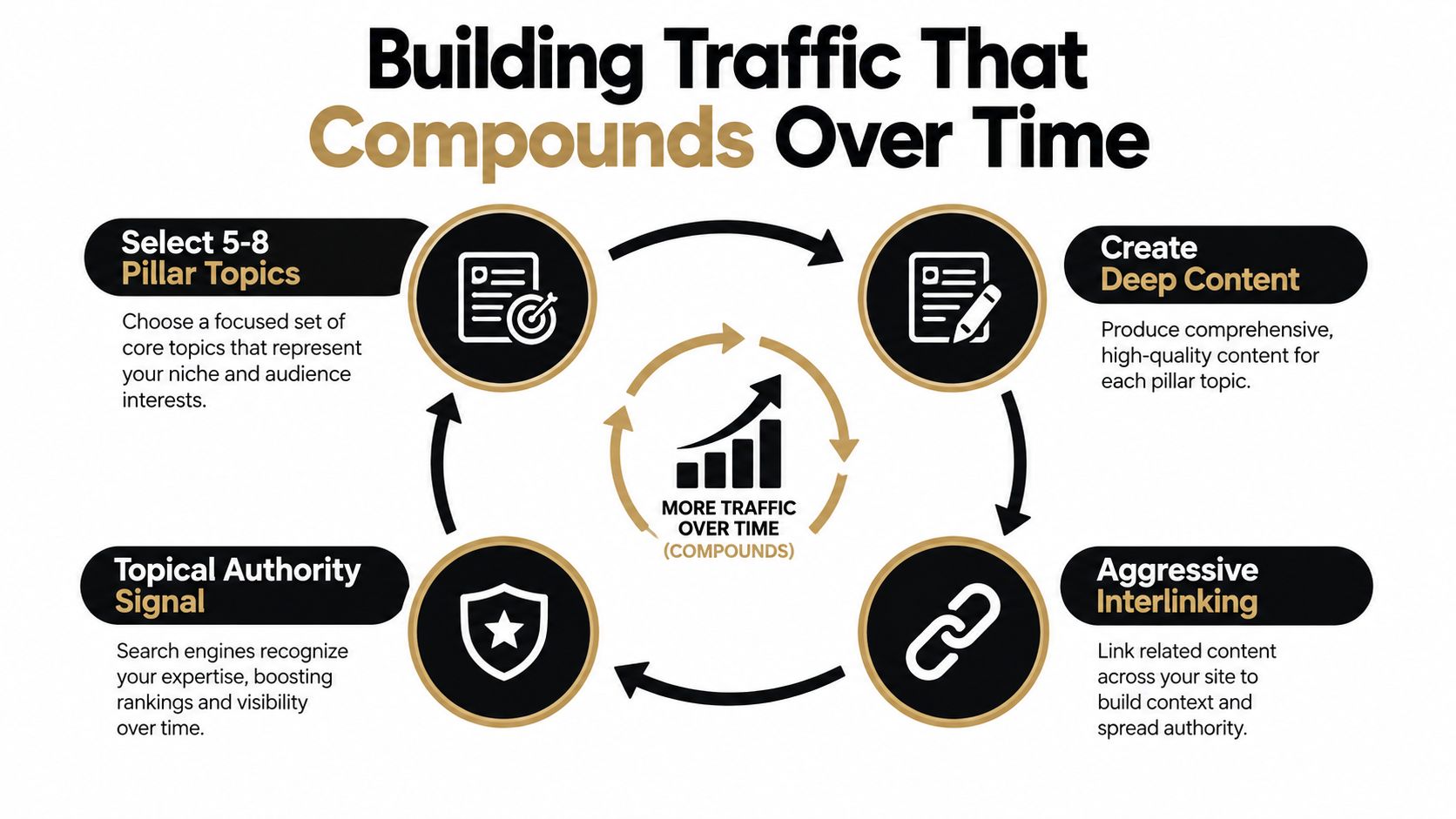
Pick 5 to 8 pillar topics and build clusters around them. Every pillar should link to supporting articles, and every supporting article should point back to the pillar. That internal structure gives readers a path and gives search engines a clearer map of your authority.
Then stop publishing into the void. Every article should become a few native assets for other channels, a short thread, a carousel, a short video, or a few pins, depending on where your audience spends time. If your niche has strong search demand, SEO comes first. If the topic is visual or demonstrative, short-form video deserves more weight.
For a practical troubleshooting angle, this guide on fixing a blog traffic plateau pairs well with the compounding approach because stagnation usually comes from weak internal linking, stale content, or too many one-off posts. The answer isn't random publishing. It's building a tighter system.
One strong post doesn't change a blog. A network of related posts does.
A clean 12-week cadence looks like this, one pillar or cluster post each week, then daily micro-content from that post. Keep updating your best pages quarterly, especially the ones already attracting clicks or email signups. The goal is to turn each article into a permanent entry point that still brings visitors two years later.
If you need a direct reference point for organic growth structure, the internal playbook at organic traffic growth fits this model well.
Choosing the Right Revenue Mix for Your Stage
Most blogs waste traffic by picking the wrong monetization model too early or too late. The stage you are at should decide the mix, and the mix should change as traffic grows.
Match the offer to the audience size
At low traffic, one affiliate offer and one simple digital product usually beat everything else. At the middle stage, a core product or service starts to carry more weight. At scale, ads, sponsorships, and memberships can sit on top of the rest without crowding out direct sales.
| Traffic Stage | Primary Revenue | Secondary Revenue | Realistic Monthly Earnings | Key Dependencies |
|---|---|---|---|---|
| 0 to 5k monthly readers | Affiliate links | Low-ticket digital product | $50 to $300/month from one affiliate offer | Email capture, clear buyer intent, useful comparison content |
| 5k to 50k monthly readers | Core product or service | Affiliate links, coaching | $500 to $3,000/month from a core offer plus affiliates | Trust, clear positioning, enough topical depth |
| 50k+ monthly readers | Ads, sponsorships, memberships | Products, affiliates | $3,000+/month from ads, sponsorships, and a product ladder | Consistent traffic, list growth, strong brand trust |
These ranges are illustrative, not guarantees. Conversion rate, offer fit, and audience quality decide the outcome.
Small blogs should skip ads as a primary plan. Growing blogs should stop hiding behind free content and start selling one clear offer. Larger blogs should avoid depending on a single revenue stream.
For a deeper breakdown of stage-based revenue models, see this guide to creator monetization. The same logic shows up in creator businesses outside blogging, and the Veo3 AI revenue tips for creators are a good reminder that the audience-to-offer match matters more than the channel. A blog is the distribution layer, not the business model.
The strongest starting stack is one affiliate offer plus one simple product. The strongest middle-stage stack is one service or coaching offer plus an email-driven product. The strongest scale stack is a balanced mix, not a single dependency. Do not run ads on pages built to close a sale, and do not place a competing affiliate offer next to your own course. That undercuts conversion.
For a cleaner framing of product logic, digital product pricing strategy is a useful companion read.
Setting Up the Money Stack Checkout Email and Bookings
A blog doesn't make money until money can move through it cleanly. That means checkout, email capture, and bookings need to work without friction. If people have to hunt for the buy button, you've already lost too many of them.
Keep the stack boring and reliable
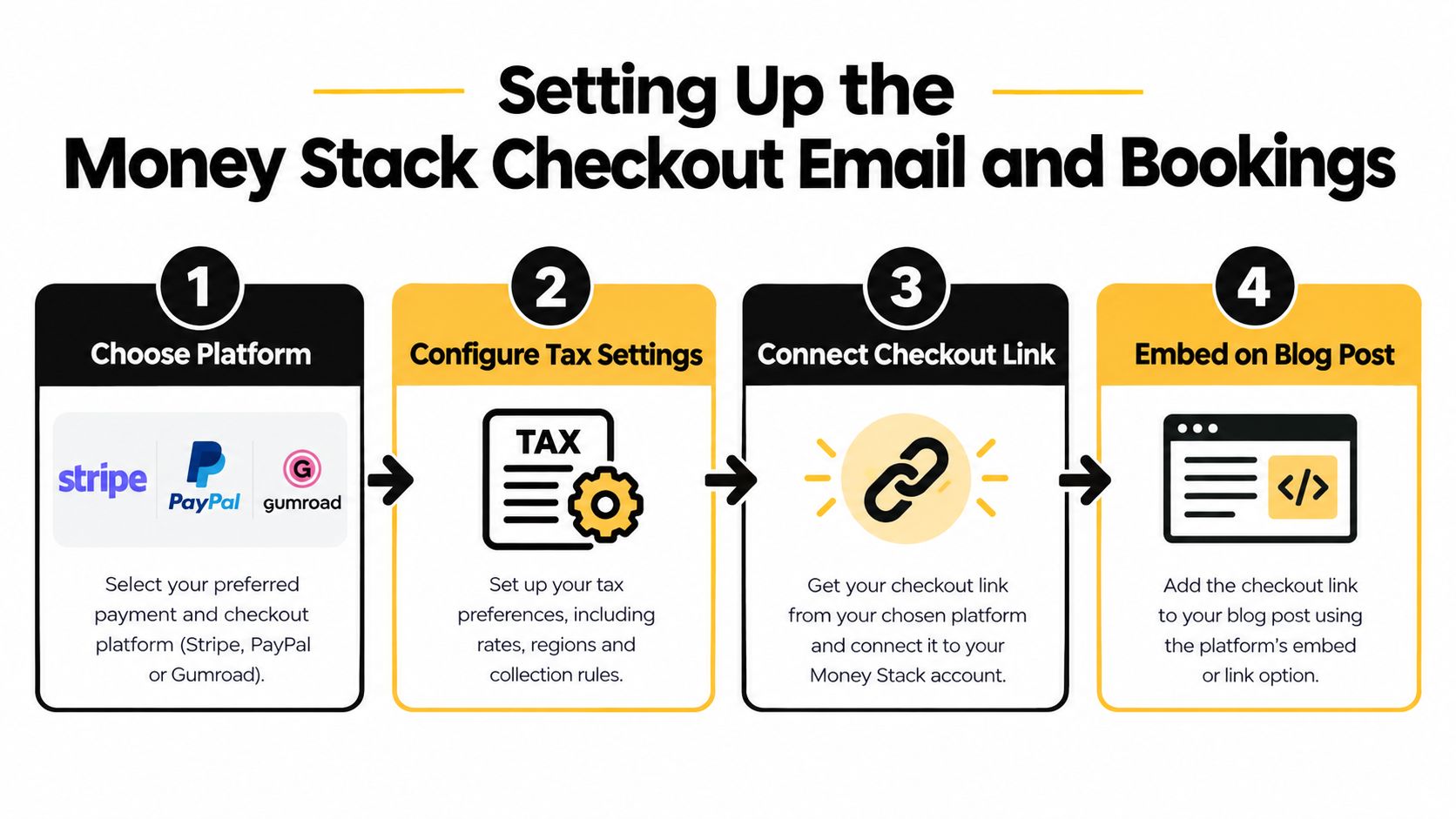
For checkout, use a tool that fits your business model. Stripe and PayPal are fine for direct payment flow. Lemon Squeezy and Gumroad make life easier for digital goods, especially if you don't want to stitch together too many moving parts. SamCart is more aggressive if you care about upsells and conversion mechanics.
Email capture should sit everywhere the reader has intent, sidebar, About page, and within posts that solve a real problem. A lead magnet can be simple, but it has to be useful enough that readers want it. Then follow with an autoresponder that does one job, turn a new subscriber into a buyer without sounding like a carnival pitch.
The booking layer matters if you sell services. Calendly, TidyCal, or Acuity can route directly into paid calls with deposits, so you don't waste time on unpaid “quick questions.” That's how a blog starts behaving like a real client acquisition system.
The checkout page examples reference is worth studying if you want a cleaner layout for the page that closes the sale. The principle is the same across tools, one page, one action, no clutter.
For creators who want to consolidate all of that, taap.bio is a link-in-bio creator store that combines storefront, scheduling, email capture, and analytics in one page. Put the page in your sidebar and About page, then use it as the default destination for sales links, booking links, and subscriber capture without breaking the blog's SEO structure.
Pricing Funnels and Offers That Convert
Pricing is where creators hesitate, and that hesitation costs sales. Price too low and the offer looks weak. Stop at one offer and you cap revenue early. The better move is a simple ladder that fits the reader's stage and the traffic on hand.
Use a three-tier ladder
Start with a tripwire, usually free or low-cost. Move into a core offer, the main product or service. Keep a premium tier for people who want direct access, implementation help, or speed.
| Offer Tier | Role | Good Example |
|---|---|---|
| Tripwire | First paid step | Ebook, template pack, small workshop |
| Core offer | Main revenue driver | Group coaching, course, implementation package |
| VIP tier | High-touch premium | 1:1 consulting, done-with-you, intensive audit |
Anchor pricing against competitors, then price against the pain the offer removes. The pricing framework covered earlier applies here too. A product that saves time, reduces risk, or replaces scattered trial and error can charge more than a generic resource.
Keep the funnel tight. Send traffic to an opt-in page. Offer a thank-you upsell. Add an order bump where it fits. Follow abandoned carts with email. Cross-sell after the first purchase. Skip these pieces and you leave conversion on the table.
The three biggest mistakes are easy to spot. Pricing absurdly low makes the offer feel cheap. Skipping upsells wastes warm intent. Trying to sell everything to everyone turns the funnel into noise.
For a practical reference on how to price a digital product against competitor anchors, use it as a check against guesswork. If your readers already trust you, the sale flow matters almost as much as the product itself.
Measuring What Matters and Optimizing Weekly
If you don't measure the business side, you're just publishing and hoping. A blog becomes a business when you can see what traffic does, what email does, and what each money page earns. The dashboard should stay small enough that you use it every week.
Track the four numbers that tell the truth
| Metric | Why It Matters | Healthy Signal | Problem It Flags |
|---|---|---|---|
| Organic sessions | Shows whether discovery is growing | Stable or rising traffic to money pages | Content decay, weak SEO, poor internal linking |
| Email list growth | Shows whether visitors are becoming owned audience | New subscribers from key posts | Weak lead magnets, no capture points |
| Conversion rate on money pages | Shows whether offers are persuasive | Readers click through and buy | Offer mismatch, weak copy, bad page flow |
| Net revenue per 1,000 sessions | Shows overall monetization quality | Revenue rises with traffic quality | Traffic without intent, weak funnel design |
Read the numbers together, not in isolation. If traffic rises and revenue stays flat, the offer is weak or invisible. If revenue rises and traffic doesn't, you probably fixed a funnel leak. If email growth is flat, the site is acting like a brochure instead of an asset.
Weekly rule: pick one problem, traffic, conversion, or retention, and test one variable only.
On Monday, pull the previous week's data and compare it with the trailing four-week average. Tag the biggest underperformer. Then change one thing, headline, price, CTA placement, lead magnet, or page order. Chasing five tests at once just hides the result.
A link-in-bio storefront helps here because clicks, leads, and sales can sit in the same view instead of scattered across tools. That matters when you want to know which post produces income, not just attention.
A blog is a real business when revenue doesn't stop the minute you stop publishing. Keep the audience on email, keep the storefront portable, and keep at least two monetization channels alive so one failure can't kill the whole stack. Reinvest a fixed portion of revenue into traffic, tools, and stronger offers, and you end up with a system that gets more valuable every month instead of more fragile.
| Metric | Why It Matters | Healthy Signal | Problem It Flags |
|---|---|---|---|
| Organic sessions | Shows whether discovery is growing | Traffic lands on posts that lead to action | Search loss, weak content targeting |
| Email list growth | Measures audience ownership | Subscribers keep rising from content | Poor opt-in placement or weak lead magnet |
| Conversion rate | Tells you if offers are working | Readers buy or book after clicking | Confusing offer, weak page copy |
| Net revenue per 1,000 sessions | Connects traffic to earnings | Revenue grows with quality traffic | Busy site, weak monetization |
taap.bio gives you the missing middle between blog traffic and actual revenue. It lets you put products, bookings, and email capture on one page, so your blog can send readers to a simple creator store instead of a scattered tool stack. If you want to turn your content into a cleaner money system, visit taap.bio and build the page that sits between your posts and your sales.