
Most advice about digital products for passive income starts with the wrong promise. Creating a course, template, ebook, or membership doesn't make revenue passive by itself. The product becomes close to passive only when it solves a specific problem, delivers repeatedly without manual work, fits a clearly defined audience, and has promotion that continues after launch.
Use those standards to compare the options below. Each model has a different balance of production effort, pricing power, customer support, repeat sales, and audience dependence. Courses can command more value but need updates. Templates deliver efficiently but face competition. Memberships create recurring revenue but require ongoing attention. Affiliate recommendations remove fulfillment work but depend heavily on trust.
A focused selling system matters just as much as the product. taap.bio can place product discovery, built-in checkout, instant file delivery, paid bookings, email capture, rich media, and widget-level analytics on one page. That reduces the number of steps between a visitor discovering your offer and taking action. You can also use pull tweets with this API as part of a content workflow that turns relevant social conversations into promotion opportunities.
Table of contents
1. Digital Courses and Educational Content
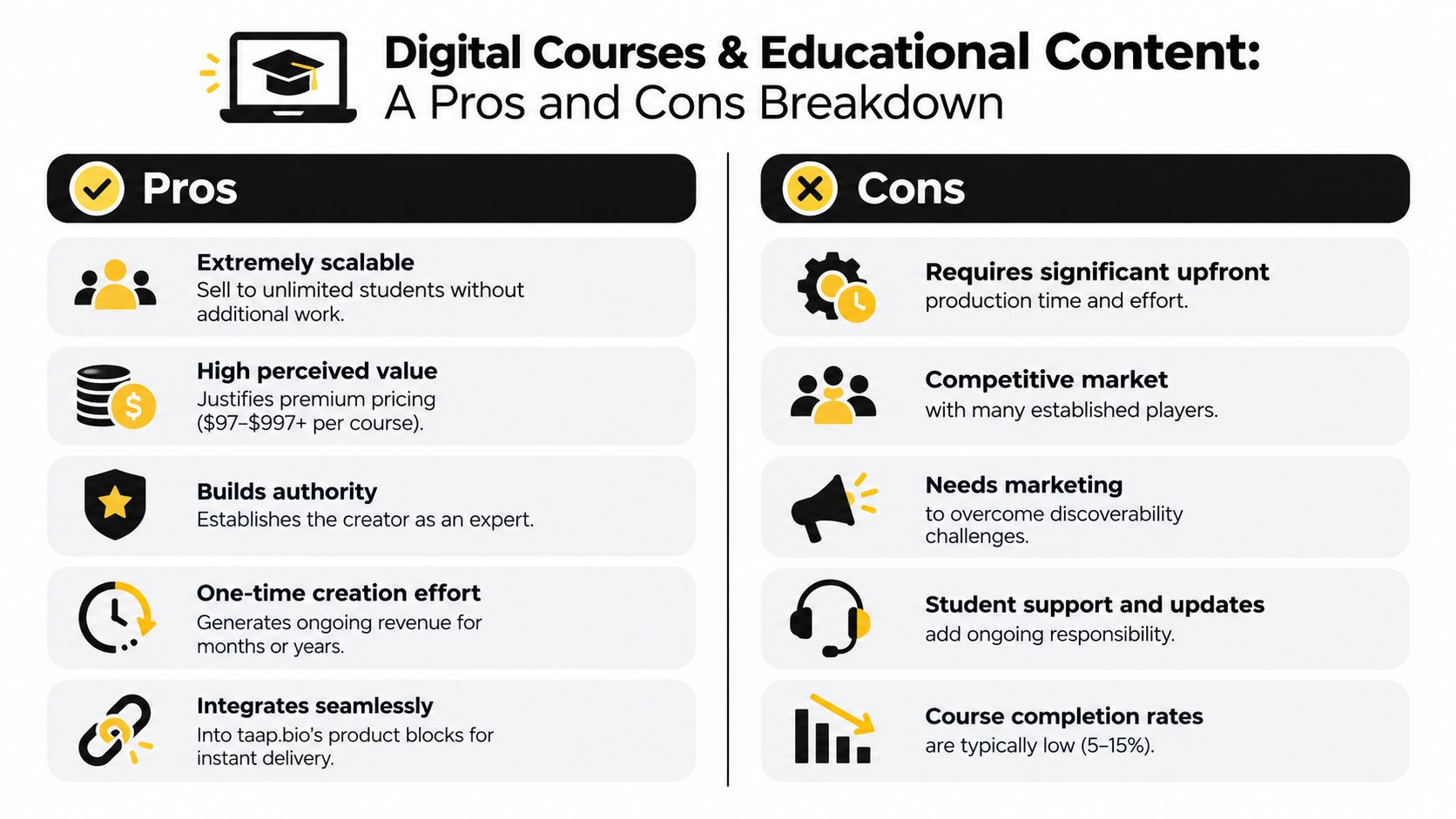
Digital courses offer the strongest combination of high perceived value and repeatable delivery when you teach a narrow, practical outcome. A course can contain video lessons, downloadable modules, exercises, or interactive resources. The format works for creators who already have expertise that buyers want to apply, such as marketing, design, writing, software, fitness, or career development.
The passive-income potential is high after production, but course creation is rarely light work. You need to structure lessons, record clear explanations, test the student experience, answer questions, and update material when tools or practices change. A short course that solves one urgent problem is a better first product than a broad program that tries to cover an entire profession.
Examples include Amy Porterfield's digital marketing courses, Skillshare classes, MasterClass programs, and technical micro-courses on Udemy. These examples show how different positioning can support the same model, from broad education to tightly scoped skills.
Build a course around one measurable outcome
Your sales page should tell buyers what they'll be able to do after completing the course. Use taap.bio's email signup widget to collect interest before recording every lesson, then use page analytics to see which content and product blocks attract attention. A short pre-sale can validate the topic while giving you questions that improve the curriculum.
Practical rule: Sell the transformation, not the video library. Buyers pay for a clearer result, faster execution, or fewer mistakes.
Use a product block for checkout and instant access to downloadable resources. A course that requires constant live support is a service disguised as a product, so define support boundaries before launch. For a deeper platform comparison, see how to choose an online course platform.
2. Templates and Design Assets
Templates come closest to passive income when they eliminate repetitive work for a clearly identifiable buyer. A social media manager, real estate agent, wellness coach, or SaaS founder doesn't want a generic design pack. They want files that match the content, dimensions, language, and workflow they use every week.
Canva links, Figma files, PSD downloads, presentation layouts, website themes, and UI kits all fit this category. The product is attractive because delivery is automatic and customers can customize the asset without needing your involvement. Your main workload shifts toward research, design quality, customer instructions, licensing clarity, and periodic updates.
A Canva shop might sell a niche social content collection, while a Figma creator could package an interface kit for product teams. Creative Market and Etsy demonstrate the breadth of the category, but marketplaces also make comparison easy for buyers. Generic templates therefore struggle to stand out.
Make the preview do the selling
Show the finished asset in context. Use taap.bio's image widget for before-and-after examples, screen previews, and a clear explanation of what the buyer receives. Offer a free sample template in exchange for an email subscription, then send useful examples instead of pushing the paid bundle in every message.
Build collections around one audience and one recurring workflow. A creator serving real estate agents might produce listing posts, open-house graphics, and property presentation slides. Someone serving feminine wellness coaches might focus on educational carousels, testimonials, and launch announcements.
For practical guidance on packaging and distribution, read how to sell Canva templates.
The product becomes less passive when buyers need repeated customization help. Include a setup guide, naming conventions, file instructions, and licensing terms so customers can begin without contacting you.
Here's a visual example of how templates can support a repeatable design workflow:
3. Email Courses and Automated Sequences
An email course is less valuable as a standalone product than as an automated path to a higher-value offer. You deliver a sequence of lessons over a defined period, then invite subscribers to buy a course, book a consultation, join a membership, or download a related product.
That makes the model highly efficient for audience building. Once the sequence is written and connected to an email service, each new subscriber can receive the same educational journey. It isn't fully passive, because you'll need to monitor unsubscribes, refresh links, refine the offer, and maintain the system. Still, the sequence can keep working long after the original writing is complete.
Seth Godin's marketing lessons, Marie Forleo's nurture campaigns, Pat Flynn's educational sequences, and Copyblogger's marketing content illustrate the range of topics that suit this approach. The strongest sequences teach one skill while naturally exposing the next problem your paid product solves.
Give every email one job
Start with a useful lead magnet, such as a checklist, template, short video, or diagnostic worksheet. Place taap.bio's signup widget prominently on the page, and connect the welcome message to a short sequence. Keep each email focused on one action, such as completing a task, reading a resource, or viewing the paid offer.
Segment subscribers by the problem they selected rather than sending one generic sequence to everyone. Analytics can show which page elements attract signups and which offer receives engagement. Export your contacts through CSV so your audience isn't trapped inside a single platform.
A sequence works best when it creates momentum. The first message should deliver an immediate win, the middle messages should address obstacles, and the final message should make the paid next step obvious. Learn the implementation details in how to create an email sequence.
4. Printable Downloads and Ebooks
Printable downloads and ebooks are practical entry points for creators who can explain a focused process clearly. Buyers might want a freelancer budget planner, a meal preparation guide, a habit tracker, a fitness plan, or a goal-setting workbook. The file arrives instantly, requires no physical inventory, and can sell repeatedly without another fulfillment task.
This model has lower pricing power than a specialized course or consultation, so the product needs a clear use case. “Productivity planner” is broad. “Monthly budget planner for freelance designers” gives the buyer a reason to click. Specific language also helps your promotional content reach people who already recognize the problem.
Package a result, not a document
A single PDF may feel disposable. A coordinated bundle can feel like a complete solution, especially when each file supports the same workflow. For example, a freelancer finance bundle could include a monthly planning sheet, an invoice tracker, a tax preparation worksheet, and a review page.
Use taap.bio's image widget to display sample pages and show how a buyer will use the files. A free page or short excerpt can collect email subscribers while letting prospects assess the design and usefulness before purchasing. Analytics can reveal which preview receives the most attention.
Buyers don't need more pages. They need a tool that helps them finish a task with less confusion.
Separate personal-use and commercial-use licenses when appropriate. Licensing can create a higher-value offer for business buyers, but the terms must be unambiguous. Protect the customer experience with clear file names, printing instructions, compatibility notes, and a support email. For delivery guidance, see how to sell digital downloads.
5. Paid Consultations and Booking Services
Paid consultations aren't passive income, but they can be the fastest way to validate a product idea and learn what buyers need. A consultation exchanges your time for revenue through a scheduled session, strategy call, review, or coaching appointment. It belongs on this list because service conversations often reveal the repeatable framework that later becomes a course, template, or ebook.
A career coach might review a resume. A designer might provide a website strategy session. A nutrition professional might help a client plan meals. A real estate professional might offer a property consultation. The buyer pays for judgment, context, and personalization, which downloadable products can't always provide.
Use bookings as research, not as your final model
Set a narrow agenda and require a pre-call questionnaire. taap.bio's booking widget can collect payment upfront, display availability, and send calendar invitations, while its email widget can gather the information you need before the appointment. Limit your calendar so service work doesn't consume the time needed to build scalable products.
Offer clear packages based on scope rather than vague access to you. A short diagnostic call, a deeper strategy session, and a follow-up package can serve buyers at different commitment levels. State cancellation, rescheduling, and refund rules before checkout.
Track recurring questions after every call. When the same problem appears repeatedly, turn your answer into a worksheet, tutorial, or automated sequence. That process lets consultations fund and improve the digital product that eventually reduces your dependence on booked hours. Learn more about how to book clients online.
6. Music, Audio, and Sample Packs
Audio products can become highly repeatable when producers create assets for a defined genre, production style, or content format. Royalty-free music, sound effects, drum kits, loops, and sample packs serve musicians, podcasters, advertisers, video creators, and game developers. Buyers usually care about immediate usability, sound quality, file organization, and licensing more than the creator's personal story.
The passive potential is strongest for packs that work inside a specific workflow. A producer might create ambient textures for meditation videos, lo-fi loops for independent artists, or short sound effects for social video editors. A general collection of unrelated sounds creates a harder buying decision and weakens promotion.
Let people hear the product before they buy
Embed preview audio through a Spotify widget or another suitable media block on your taap.bio page. Give prospects a small sample that demonstrates the production quality, then explain the included formats, tempo information, stems, and license terms. Buyers should know whether they can use the files personally, commercially, or in client work.
Use licensing to separate audiences without creating confusion. A personal license can serve hobbyists, while a commercial license can target creators whose work generates revenue. A broader license may suit agencies or production teams. Put the terms beside checkout, not inside a document buyers see only after payment.
Bundle related packs when the sounds belong together. Then promote one useful production tip for each pack, rather than posting only “new product” announcements. Analytics can show which previews receive attention and which packs deserve follow-up products. If a genre-specific collection sells, create complementary sounds that expand the buyer's existing library.
7. Webinars and Live Training Events
Webinars are a strong promotion and conversion format, but they aren't passive at launch. You must choose a topic, promote registration, show up live or prepare a polished recording, answer questions, and follow up with attendees. Their long-term value comes from turning one event into an evergreen asset that feeds a course, consultation, membership, or product bundle.
Use a webinar when the buyer needs to understand a problem before committing. A live training session can demonstrate a process, handle objections, and show the difference between a free educational idea and a paid implementation system. It works particularly well for complex services and higher-value educational offers.
Build one event into several assets
Promote the event through organic content, email, and relevant social conversations. Place taap.bio's signup widget next to the registration offer, then send reminders and a clear preparation note. During the session, teach a complete, useful concept before presenting the paid next step. Trust falls quickly when the event feels like a disguised sales pitch.
Offer a useful live-attendee bonus, such as a worksheet or template, but don't make the core education deliberately incomplete. Afterward, record and transcribe the event. Turn the material into a blog post, video clips, email lessons, and a product preview.
Review the registration, attendance, and purchase journey in your analytics. A drop-off at registration suggests a weak promise. A drop-off after attendance suggests unclear positioning, poor follow-up, or a mismatch between the training and the offer. Once the recording sells without your presence, the model moves closer to passive, but the promotion system still needs maintenance.
8. Membership Communities and Exclusive Content
Memberships create recurring revenue, but they demand the most consistent ongoing work on this list. Members pay for access to resources, discussions, live sessions, feedback, or a community organized around a shared outcome. A resource library alone rarely retains people. Members stay when the community helps them make progress.
This model suits creators with an audience that wants continued guidance, accountability, or peer interaction. It can work for business education, professional development, creative practice, fitness, or specialized workflows. It doesn't suit a creator who dislikes moderation, regular communication, or customer support.
Sell access to progress
Start with a waitlist on taap.bio and use email responses to test the promise before building a large content library. Define what members receive, how often you interact, where conversations happen, and what support you won't provide. Customers need a reliable rhythm, not an endless archive of unused files.
Use tiering only when each level has a clear difference. A content tier might provide the resource library. A higher tier could add group Q&A. A premium tier could include paid bookings for individual guidance. The tiers should reflect different outcomes, not arbitrary labels.
Membership revenue is recurring, but membership responsibility is recurring too.
Create a cancellation process that preserves goodwill. Publish a clear content calendar, respond to questions, and identify the moments when members get stuck. If the group requires your constant presence to remain useful, call it an active business rather than passive income. That honesty improves both pricing and workload planning.
9. Photography and Stock Assets
Photography, video, illustrations, and graphics can produce repeat sales when the assets serve a commercial niche with consistent content needs. Buyers include small businesses, agencies, creators, real estate professionals, and marketing teams. They aren't buying attractive images. They're buying permission to communicate a message without commissioning a new shoot.
Niche positioning matters. A collection focused on sustainable lifestyle content, diverse family marketing images, luxury property visuals, or profession-specific business scenes gives buyers a more relevant starting point than a broad stock library. The clearer the use case, the easier it is to show the product in promotion.
Make licensing impossible to misunderstand
Use taap.bio's image gallery widget to show a curated selection rather than a random gallery. Group assets into themed collections and explain file types, image dimensions, model releases where relevant, and usage rights. A free sample can demonstrate quality while bringing interested buyers onto your email list.
Separate personal, commercial, and extended usage terms if your audience needs different permissions. Don't bury restrictions in small print. A buyer who understands the license before checkout is less likely to request support or dispute a purchase later.
Stock products need a dependable discovery system because individual assets may not create enough value alone. Publish behind-the-scenes content, show the images in mock campaigns, and create seasonal or industry-specific collections. Use analytics to identify which gallery images attract attention, then build related sets around the same buyer intent.
The model is close to passive after the shoot and cataloging are complete, but it still requires metadata, quality control, licensing administration, and regular promotion. Strong organization is part of the product.
10. Affiliate Marketing and Recommendation Systems
Affiliate marketing removes the hardest fulfillment tasks. You recommend a third-party product or service, the vendor handles checkout and delivery, and you receive a commission when a referred customer buys. That makes the model operationally light, but it isn't automatically passive. You need attention, trust, content, and accurate recommendations.
The best affiliate systems serve a narrow audience with a recurring decision. A podcast host might recommend hosting and editing tools. A freelancer might publish a software stack guide. A creator educator might compare email platforms, course tools, or design software. The recommendation should help someone choose, not merely place a collection of links in a profile.
Build a useful decision system
Create one taap.bio page that groups complementary tools by job. Add short explanations, relevant media, and clear disclosures wherever affiliate relationships exist. Use the email widget to build an owned audience, then send occasional updates when tools change, pricing changes, or a better option becomes available.
Comparison content usually performs better than generic promotion because it answers a buyer's question. Explain who each tool suits, where it falls short, and what type of user should avoid it. Never recommend a product you haven't evaluated or wouldn't suggest without a commission.
Track clicks through page analytics and improve the placement, wording, and order of recommendations. Your goal isn't to maximize link volume. It's to reduce decision friction for a specific audience. A curated referral workflow can complement your own products, especially when customers need software or services to use your templates, course, or consulting framework.
You can also explore earning with referrals, but treat affiliate income as one part of a broader portfolio rather than your entire business.
Comparison of 10 Passive-Income Digital Products
| Product | Implementation Complexity 🔄 | Resource & Speed ⚡ | Expected Outcomes ⭐📊 | Ideal Use Cases 💡 | Key Advantages ⭐ |
|---|---|---|---|---|---|
| Digital Courses & Educational Content | High, course design, recording, structure 🔄🔄🔄 | High upfront production; slow launch, long-term passive delivery ⚡ | High revenue potential; authority building; low completion rates 📊⭐ | Coaches, experts, educators validating high-ticket offers 💡 | Extremely scalable; premium pricing; long-tail revenue ⭐ |
| Templates & Design Assets (Canva, Figma, Adobe) | Low–Medium, repeatable systems, less complexity 🔄🔄 | Low creation cost; fast to produce and update ⚡⚡ | Moderate steady sales at low price points; repeat buyers 📊 | Social media creators, small businesses needing quick visuals 💡 | Quick to create; high margin; appeals to non-designers ⭐ |
| Email Courses & Automated Sequences | Low, copy and sequence planning 🔄 | Very low infrastructure cost; fast setup; ongoing optimization ⚡⚡ | Strong lead generation; conversion to paid offers depends on funnel 📊⭐ | List-building, nurturing prospects, pre-sell funnels 💡 | Owned channel; inexpensive; high engagement potential ⭐ |
| Printable Downloads & Ebooks | Low, design and formatting 🔄 | Very low production cost; fastest to launch ⚡⚡⚡ | Low-ticket volume sales; scalable but commoditized 📊 | Solopreneurs, planners, niche problem-solvers 💡 | Fast to create; instant delivery; broad audience fit ⭐ |
| Paid Consultations & Booking Services | Medium, scheduling, policies, prep 🔄🔄 | Time-intensive per sale; immediate income but limited scale ⚡ | Predictable per-session revenue; limited by available hours 📊 | Coaches, consultants, specialists offering high-touch services 💡 | High per-session pricing; direct client relationships; low tech stack ⭐ |
| Music, Audio & Sample Packs | Medium–High, production skill and quality standards 🔄🔄🔄 | Moderate equipment/time; previews and licensing setup ⚡ | Premium pack sales and licensing revenue; niche demand 📊⭐ | Producers, musicians, content creators needing sounds 💡 | Can command premium prices; scalable licensing model ⭐ |
| Webinars & Live Training Events | Medium–High, live delivery and technical setup 🔄🔄🔄 | Moderate prep and promotion; live energy required ⚡⚡ | Strong engagement and funnel conversions; replay sales 📊⭐ | Product launches, course sales, SaaS demos, high-ticket funnels 💡 | Real-time trust building; converts to high-ticket offers ⭐ |
| Membership Communities & Exclusive Content | High, ongoing content + community management 🔄🔄🔄🔄 | High recurring effort; requires consistent updates ⚡ | Recurring revenue, high LTV if engagement maintained 📊⭐ | Creators with engaged audiences seeking recurring value 💡 | Predictable cash flow; strong retention potential; community loyalty ⭐ |
| Photography & Stock Assets (Photos, Videos, Graphics) | Medium–High, production, legal/releases 🔄🔄🔄 | Equipment and editing time; moderate launch speed ⚡⚡ | Steady asset sales or subscription revenue; niche demand 📊 | Agencies, marketers, creators needing licensed visuals 💡 | High perceived value; scalable sales; subscription options ⭐ |
| Affiliate Marketing & Recommendation Systems | Low, curation and link setup 🔄 | Very low production; requires traffic to perform ⚡⚡⚡ | Commission-based revenue; highly variable and performance-driven 📊 | Content creators with audiences or traffic channels 💡 | Truly passive with no fulfillment; low overhead ⭐ |
| Music, Audio & Sample Packs | Medium–High, production skill and quality standards 🔄🔄🔄 | Moderate equipment/time; previews and licensing setup ⚡ | Premium pack sales and licensing revenue; niche demand 📊⭐ | Producers, musicians, content creators needing sounds 💡 | Can command premium prices; scalable licensing model ⭐ |
Choose the Product You Can Promote Repeatedly
The best digital product for passive income isn't the one with the highest theoretical margin. It's the one you can create well, explain clearly, deliver automatically, and promote repeatedly without exhausting your audience or yourself. A product that customers understand and use often will usually outperform a more ambitious offer that takes too long to build and is difficult to position.
Start with your existing expertise. If you solve the same problem for clients, turn your process into a template, workbook, or micro-course. If buyers need personal context, begin with paid consultations and document the questions that appear repeatedly. If your audience already asks for resources, package those resources into a focused product rather than creating something unrelated because it appears popular.
Audience urgency should determine your category choice. A niche product often has a clearer buyer than a broad “evergreen” product because it names a specific pain point. Specialized templates, workbooks, automation resources, and AI-enhanced products can serve narrow workflows where buyers care more about saved effort than general inspiration. The product should reduce customer work, not merely promise to reduce creator work.
Your production capacity matters too. Templates and downloadable products can launch faster than courses or memberships. Courses need curriculum design, recording, support, and updates. Memberships need a continuing content and community commitment. Affiliate systems need reliable publishing and honest evaluation. Choose the model that matches the work you can sustain after the launch excitement fades.
The market data supports ambition, but it also requires realism. The global digital goods market was valued at USD 124.32 billion in 2025 and is estimated to reach USD 157.39 billion in 2026, with a projection to USD 511.43 billion by 2031 at a 26.60% CAGR, according to digital product market statistics for 2026. That expansion shows the category is substantial, but it doesn't guarantee that an individual product will sell. A separate analysis estimates creator-led digital products at roughly USD 32 billion in 2026, while reporting median active creator earnings of about USD 1,200 per year, a reminder that market size and personal results are very different outcomes. Read the creator-led digital product market analysis for that context.
A portfolio approach is safer than betting everything on one launch. Independent creator data reports that more than half of creators earn under $15,000 per year, the median creator income from digital products is about $72 per month, and fewer than 5% earn over $1,000 monthly. The same creator earnings report supports a practical sequence: start with one narrow offer, build an audience, add a service or higher-value product, and expand only after buyers show you what they need.
Use taap.bio to validate before you overproduce. Publish a focused page, add an email signup form, show product previews, and watch which blocks receive attention. Then connect the appropriate action, instant checkout and file delivery for downloads, product access for courses, bookings for services, or referral links for affiliate offers. Once the first offer has demand, use digital product ad automation to support promotion, then expand into bundles, recurring offers, or premium services.
The right target isn't “passive” in the absolute sense. It's a selling system where each new customer doesn't require the same amount of manual fulfillment, while your content, email list, product improvements, and audience research keep the system healthy.
taap.bio gives creators one page for digital product checkout, instant file delivery, paid bookings, email capture, rich media, and analytics. Build a focused offer, connect the right selling workflow, and visit taap.bio to start turning your audience into a more repeatable revenue system.


