

Most advice on social traffic gets the sequence backward. It tells you to post more, chase reach, and drop your link often. That’s exactly how creators end up with decent engagement and weak website traffic.
Social platforms are built to keep people inside the feed. Your job isn’t to force people out with blunt promotion. Your job is to make the click feel like the obvious next step.
Table of contents
Why Your Social Following Isn't Driving Website Traffic
A large following doesn’t mean you have a traffic system. It usually means you have attention. Those are not the same thing.
A creator can have comments, saves, and shares all day long and still send almost nobody to their website. The gap usually comes from one mistake. They treat the website link like an afterthought instead of part of the content journey.
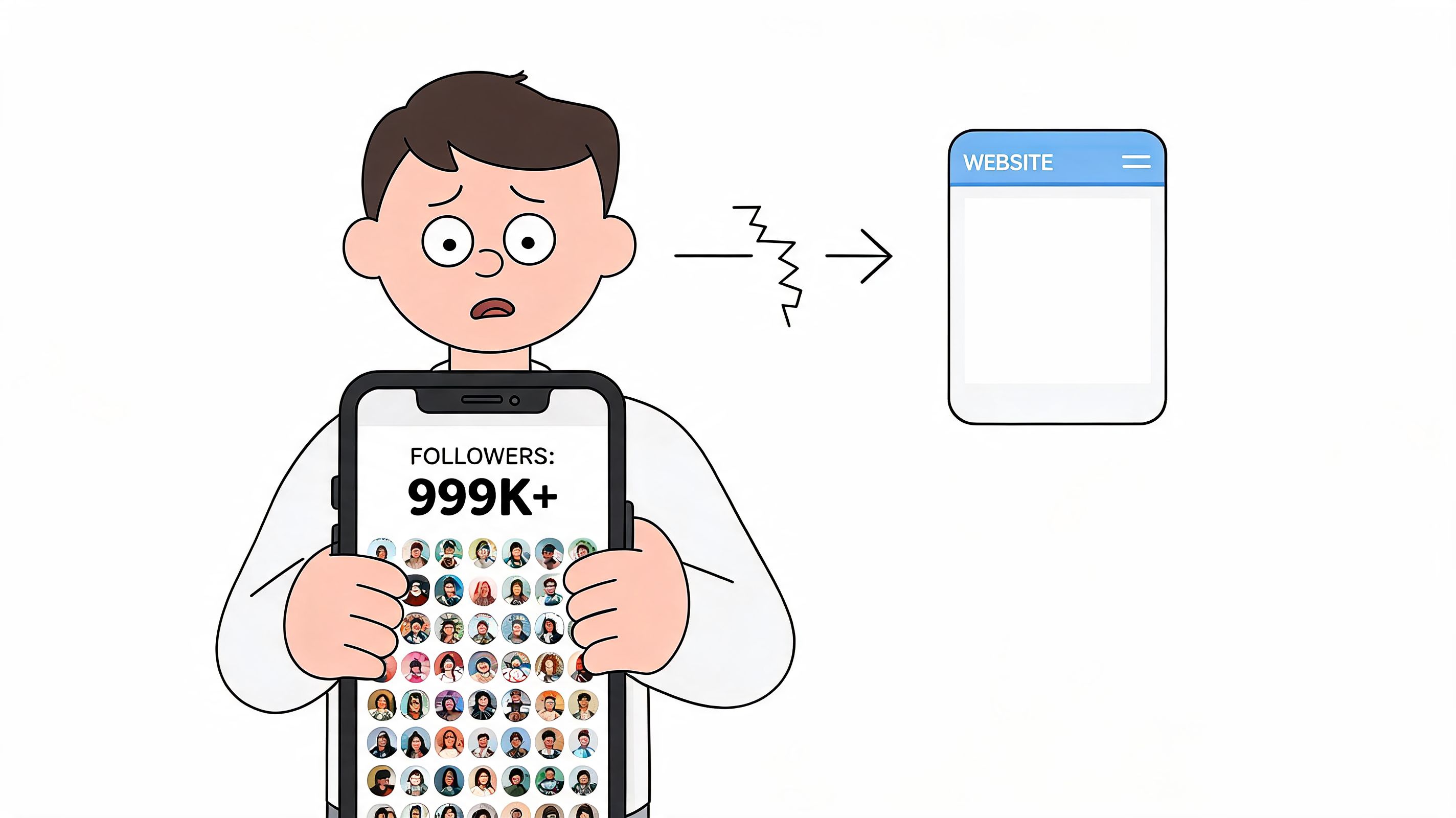
That’s costly because social can drive serious traffic when handled correctly. Social media platforms drive approximately 10.12% of all web visits, making it the second-largest traffic source after organic search. Facebook alone accounts for 7.75% of total website traffic, according to SE Ranking’s social media traffic research.
What usually goes wrong
Most underperforming accounts share one of these patterns:
- They post links without context. “New blog live. Link in bio” doesn’t answer why someone should leave the app.
- They optimize for applause, not action. Likes feel good. Website sessions pay the bills.
- They send people to a dead-end bio page. A generic list of links gives visitors no reason to stay, explore, or self-qualify.
- They ask for clicks too early. Trust hasn’t been built yet, so the audience scrolls past.
Social traffic doesn’t break when your audience is small. It breaks when the path from post to click is weak.
What actually changes the outcome
The creators who learn how to drive traffic from social media to website stop thinking in isolated posts. They build a chain:
- Content that creates intent
- A bio page that continues the story
- A destination page that matches the promise
- Tracking that shows what people do next
If your current strategy is all reach and no visits, fix the middle of the funnel first. Better engagement can help, and these social media engagement improvements matter, but engagement alone isn’t the win. Traffic is.
Build a Content Strategy That Earns the Click
The fastest way to kill click-throughs is to make every post a pitch. People don’t follow creators to be interrupted. They follow creators to learn, watch, laugh, compare, save, or feel understood.
The content mix that works is simpler than commonly perceived. The most effective social media traffic strategies follow an 80/20 rule: 80% of content should be high-value and trust-building, while only 20% is directly promotional. This balance amplifies the reach of promotional posts and results in more qualified, higher-converting website visitors, as outlined in this practical guide to social traffic.
What the 80 percent looks like
This isn’t “post inspirational quotes and hope.” Trust-building content still needs a job.
For a freelancer or creative business, the non-promotional majority usually includes:
- Process content. Show how you work. A designer can share early sketches, a photographer can explain shot selection, a musician can post a rehearsal clip.
- Educational content. Teach one useful thing. Keep it narrow. One mistake. One framework. One fix.
- Opinion content. Take a clear stance on bad industry habits. Strong opinions often create the curiosity that leads to clicks later.
- Proof content without a hard sell. Show outcomes, lessons learned, or behind-the-scenes decisions.
What the 20 percent looks like
Promotional content works better when it doesn’t sound detached from everything around it.
Good promotional posts usually do one of three things:
| Post type | Weak version | Better version |
|---|---|---|
| Blog promotion | “New article up. Link in bio.” | “I broke down the exact homepage changes that stopped visitors from bouncing. Full walkthrough is on my site.” |
| Service offer | “Now booking clients.” | “If your portfolio gets views but no inquiries, I fixed that issue on my services page. You can review the process and pricing there.” |
| Newsletter push | “Subscribe to my newsletter.” | “I turned this framework into a checklist you can save and reuse. It’s on my site with the signup.” |
The second version earns the click because it promises a specific payoff.
Plan content around traffic intent
A practical calendar works better than random posting. One useful reference is Data Hunters Agency's content strategy, especially if you need a clearer system for mapping content types to business goals.
Here’s a lean structure that works well for creatives:
- Early-week authority post. Teach something people can use now.
- Midweek behind-the-scenes post. Build familiarity and show your method.
- Conversation post. Ask a sharp question or take a stance that reveals audience pain points.
- Traffic post. Send people to a resource, service page, or newsletter only after the value posts have done their work.
Practical rule: If a post asks for a click, the audience should already understand what they’ll gain on the other side.
A musician might post rehearsal footage, talk about arrangement choices, then promote a page with the full track, lyrics, tour updates, or email signup. A designer might share a teardown of a bad portfolio, show their own revision process, then link to a case-study page.
If you’re building this workflow from scratch, content planning tools for social media make it easier to map trust posts and traffic posts together instead of improvising every week.
Transform Your Bio Link into a Traffic Destination
The biggest leak in most social funnels isn’t the post. It’s the bio link page.
A plain vertical list tells visitors almost nothing. It doesn’t create momentum. It doesn’t help them choose. It doesn’t preview your work in a way that makes the next click feel worthwhile.
The smarter approach is to treat the bio page like a micro-landing page.
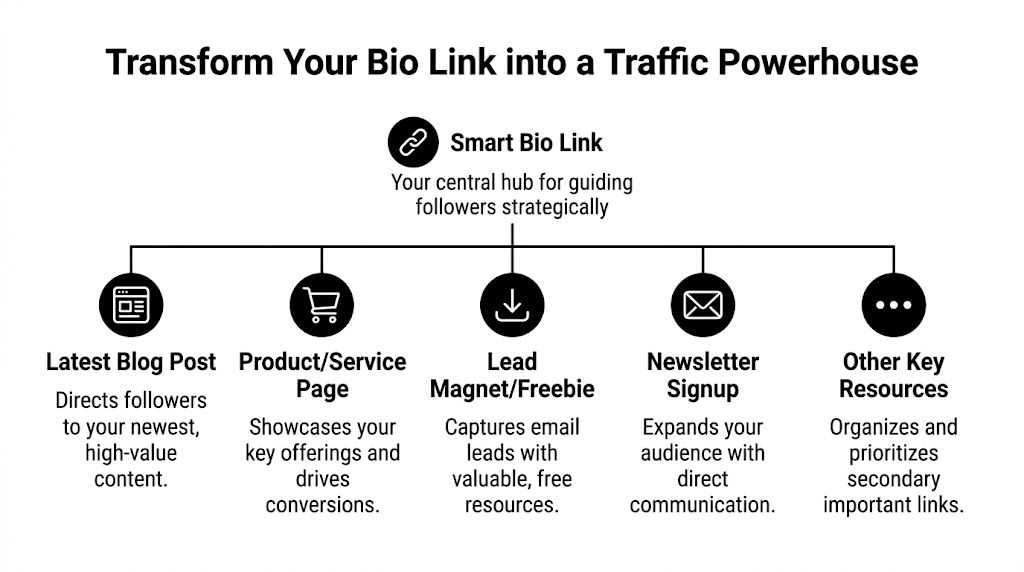
A/B tests from creator tool platforms show that optimizing link-in-bio pages with modular, asymmetric layouts and interactive smart widgets can increase click-through rates by 25-40% compared to traditional vertical link lists, based on Brafton’s analysis of social traffic tactics. That difference makes sense. People engage more when the page feels curated and alive.
Why list-style bio pages underperform
A list-only page assumes every visitor wants the same thing. They don’t.
One person wants your newest article. Another wants your portfolio. Another wants proof that you’re active. Another wants to hear your music before deciding whether to follow or buy. A flat stack of links treats all of those intents as equal and invisible.
A better bio page creates visual hierarchy. It says, “Start here, then explore this, then take this action.”
What a destination-style bio page should do
The page should help visitors self-select fast. It should also give them enough context that the click to your main website feels low-risk.
That’s where a tool like Taap.bio’s link in bio grid fits the workflow. It uses a modular bento-style layout instead of a plain list, so creators can position content blocks with different sizes, add media, and show live widgets from platforms like Instagram, YouTube, TikTok, Spotify, Dribbble, Behance, GitHub, and maps.
Build the page like a homepage, not a directory
Think in zones, not links.
Top zone with identity and intent
The first view should answer three questions:
- Who are you
- What do you make or offer
- What should I do first
For a designer, that might be a short statement, a featured portfolio block, and one strong “Work with me” destination. For a podcaster, it could be the latest episode embed, a newsletter signup, and a best-of archive.
Middle zone with proof and interaction
Smart widgets matter. Instead of saying “follow me on Instagram,” show the recent grid. Instead of saying “listen on Spotify,” let visitors preview the track or album. Instead of saying “watch on YouTube,” show recent video thumbnails.
That extra interaction changes the psychology. Visitors stop feeling like they’re being redirected around the internet. They start feeling like they’ve landed in a controlled brand environment.
Here’s a visual example worth studying:
Bottom zone with conversion paths
The final area should hold your lower-friction conversion actions:
| Visitor intent | Best block to show |
|---|---|
| Wants to learn more | Featured blog or guide |
| Wants to hire you | Services or booking page |
| Wants updates | Newsletter signup |
| Wants proof | Testimonial or portfolio block |
| Wants quick trust signals | Social profile widgets or embedded content |
Your bio page shouldn’t ask visitors to do all the sorting work. The layout should do that for them.
Examples by creator type
A musician should prioritize inline audio playback, latest release, tour or booking info, then merch or website.
A freelance designer should surface portfolio shots, one testimonial block, a focused services page, then a contact path.
A YouTuber or educator should lead with recent videos, then a free resource, then a deeper article or course page.
A small business owner should feature one primary offer, one proof element, one local trust signal, and one contact action.
The shift is simple. Don’t build a page that says “here are my links.” Build one that says “this is my world, and here’s the right next step for you.”
Crafting Calls-to-Action That People Actually Follow
“Link in bio” isn’t a strategy. It’s a location.
A strong CTA connects the content someone just consumed with the exact next action they should take. If the CTA feels pasted on, people ignore it. If it feels like the natural continuation of the post, clicks go up.
Match the CTA to the content format
Different formats need different CTA styles.
Short-form video
In Reels, TikTok, and Shorts, the CTA should be spoken, visible on screen, and reinforced in the caption.
Examples that work better than “link in bio”:
- For tutorials. “The full checklist is on my site. Tap my bio and open the guide.”
- For service content. “If you want the full process I use with clients, it’s on my site.”
- For resource-based posts. “I put the template and examples in one page on my site.”
Carousels and static posts
Use the final slide to create an information gap. Don’t dump everything in the post.
Good closing slides usually do one of these:
- Promise the complete version. “This is the summary. The full walkthrough is on my site.”
- Offer the usable asset. “Want the worksheet version? It’s linked in my bio.”
- Drive to a single next step. “Review the full portfolio and inquiry details on my site.”
Replace vague asks with specific outcomes
Weak CTAs are generic because they focus on the action. Strong CTAs focus on the benefit.
| Weak CTA | Better CTA |
|---|---|
| Link in bio | Tap the bio link to get the full tutorial |
| Visit my website | See the full case study on my site |
| Check it out | Compare the examples and download the template |
| Learn more | Review the service details and pricing |
If your CTA can fit under any post you publish, it’s probably too vague.
Keep the click path friction-free
A CTA fails when the destination doesn’t match the promise. If the post says “full tutorial” and the visitor lands on a cluttered page with five unrelated options, they leave.
That’s why CTA writing and page structure have to work together. The post creates intent. The destination satisfies it.
For day-to-day refinement, use a simple review process:
- Read the CTA aloud. If it sounds like an ad, rewrite it.
- Check the promise. Is the benefit specific enough?
- Check the destination. Does the first screen confirm they’re in the right place?
- Trim extra choices. One CTA should point to one main next action.
If you want to tighten this part of the funnel, improving click-through rates starts with message-to-destination consistency more than clever wording.
Amplify Your Reach with Paid and Organic Synergy
Organic content tells you what deserves more distribution. Paid social makes that distribution repeatable.
Too many freelancers burn money by boosting random posts. That usually produces cheap attention and weak traffic. The better move is to promote content that already proved it can pull qualified clicks or strong profile actions organically.
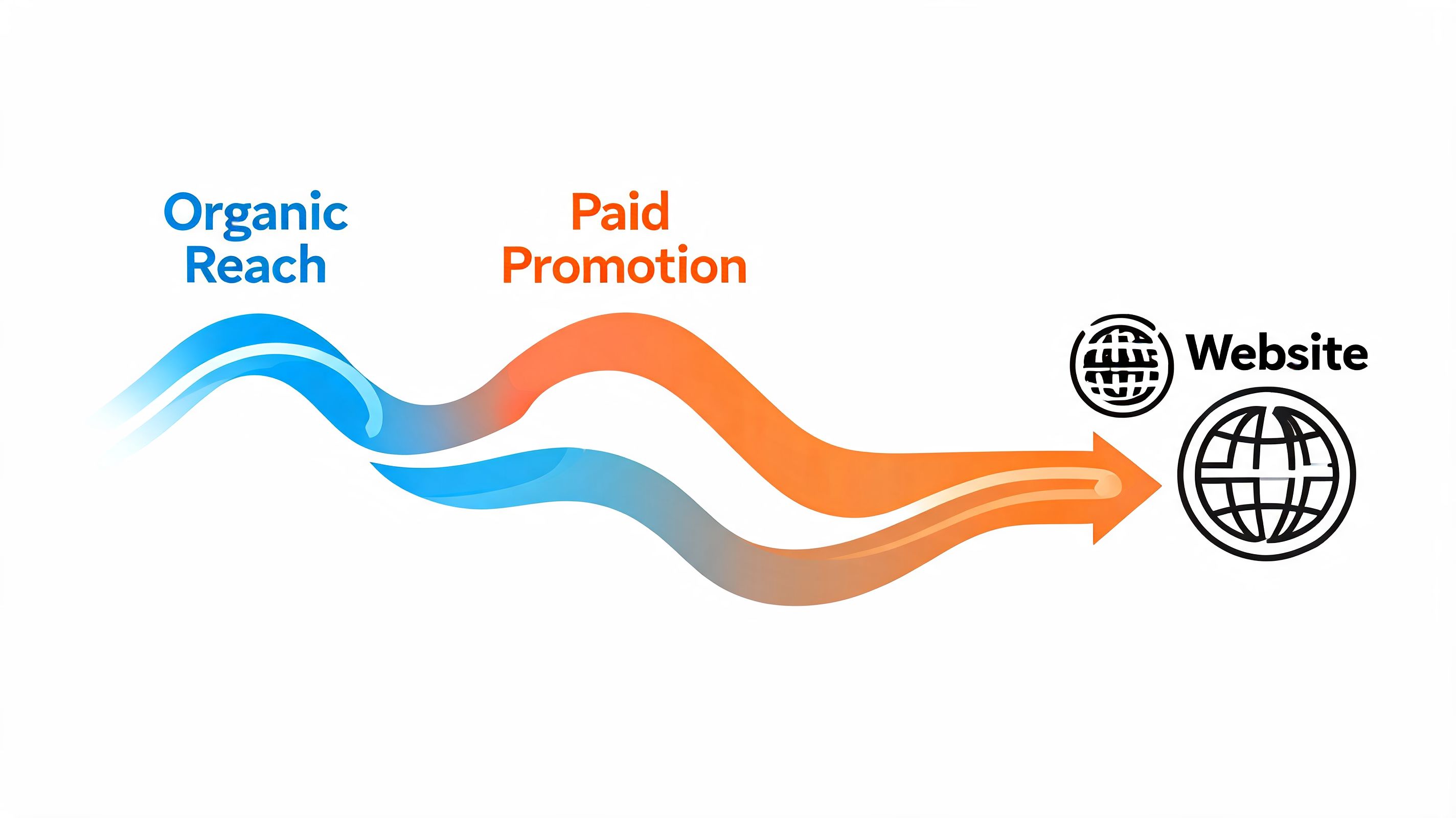
The reach potential is massive. Paid social media advertising can reach 3.5 billion people globally, with 20% of marketers reporting it as their highest-ROI channel for website visits. Also, influencer-amplified traffic generates an average of $6.50 in revenue for every $1 spent, based on Firebelly Marketing’s breakdown of social traffic growth.
What organic should do first
Organic content should validate three things before you spend:
- The hook works. People stop scrolling.
- The message is clear. The audience understands the offer or resource.
- The destination fits. Visitors don’t bounce because the landing experience matches the post.
If a post falls apart on any of those points, paid won’t fix it. It will just expose the weakness to more people.
Where paid actually helps
Paid works best in two situations.
Amplifying proven content
Take the post that already started meaningful conversations or sent decent traffic. Promote that, not the post you wish had worked.
Reaching adjacent audiences
Platforms let you target people who resemble your current visitors or engaged audience. That’s especially useful when you already know which creative angle pulls the right kind of click.
For campaign structure and creative testing ideas, this guide to boosting campaign success with ads is a useful reference even outside crowdfunding. The planning discipline applies broadly.
Don’t ignore influencer traffic
For creators and small brands, influencer collaboration often works better than polished brand ads because the traffic arrives with context. Someone trusted already framed the click.
Keep the collaboration tight:
- Use creators with audience fit. Relevance matters more than broad visibility.
- Match the landing experience. The destination should reflect the same message and tone from the post.
- Track quality, not just click volume. A smaller batch of interested visitors beats a flood of curious but uncommitted traffic.
Paid and organic are not separate systems. Organic finds the angle. Paid scales it. Influencers add borrowed trust.
Measure and Optimize Your Social Traffic Funnel
If you don’t track beyond clicks, you’ll keep rewarding the wrong posts.
Traffic quality matters more than raw traffic volume. A post that sends fewer visitors can still be the winner if those people stay longer, view key pages, join your list, or contact you.
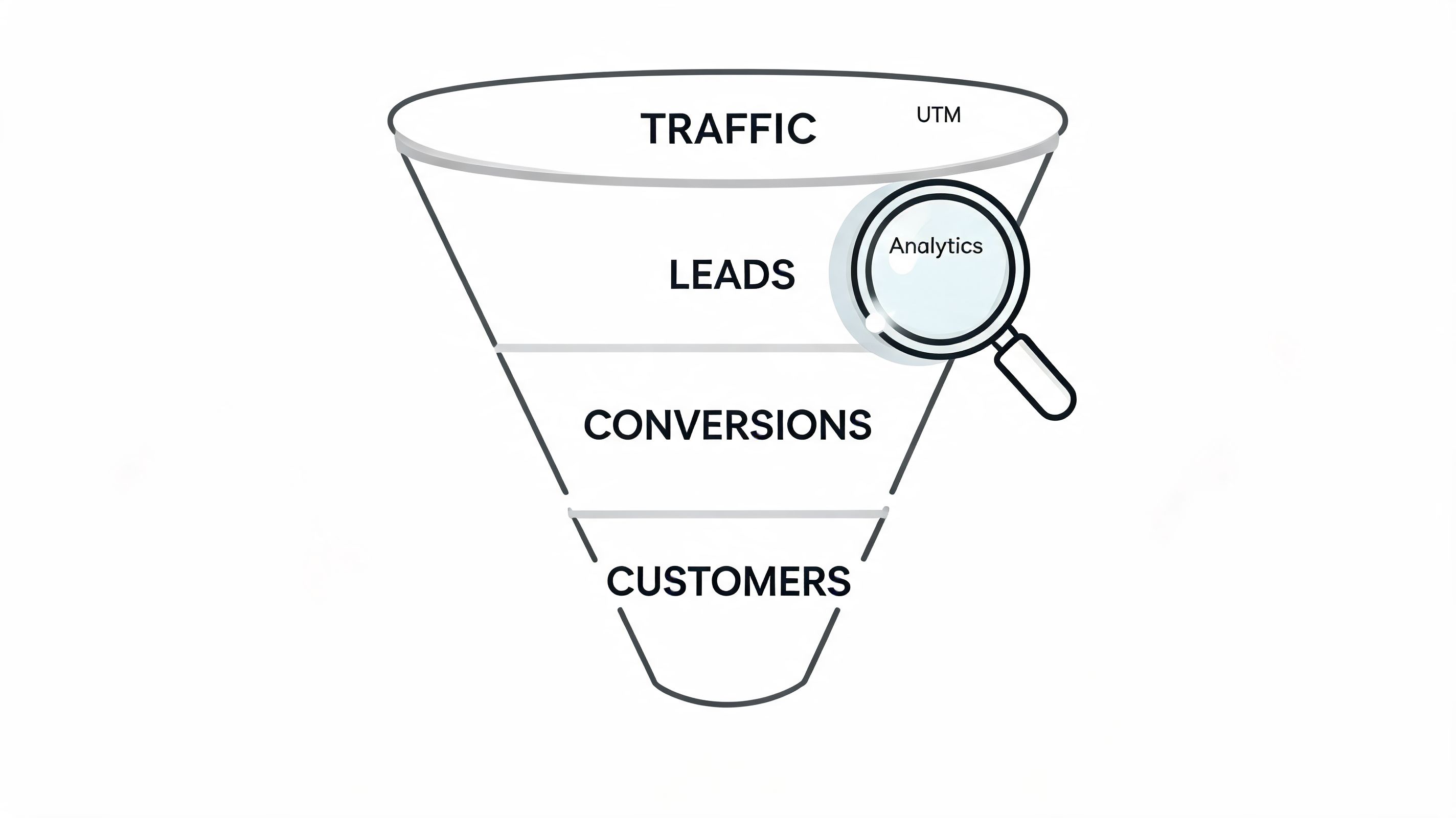
There’s a strong reason to care about richer page experiences here. Analytics show an 18% conversion uplift from websites using dynamic, interactive embeds. By using UTMs to track clicks from specific widgets and analyzing on-site behavior, creators can pinpoint their most valuable social traffic sources and optimize for repeat visits and email captures, according to Sesame Communications’ traffic analysis.
Use UTMs at the block level
UTMs are just labels added to a URL so analytics tools can tell you where a visitor came from.
Don’t stop at platform-level tracking. Track the exact asset.
For example, label links differently based on:
- Platform. Instagram, TikTok, Facebook, LinkedIn
- Content format. Reel, carousel, story, profile
- Bio page block. Portfolio tile, Spotify widget, newsletter card, booking button
- Campaign theme. Spring launch, free guide, service refresh
That tells you whether your traffic came from a Reel promoting a guide, a story linking to a booking page, or a specific block on your bio page.
Review behavior after the click
Inside your analytics tool, check what those visitors do.
Useful questions to ask
- Do they leave immediately, or do they continue into other pages?
- Which source sends the most engaged visits
- Which destination creates inquiries or email signups
- Which content angle attracts the wrong audience
A creator who sees strong clicks but weak downstream behavior usually has a message mismatch. A creator who gets modest clicks but strong conversion behavior has found a high-intent path worth expanding.
The right post isn’t the one that gets the most attention. It’s the one that sends visitors who act.
Build a monthly optimization loop
Keep the review simple so you’ll do it.
- Identify top traffic sources by post type and platform.
- Compare destination performance across blog posts, service pages, and signup pages.
- Promote the blocks that pull useful behavior.
- Rework or remove weak bio page elements that get seen but don’t get tapped.
- Turn winning traffic into owned audience through email capture, booking flows, or repeat-visit resources.
If you want a cleaner view of all of this, social media dashboard tools help centralize the traffic signals that matter without forcing you to piece everything together manually.
The point isn’t to become obsessed with dashboards. The point is to stop guessing. Once you know which post, which CTA, which block, and which destination drive outcomes, you can build a repeatable system instead of relying on lucky spikes.
If your current bio link is just a stack of URLs, rebuild it into a destination that helps visitors choose their next step. taap.bio lets you create a modular link-in-bio page with drag-and-drop layouts, smart widgets, and separate mobile and desktop editing, so your social traffic has somewhere better to land than a generic list.


