A strong Instagram bio usually combines four things inside Instagram's 150-character limit: a clear value proposition, relevant offer categories, one focused CTA, and a destination link such as a link-in-bio page. Because spaces, punctuation, emojis, and line breaks all count toward that cap, every word has to help the right visitor understand what you offer and what to do next.
Still treating the bio like a mini résumé wastes one of the highest-intent spots on the platform. Instagram profiles often act as a traffic gateway, and a large analysis of 1.7 million accounts found that 55% of profiles had a website link in the bio, with Linktree as the most common destination at 15.73%, followed by YouTube at 9.22% and Facebook at 2.09% in that 2022 dataset, as reported by Business Insider's coverage of the Instagram link in bio analysis.
Treat your bio like the first screen of a compact creator funnel. Every element should earn its place by doing one of three jobs: clarifying the audience, presenting the offer, or moving a visitor toward a measurable action like a sale, booking, or email signup.
That changes what to put in Instagram bio. You don't need more personality filler. You need tighter positioning, better category labels, and a destination that matches the promise in the copy.
Below are 10 practical elements worth considering. Use the ones that support your primary goal, then cut the rest.
Table of contents
1. Direct Link to Your Link-in-Bio Page
If you sell more than one thing, don't send people to a random homepage. Send them to one page built for Instagram traffic.
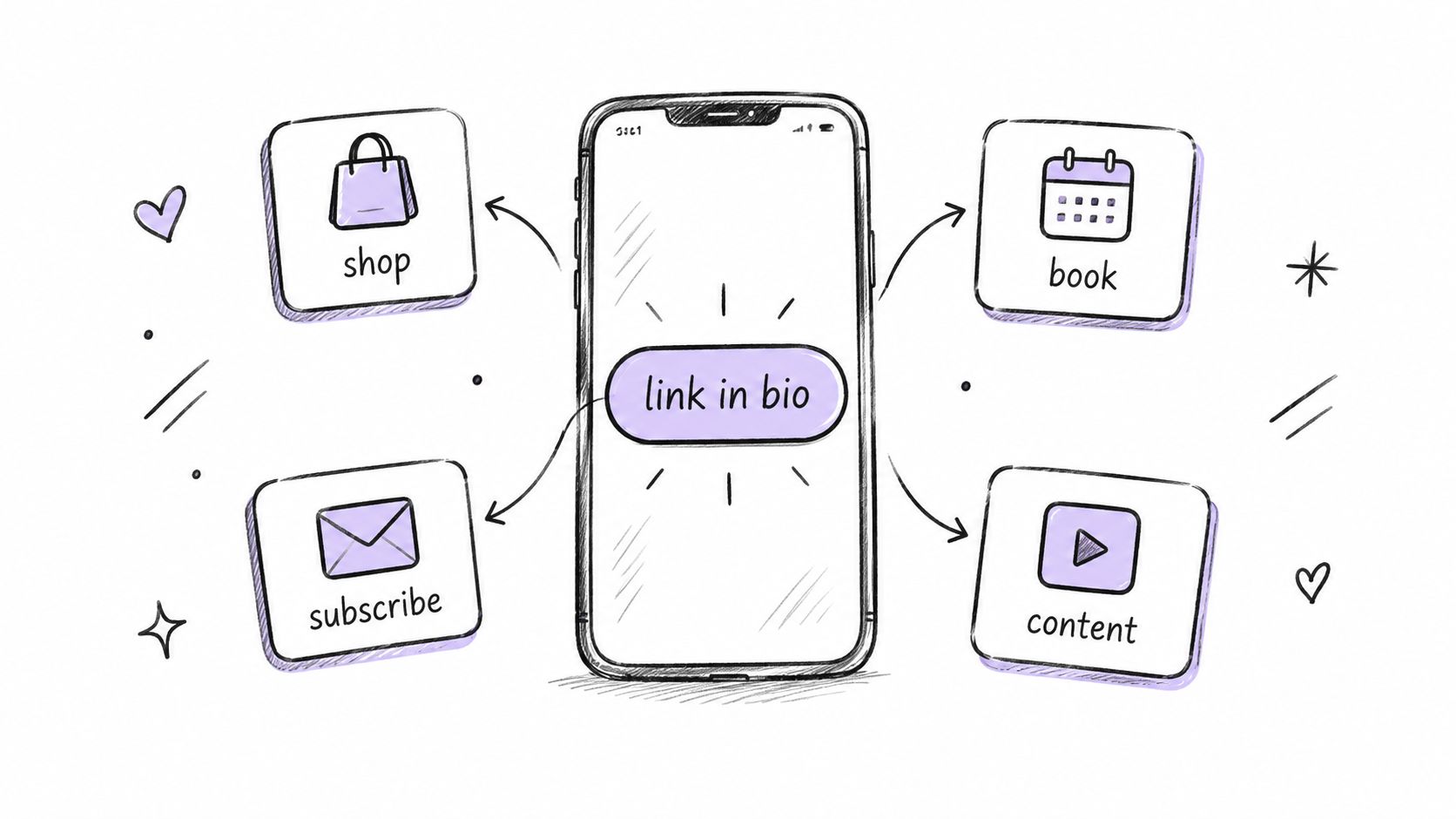
A musician can route fans to Spotify, merch, and tickets from one page. A coach can route visitors to booking, a paid offer, and an email signup. A real estate agent can send people to listings, a consultation form, and neighborhood guides.
Make the destination easy to trust
Use a short branded URL when possible. A custom domain looks cleaner in podcasts, business cards, and Stories than a long platform subdomain.
If you want a dedicated page for this setup, see Instagram link in bio landing page examples. The key is not the tool itself. The key is keeping the click path obvious.
Practical rule: The page linked in your bio should answer the same promise your bio makes, without forcing visitors to hunt.
Many creators lose momentum after the click because the destination offers too many choices. Independent 2026 benchmarking reported that only about 25% to 40% of bio-link visitors take any action on the destination page, while bio-link click rate itself is typically 3% to 5% of followers per month, according to this Instagram bio link traffic benchmark. That's a strong reason to simplify the page and prioritize one profitable next step.
Before you publish, test the link on iPhone, Android, and desktop. If the page loads slowly, hides the main action, or buries your best offer below filler, fix the page before rewriting the bio.
A quick walkthrough helps:
2. Clear Value Proposition or Tagline
Your first job isn't to sound interesting. It's to tell the right person why they should care.
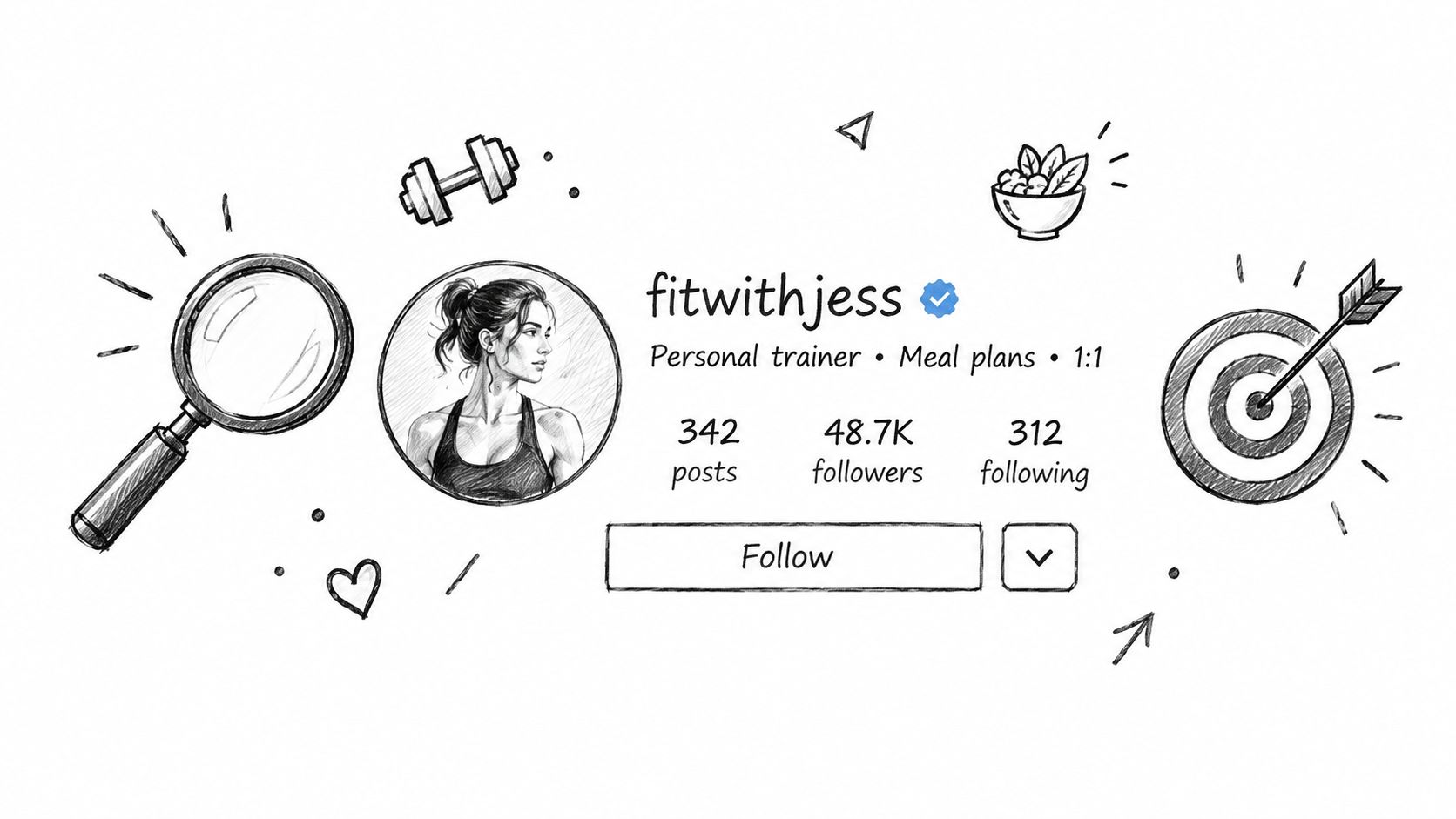
A good value proposition says who you help, what you help them do, and how you deliver it. That can fit in one line if you cut vanity filler.
Examples:
- Coach: “Helping founders fix messy messaging | 1:1 strategy”
- Artist: “Original prints, commissions, and tutorials”
- Fitness creator: “Strength coaching for busy women who hate long workouts”
- Consultant: “SaaS positioning and homepage strategy for lean teams”
Write it like above-the-fold copy
The easiest way to improve a weak bio is to borrow homepage thinking. The same clarity that works in a landing page headline works in a bio. This is why SaaS homepage above the fold copy principles are useful here too.
You don't need credentials first. Lead with the offer. If you need help tightening the promise, use a simple value proposition framework for creators.
Avoid lines like:
- Passionate creator
- DM for collabs
- Living life
- Helping you thrive
Those say almost nothing. A better bio makes the audience visible inside the sentence.
Write for the person who just landed on your profile from a Reel. They should know within a glance whether they're in the right place.
If you're deciding what to put in Instagram bio, start here. Everything else performs better when this line is sharp.
3. Call-to-Action Button Text
Pick one action. Then say it directly.
Too many bios stack weak prompts like “shop | collabs | subscribe | contact.” That forces the visitor to choose before they understand the priority. You want the opposite. Remove the decision load.
Use one primary CTA
Strong CTA lines include:
- Book your session
- Shop the new drop
- Download the guide
- Join the newsletter
- Apply for coaching
- Watch the full tutorial
The wording should match how you make money. If your main offer is consulting, “Book a strategy call” beats “Check my links.” If your main offer is a digital product, “Get the template” beats “Learn more.”
A lot of profile traffic never converts, so clarity matters more than cleverness. One 2026 guide reported average bio-link CTR around 1% to 5% of profile visitors, with well-optimized profiles reaching roughly 4.7% and top-performing accounts hitting 8% to 10%, according to this Instagram profile-to-site conversion guide. That means your CTA should reduce ambiguity, not add personality fluff.
For copy ideas on the destination page itself, review these landing page best practices for creator pages.
A few direct rewrites:
- “Link below” becomes “Book your consult”
- “New stuff” becomes “Shop the collection”
- “Work with me” becomes “Apply for 1:1 coaching”
The best CTA in your bio is the one that sends people to the highest-value next step without explanation.
4. Emoji Strategy and Visual Hierarchy
Your bio should read like a mini menu. Emojis help visitors scan that menu in seconds.
Use them to label the parts of your conversion path. One icon for the offer. One for the next action. One for a supporting category if you need it. More than that usually turns the bio into visual noise.
A simple rule works well: if an emoji does not make the line easier to scan, delete it.
Instagram gives you very little room, so hierarchy matters. Bio limit references note that the bio is capped at 150 characters, and spaces, punctuation, emojis, and line breaks all count, as explained in this Instagram bio character limit reference. That makes every symbol a trade-off. A shopping bag can replace the word "shop." A calendar can signal booking faster than extra copy. Random sparkle icons do nothing unless sparkle is part of the brand and the offer still reads clearly.
Here is the difference in practice:
Cluttered
✨ helping you thrive ✨
👇 new things here
💖 DM for collabs
🎉 link below
Structured
📅 Book brand shoot
🛍️ Shop presets
💌 Join weekly email
The second version wins because each line points to a measurable next step.
Pick emojis with a job:
- 📅 for booking
- 🛍️ for products
- 💌 for newsletter or lead magnet
- 📍 for local relevance
- 🎥 or 🎙️ for content format
Match the icon to the destination. If the bio uses 📅, the linked page should show booking first. If the bio uses 🛍️, the visitor should land on products, not a generic link hub. For more examples, review these link in bio emoji formatting ideas.
5. Social Proof and Recent Achievements
Trust belongs in the bio, but only if it helps someone decide faster.
The mistake is stuffing in vanity signals that don't change behavior. Follower count, old press logos, and vague “as seen in” lines often waste space unless they directly support the buying decision.
Use proof that reduces hesitation
Better proof looks like this:
- Verified by Instagram
- Featured in a relevant publication
- Recent launch live now
- New client spots open
- Bestseller available now
- Returning soon for spring bookings
You can also rotate a timely achievement when it supports the current offer. A course creator might swap in “New workshop now open.” A photographer might swap in “Fall sessions booking now.” A musician might swap in “New single out now.”
For service businesses, outcome-focused proof usually beats ego-based proof. The same principle shows up in social proof examples for conversion pages.
Reality check: Only keep proof in the bio if it makes the next click easier. If it doesn't reduce doubt, cut it.
Keep claims verifiable. If you can't back it up, don't write it. Instagram bios are short enough that one false line can damage the whole profile.
A practical example:
- Weak: “Award-winning entrepreneur”
- Better: “Now booking Q4 brand strategy intensives”
- Better still: “Featured in Business Insider | Book a strategy call”
The second and third versions create clearer buying context. They don't just flatter the owner of the profile.
6. Email Signup or Lead Magnet Reference
An Instagram bio should do more than describe you. It should capture a contact you can reach again.
If email is part of your business, say so in the bio. Give people a reason to join before they ever hit your link. “Newsletter” rarely sells the click. A specific asset does.
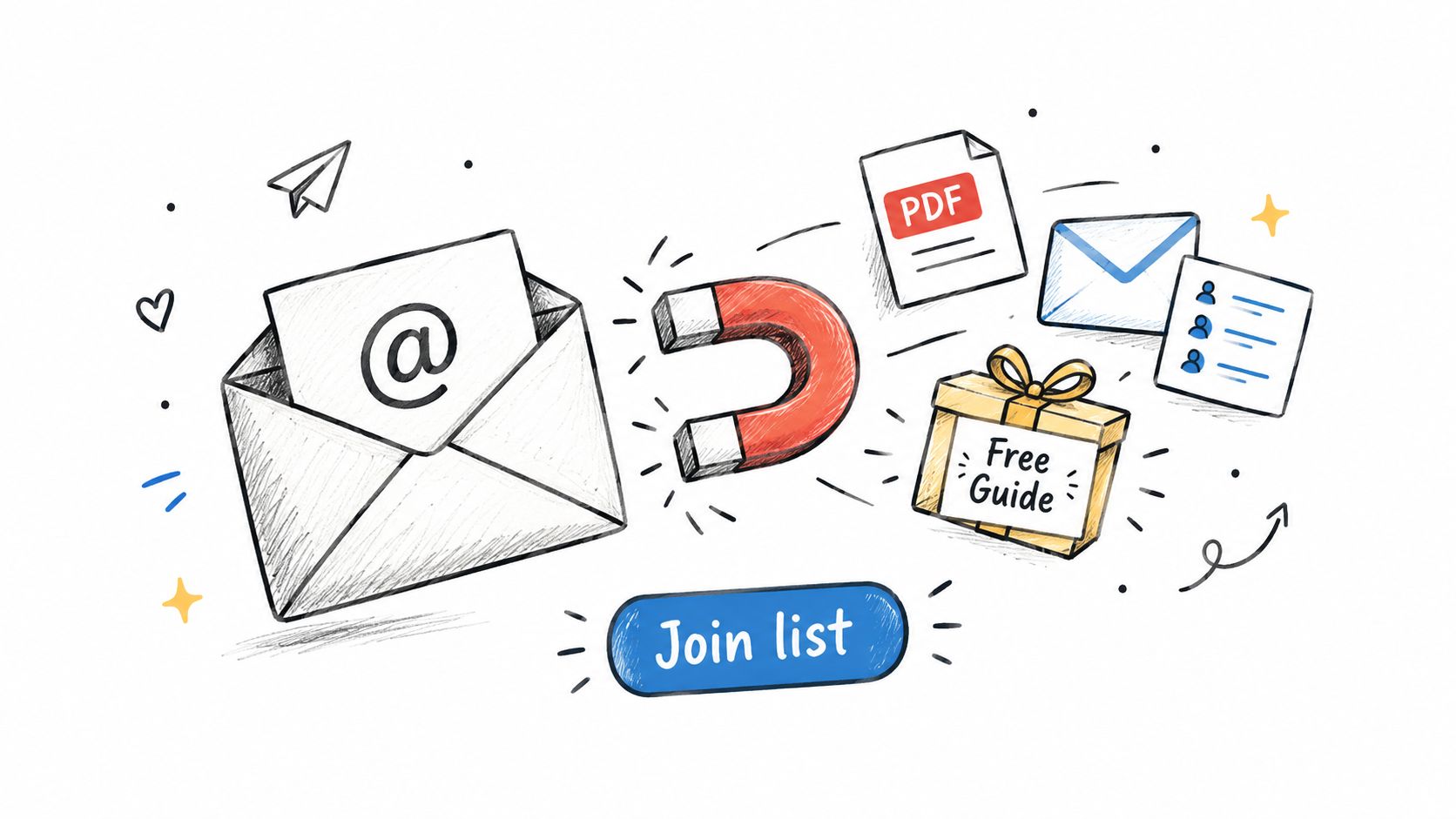
Use this simple test. If a visitor reads your bio and asks, “What do I get?”, your wording is too vague.
Write the offer like a mini product:
- Free pitch template
- Weekly creator growth notes
- Meal prep guide
- Homebuyer checklist
- Launch updates + bonus lesson
The best phrasing names the asset and the outcome. “Get the client outreach template” beats “Join my list.” “Free skincare routine guide” beats “Subscribe for updates.” The first version helps a visitor decide. The second asks for attention without giving a clear return.
Placement matters too. If email signup is one of your main conversion goals, feature it high on your link page and keep the path clean. One promise. One click. One signup form.
Instagram gives you broad link-tap data, not a clear picture of who clicked. As noted in this explanation of Instagram link click visibility and CTR context, that makes offer clarity even more important. You need wording specific enough to tell whether your bio is attracting qualified interest, not random taps.
Good bio references:
- Get the free swipe file
- Grab the buyer checklist
- Join for weekly deal drops
- Free lesson in the link
- Download the creator kit
Treat the email mention as a conversion step, not a side note. If the free offer supports your sale, booking flow, or launch pipeline, it deserves bio space. If it does not lead anywhere measurable, cut it.
7. Product or Service Categories
Your bio is not a catalog. It is a sorting tool.
Use product or service categories to qualify the click fast. A visitor should know, within one line, what you sell and whether the link is worth their tap. If your offers are mixed, categories do that job better than a vague title like “creator” or “consultant.”
Here's the standard to use. Each category should answer one of these questions:
- What can I buy?
- What can I book?
- What can I learn?
- What should I click for?
Strong category lines look like this:
- Digital products | Coaching | Newsletter
- Prints | Commissions | Tutorials
- Listings | Buyer guides | Consultations
- Courses | Templates | Advisory
- Meal plans | Training | 1:1 coaching
Keep it tight. Two to four categories is enough. Past that, your bio stops guiding and starts dumping options.
Priority matters more than completeness. Lead with the offer that drives revenue, supports your current campaign, or filters the best-fit visitor. If consulting is your main sale, put it first. If you are pushing a workshop this month, move it to the front.
A few examples make the difference clear.
A music producer can write “Beats | Mixing | Sample packs.” That tells visitors what is for sale and what kind of click comes next. A freelance designer can write “Brand identity | Web design | Templates.” That sorts clients from lower-ticket buyers. A real estate agent can write “Homes | Buyer consults | Market updates.” That covers search, service, and ongoing interest in one line.
Format is flexible. Clarity is not.
You can use pipe separators, simple emoji labels, or short stacked lines if readability stays clean:
- Coaching | Courses | Community
- 📚 Courses | 📞 Consulting | ✉️ Email list
- One category per line for short offer names
Only list categories that are available on the linked page. If the bio says “Templates” and the link leads to a generic homepage or a contact form, you create friction and lose buying intent. Every category in the bio should map to a clear destination, clear offer, or clear next step.
Treat categories like navigation labels for a compact conversion path. If a category does not help the right visitor choose, click, buy, or inquire, cut it.
8. Booking or Availability Information
If you sell your time, say that in the bio.
People won't assume you're available, what format you use, or whether they can book directly. Remove that friction. Spell it out.
Show the service and the booking state
Good booking lines include:
- Book a 30-min strategy call
- Coaching spots open
- Sessions available this month
- Photography bookings now open
- Apply for private consulting
This works especially well for coaches, consultants, freelancers, photographers, real estate agents, and service businesses. A direct booking line qualifies the click before it happens.
The most important part is matching the destination. Recent guidance on Instagram bio optimization stresses that the bio CTA should match the linked destination, and that one clear action often works better than multiple competing prompts, as discussed in this Instagram bio optimization article. If your bio says “Book now,” the visitor should land on a booking page, not a generic link list full of distractions.
A few useful details to include when they fit:
- Session type
- Duration
- Remote or in-person
- Whether spots are limited
- Whether applications are open
Keep availability current. An expired “Now booking” line makes the whole profile feel neglected.
For example, “Book a buyer consult” is stronger than “Let's connect.” “Portrait sessions open” is stronger than “DM for rates.” It sets a clearer expectation and filters casual messages.
9. Location and Geographic Relevance
Location earns bio space only if it changes who can buy, book, or inquire.
Treat it like a qualifier, not a personal fact. A city, region, or time zone should help a visitor answer one of three questions fast: “Are you near me?” “Do you serve my area?” “Can I work with you on my schedule?”
A good location line does one job well:
- NYC realtor for first-time buyers
- London stylist, virtual + in person
- Austin photographer, travel available
- EST consultant, remote worldwide
- Paris artist, ships internationally
Specificity sharpens fit. The same audience-framing logic in Apple and Notion brand positioning applies here. A tighter location cue helps the right visitor self-select faster.
Use the smallest useful label. City beats country for local services. Time zone beats hometown for remote calls. Service area beats vague travel claims.
Here's the practical rule. If geography affects delivery, trust, shipping, scheduling, or legal coverage, say it in the bio. If it does not, give that space to your offer or CTA instead.
A few strong use cases: A real estate agent can name the city and neighborhood focus. A coach can list EST or GMT to cut scheduling confusion. A wedding photographer can add “travel available” to widen the buying pool. A local shop can name its area if pickup or in-store visits matter.
“Based in Berlin” is weak for a digital product seller unless the location itself supports the sale. “Serving DACH startups” is stronger because it qualifies the audience and market.
10. Brand Voice and Personality Markers
Clarity sells first. Personality helps the right people stick.
The best bios don't sound corporate unless the account itself is corporate. They sound like a real person or a distinct brand. That doesn't mean being quirky for the sake of it. It means choosing words that fit your content and audience.
A few examples:
- “Helping first-time founders fix confusing messaging”
- “Making weird prints for people with excellent taste”
- “Plain-English money content for freelancers”
- “Strength coaching for women who want simple plans”
Use voice to sharpen fit
Your tone can be polished, funny, blunt, warm, nerdy, calm, or premium. Pick one and stay consistent with the destination page. If the bio feels playful and the landing page reads like enterprise software, the transition breaks trust.
Good personality markers are small:
- A niche phrase your audience already uses
- A slightly sharper verb
- A more human rhythm
- One memorable detail
If you need inspiration beyond Instagram, these bios for LinkedIn and websites show how voice shifts across platforms without losing clarity.
Avoid generic personality placeholders:
- coffee lover
- dreamer
- hustling every day
- making magic happen
Those lines are overused because they're easy to write. They're weak because they don't help someone decide whether to follow, click, or buy.
Your bio should sound like you on your best day. Clear, specific, and easy to trust.
Top 10 Instagram Bio Elements
| Item | 🔄 Implementation Complexity | ⚡ Resource Requirements | 📊 Expected Outcomes | 💡 Ideal Use Cases | ⭐ Key Advantages |
|---|---|---|---|---|---|
| Direct Link to Your Link-in-Bio Page | Low–Medium: set up landing page and map domain | Moderate: link-in-bio platform, optional custom domain, analytics | Consolidates traffic, improves tracking and conversion rates | Product sellers, creators, coaches needing centralized monetization | Centralized revenue path, branded experience, reduced drop-off |
| Clear Value Proposition or Tagline | Low: copywriting and iterative testing | Minimal: copy tests, occasional edits | Faster audience understanding and higher-qualified clicks | All creators; especially SaaS founders and influencers | Immediately communicates value and filters audience |
| Call-to-Action (CTA) Button Text | Low: write and place CTAs in bio/stickers | Low: copy variations, analytics for A/B testing | Higher CTRs (≈20–30%) and clearer visitor intent | E‑commerce, bookings, lead-generation campaigns | Directs action, improves conversion when specific |
| Emoji Strategy and Visual Hierarchy | Low: choose and arrange emojis for scannability | Minimal: testing across devices for consistency | Improved readability and quick category recognition | Multi-offering creators, international audiences | Enhances scannability and visual brand signature |
| Social Proof and Recent Achievements | Low–Medium: collect metrics and rotate highlights | Moderate: tracking, updates, possible verification efforts | Increased trust, urgency, and perceived authority | Coaches, course creators, product sellers | Validates credibility and encourages conversions |
| Email Signup or Lead Magnet Reference | Medium: create lead magnet and integrate signup | Moderate: email platform, lead magnet creation, nurture workflows | Builds owned audience, higher long-term LTV | Content creators, coaches, course sellers | Owns audience, enables repeat revenue and portability |
| Product or Service Categories | Low: list 2–4 offerings with clear separators | Minimal: copy and formatting aligned with page widgets | Faster user scanning and better click intent alignment | Creators with multiple revenue streams, e‑commerce | Clarifies offerings and directs targeted clicks |
| Booking or Availability Information | Medium: calendar/payment widget and policies | Moderate: scheduling tool, payment setup, calendar management | Directly converts followers into paid clients; fewer admin back-and-forths | Coaches, consultants, photographers, freelancers | Immediate paid conversion and professional positioning |
| Location and Geographic Relevance | Low: add city/timezone or service regions | Minimal: update bio and optional maps widget | Better local discovery and fewer irrelevant inquiries | Local service providers, real estate, in-person businesses | Attracts local clients and clarifies availability/timezone |
| Brand Voice and Personality Markers | Medium: define consistent tone and test iterations | Low–Medium: content refinement and audience feedback | Stronger audience alignment, loyalty, and differentiation | Personal brands, indie creators, community builders | Distinguishes brand, builds parasocial trust and retention |
Build, Check, and Test Your Bio
Start with the value proposition. Write one short line that tells the right visitor who you help, what you offer, or what they'll get from following you. Then add only the offer categories that support your main business model. If they don't help someone choose a next step, remove them.
After that, choose one primary CTA. Not three. Not a vague “check it out.” Pick the action that matters most right now, whether that's booking, buying, joining your list, or applying to work with you. Then make sure the linked destination matches the promise in the bio word for word. If the bio says “Book a strategy call,” the page should open with booking, not force visitors through extra options first.
Check every destination manually. Tap the link from your profile. Read the bio as if you've never seen your brand before. Open the page on different devices. Confirm the offer is active, the wording matches, and the first action is obvious. Link-in-bio traffic is selective, and weak alignment wastes the small set of visitors willing to click.
Then test one variable at a time. Try a benefit-led CTA against an urgency-led one. Test “Get the free guide” against “Join weekly growth notes.” Swap category order. Rotate a timely proof line. Keep the rest stable so you can learn something from the change.
If you use a tool like taap.bio, keep the page content aligned with the bio language. The page should reflect the same priority. If the bio pushes coaching, coaching should appear first. If the bio promotes a lead magnet, the signup should be easy to find. Don't let the linked page drift into a generic list of everything you've ever made.
Refresh stale details often. Old launches, closed bookings, expired promotions, and outdated achievements make a profile feel unattended. Update availability. Replace old proof with current proof. Change the CTA when the business goal changes.
That's the core answer to what to put in Instagram bio. Keep the promise clear, the action singular, and the destination aligned. A short bio can still do real conversion work when every character has a job.
If you want your bio link to do more than send people to a list of links, taap.bio gives you one page to sell products, take paid bookings, collect email signups, and track on-page actions. It fits this exact use case: write a tighter Instagram bio, send visitors to a destination that matches it, and make the next step easier to take.