Ever played with Lego? You start with a pile of individual bricks, each with a simple, standard design. But by combining them, you can build just about anything—a simple house, a sprawling spaceship, a detailed cityscape. That’s the perfect picture of modular design.
It’s an approach centered on building complex things from smaller, independent, and reusable parts, which we call ‘modules.’
Table of contents
So, What Exactly Is Modular Design?
At its heart, modular design is a mindset that champions flexibility and common sense. Instead of creating something as a single, giant, interconnected piece (what developers call a ‘monolithic’ structure), you build it from a collection of self-sufficient components.
Each module has its own specific job, and it does that one job really well without needing to know what the other modules are doing. This means you can add a new part, get rid of an old one, or just tweak a single component without the whole system falling apart.
Think about how a modern PC is built. You can pop in more RAM for better performance, swap out the graphics card for better gaming, or add another hard drive when you run out of space. Each of those parts is a module. You don't have to trash your entire computer just to get more storage—you just replace one piece. It’s a brilliant real-world example of modular design saving you time and money while giving your setup a longer, more useful life.
Why Independent Parts Are a Game-Changer
The real power of this approach comes from how these separate pieces connect and work together. Because each module is built to stand on its own, different people or teams can work on different parts at the same time, which dramatically speeds up the whole process.
This separation also makes fixing problems a breeze. If one component stops working, you know exactly where to look. You only have to fix or replace that one module, not take apart the entire system to find the source of the issue.
This philosophy brings a few key advantages to the table:
- Ultimate Flexibility: You can adapt, update, or completely reconfigure a system just by swapping modules.
- Serious Efficiency: It's way faster to assemble something from pre-built, standardized parts than to create every single thing from the ground up.
- Effortless Growth: Want to add new features? Just plug in a new module. The system can grow with your needs.
By breaking down a big, intimidating system into a set of smaller, manageable pieces, modular design makes even the most complex projects feel achievable. It changes the goal from building one perfect, finished product to creating a living, breathing system of components that can adapt and evolve over time.
The Four Pillars Of Modular Design
To really get a handle on modular design, you have to understand the four core principles that give it its power. These aren't complicated technical rules, but rather common-sense ideas about how independent pieces can snap together to build something flexible and strong. Think of them as the foundational pillars holding up any great modular system.
Let’s stick with a simple analogy: your kitchen. Each appliance is a module. You've got a toaster, a blender, a coffee maker, and a microwave. Each one is a self-contained unit built to do one specific job really well. This is the first, and most important, pillar.
Modularity: The Building Blocks
The principle of modularity is all about the decision to break a big, complex system into smaller, self-contained parts. Instead of having one giant, clunky machine that tries to do everything, you have individual appliances. Each module—your toaster or your blender—is designed, built, and operates on its own.
This separation is the secret sauce. If your toaster breaks, you don't have to tear out your entire kitchen; you just fix or replace that one unit. In the digital world, this means a glitch in your website's photo gallery won't bring down your entire online store. It neatly isolates problems, making everything much easier to manage.
Encapsulation: The "Black Box" Effect
Next up is encapsulation. This idea is simple: you should be able to use a module without needing to know the nitty-gritty details of how it works inside. You use your microwave by pushing a few buttons; you don't need a degree in electrical engineering to understand the magnetron tube humming away inside.
All the complex inner workings are hidden—or "encapsulated"—behind a simple interface. For a creator's link-in-bio page, this means you can drag and drop a YouTube video block onto your page without ever seeing or touching the complex code that fetches data from YouTube's API. You just interact with the simple controls you're given.
Encapsulation protects you from complexity. It allows the internal parts of a module to be updated or improved without breaking the way you use it, keeping the whole system stable and user-friendly.
Reusability: Your Go-To Tool
Then we have reusability, which is where modular design really starts to pay off in terms of pure efficiency. Think of your favorite coffee mug—you use the same one every single morning. It's a reliable, proven component you can use again and again without reinventing the wheel each time.
In the world of design and development, this is a massive time-saver. Instead of coding a new "contact me" button from scratch for every single page, you build one standard button module and reuse it wherever you need it. A 2023 study actually found that reusing software components can slash development time by an incredible 40-80%.
This concept map helps visualize how these principles work together to create a system that’s flexible, efficient, and ready to grow.
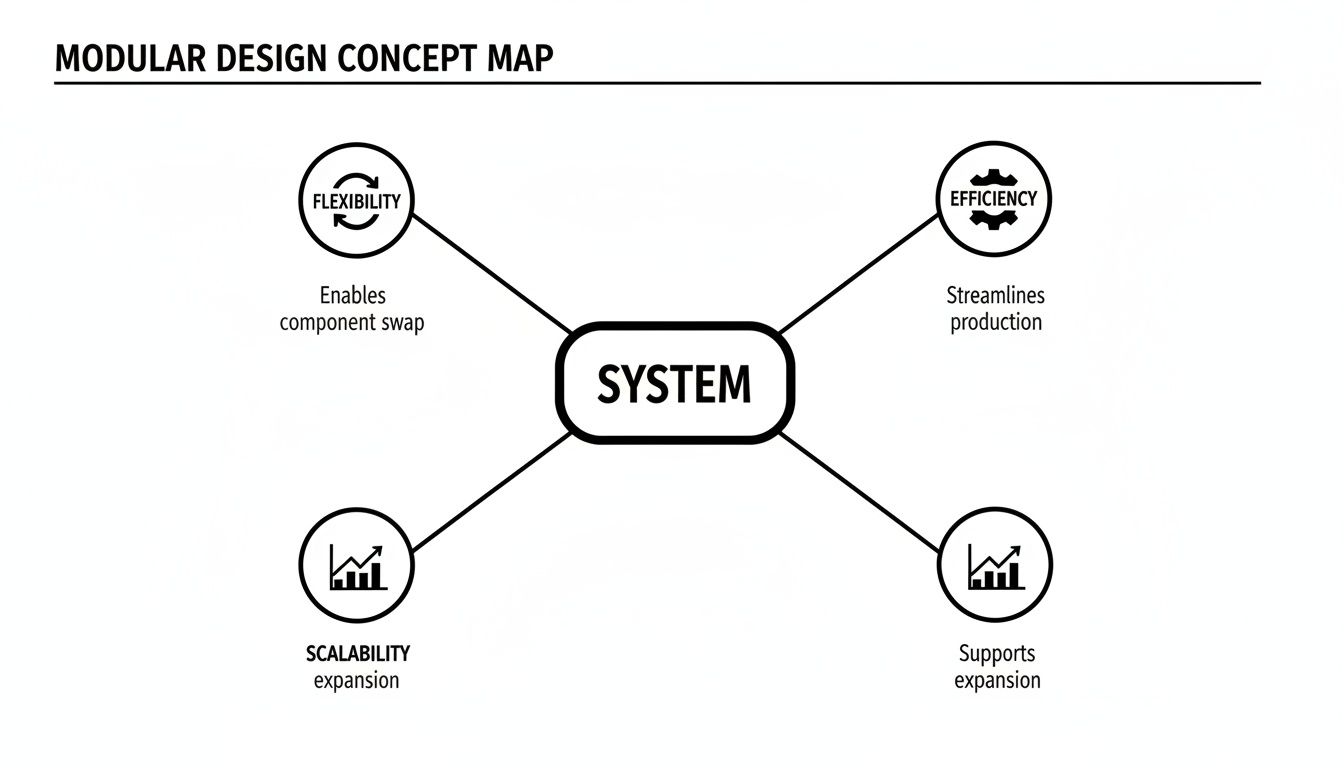
As you can see, the core benefits of a modular system—like the freedom to swap parts, the efficiency of building things faster, and the ability to scale up—are direct results of these design principles.
Composition: The Artful Arrangement
Finally, composition is the art of arranging all these individual modules to create something that feels cohesive and works perfectly. It’s how you place your toaster, coffee maker, and fruit bowl on the kitchen counter to create a morning routine that just flows.
This is where your unique creative vision comes to life. On a link-in-bio page, composition is how you organize your video player, your latest blog posts, and your social links. Do you lead with a big, bold video at the top, or a clean grid of your portfolio work? The way you combine these modules is what tells your story.
How Ancient Builders Mastered Modularity
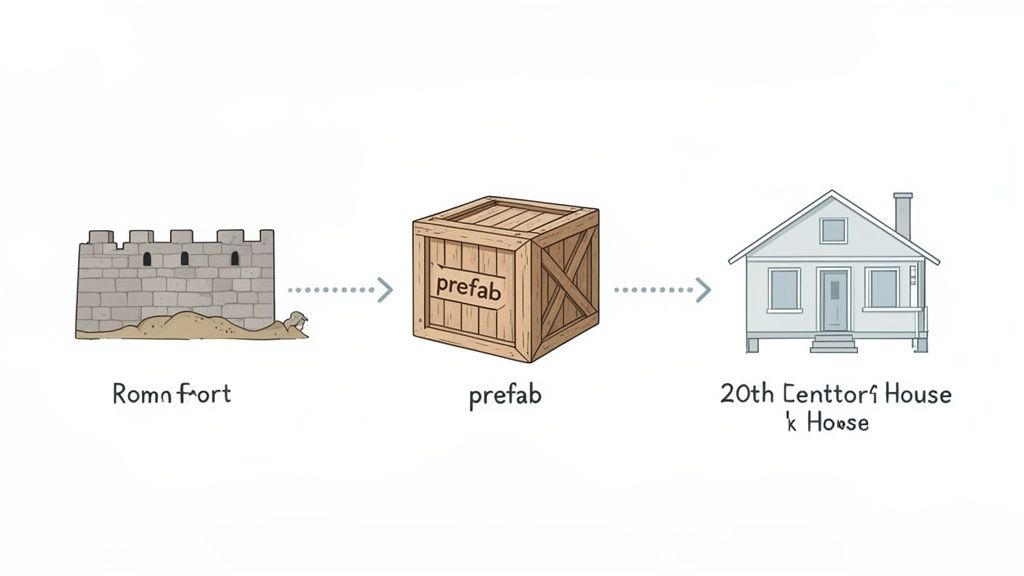
This whole idea of building big things from smaller, independent parts? It’s not some new-age tech concept. It’s an age-old strategy that’s been fueling human innovation for thousands of years. Long before we were dragging and dropping widgets on a screen, ancient builders were proving that what is modular design is really about being smart, practical, and efficient.
Take the Roman Empire. As the legions pushed across Europe, they had to throw up secure forts in a hurry, often in enemy territory. Their brilliant solution was essentially a flat-pack fortress. Military engineers designed standardized sections for walls, towers, and gates that could be made elsewhere, transported, and snapped together on-site. This let them build a fully functional, defensible camp in mere hours.
From Forts To Mail-Order Homes
That same thread of thinking—building with blocks—never really went away. It just evolved, popping up again in architecture. While the first "prefabricated" house patent was filed way back in 1837, the concept really hit its stride during the California Gold Rush. The sudden flood of people created a housing crisis, and modular construction was the only way to keep up.
But it was Sears, Roebuck & Co. that truly brought the idea to the masses. Their Modern Homes catalog, launched in 1908, completely changed the game for the average American family wanting to own a home.
You could flip through a catalog of over 400 different house styles, pick the one you liked, and Sears would ship you a complete kit. We're talking thousands of pre-cut, numbered pieces—everything down to the last nail and doorknob—all delivered by rail.
It was a runaway success. Sears sold over 75,000 of these mail-order homes, proving that even something as complex as a house could be built affordably and efficiently using standardized parts. This journey from Roman forts to mail-order catalogs tells a powerful story, and you can learn more about how modular architecture has shaped design from these early examples.
The Timeless Power Of Modules
Whether you’re snapping together a fortress wall or assembling a three-bedroom bungalow, the core logic is identical: break a massive project down into smaller, repeatable chunks. This early mastery of modular thinking made things more efficient, easier to build, and far more adaptable.
It's the same philosophy that paved the way for everything from the personal computer to the customizable link-in-bio pages you can create with a tool like Taap.bio. Understanding these historical roots makes it clear that modularity isn't just a fleeting trend—it’s a battle-tested strategy for solving complex problems.
From The Assembly Line To The Digital Age
While the idea of using standard parts has been around for centuries, it was the Industrial Revolution that really kicked modular design into high gear. This wasn't just about steam engines and new factories; it was about a fundamental shift in how we make things—building with standardized parts to create products faster and more reliably than ever before.
Think about Henry Ford’s legendary assembly line. Before Ford, cars were painstakingly built one by one, a slow and expensive process reserved for skilled artisans. Ford flipped the script. By breaking down car manufacturing into simple, repeatable steps using interchangeable parts, he didn't just invent mass production; he showcased modular thinking at a monumental scale.
From Housing Booms To Digital Blocks
This same revolutionary idea found new life after World War II. With soldiers returning home, the United States was staring down a massive housing shortage. The answer? Prefabrication. Manufacturers took the techniques they’d perfected during the war, building entire sections of houses in a factory before shipping them out for quick on-site assembly. This modular approach delivered affordable housing at a speed no one thought possible.
The factory-based mass production of the Industrial Revolution, perfectly captured by London's Crystal Palace in 1851 with its interchangeable cast-iron parts, laid the groundwork. When you combine that with the raw efficiency of Ford's 1913 assembly line, you can see how modular construction became such a powerful solution. You can dive deeper into the historical perspective of modular construction's evolution to see just how big its impact was.
It’s a surprisingly straight line from Ford’s assembly line and those post-war prefab homes to the digital world we live in today. The UI component libraries that web developers rely on, or the little API-driven widgets on your phone's home screen, are the direct descendants of those factory-made parts.
Just as a standardized window frame could be slotted into any house, a modern "social media widget" can be dropped into any digital layout without needing to be built from scratch.
This Taap.bio page is a perfect example of this principle in action.
Look closely. Every element—the profile picture, each link block, the row of social icons—is its own independent module. They’re all arranged on a flexible grid, ready to be moved, customized, or swapped out.
Platforms like Taap.bio have essentially given creators a digital assembly line for their personal brand. You get to build a unique, professional-looking page not by coding it from the ground up, but by combining high-quality, pre-built parts.
Putting Modular Design Into Practice Today
So, how does all this theory actually help you? The real power of modular design isn't in the concept; it's in the execution. It's about taking these ideas and using them to build something that truly represents you. This is where a tool like Taap.bio comes in, turning a cool design principle into a practical tool for creators.
Think of it like building with LEGOs. Each brick is a self-contained piece, but you can snap them together in endless combinations to create anything you can imagine. Your Taap.bio page works the same way. Every piece of content you add is a distinct "module" or "block."
- A YouTube video embed? That’s a block.
- A Spotify playlist player? That’s a block.
- An image gallery showcasing your latest work? You guessed it—that's a block too.
Each one of these is a standalone unit. You can drag them around, resize them on a flexible grid, and arrange them however you want. You're no longer trapped in a rigid, top-to-bottom list. You have a canvas.
Composing Your Digital Hub
This hands-on approach completely changes the game. Imagine putting a big, auto-playing video right at the top to instantly wow your visitors. To the side, you could place a neat grid of your latest social media posts, giving people a quick peek at what you've been up to.
That’s the principle of composition at work. You're not just throwing links on a page; you're building a visual experience that directs your audience's attention. The goal is to create a dynamic hub for your brand, not just a static menu.
This layout from a Taap.bio page shows exactly what I mean.
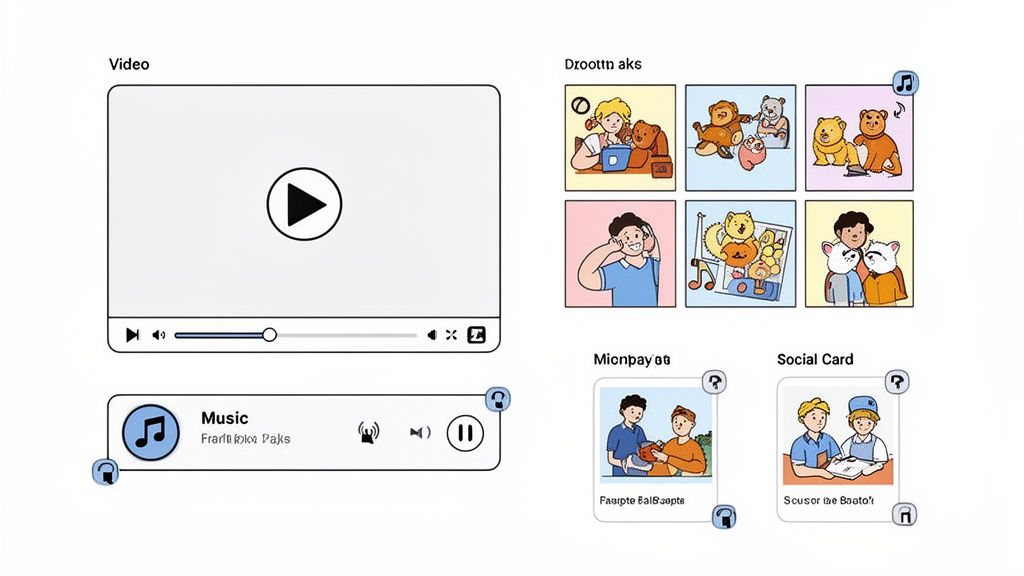
See how the different sized blocks for social profiles, media, and links create an experience that’s way more engaging than a simple list? It feels organized, intentional, and much more professional.
Modular tools give you the power to tell a story visually. The size, placement, and combination of your content blocks communicate what’s most important, turning a simple page into a strategic asset for your brand.
Beyond the Basic List: A Direct Comparison
Let's be clear: the gap between a traditional link list and a modular page is massive. One is just a signpost pointing elsewhere; the other is the actual destination.
To see the difference, let’s compare them side-by-side.
Traditional Link Lists Vs Modular Taap.bio Pages
| Feature | Traditional Link-in-Bio (e.g., Linktree) | Modular Taap.bio Page |
|---|---|---|
| Layout | Stuck in a single, vertical column of buttons. | A flexible grid for creative, custom layouts. |
| Content | Mostly just text links that send people away. | Interactive "smart widgets" that show live content. |
| Customization | Limited to basic colors, fonts, and a background. | Full control over block size, placement, and page flow. |
| User Experience | A quick stopover on the way to other sites. | An immersive hub where people can watch, listen, and engage. |
Ultimately, a modular approach makes sophisticated design accessible to everyone. You don't need to be a web developer or write a single line of code to apply these powerful principles.
It transforms your link-in-bio from a simple utility into one of your most powerful creative outlets.
Why Modular Design Is The Future For Creators
In a space this crowded, a simple list of links just doesn't cut it anymore. We need to think bigger. Modular design isn't just some clever web-building trick; it's the future for creators because it directly solves the biggest problems we all face: grabbing attention, moving fast, and keeping total creative control.
It’s about shifting your mindset away from static lists and toward building a dynamic, interactive experience for your audience.
This whole approach is built on flexibility. Got a new video that’s blowing up? Put it front and center on your page. Dropping a new product? Give it the spotlight. With modular blocks, you can completely re-arrange your digital storefront in minutes, not hours, keeping everything fresh and relevant without needing to know a lick of code.
This isn’t just a digital fad, either. It mirrors a huge shift we're seeing across industries that need to build things efficiently and well. Take the construction world, for instance, where modular methods are taking over. A whopping 71.4% of firms using modular building reported massive schedule advantages, and the entire market is booming. These modular construction stats and what they say show the same core idea: use high-quality, pre-built components to assemble something incredible.
Stop Thinking in Lists and Start Building in Blocks
Ultimately, modular design is about being able to grow without limits. As your brand gets bigger, your link-in-bio page should grow with you, not hold you back. Adding a new podcast, a newsletter, or a merch line becomes as simple as plugging in a new module.
You stop being a manager of links and become the curator of a living, breathing portfolio that evolves right alongside your ambitions.
Modular design puts the power of professional design philosophy into every creator's hands. It gives you the ability to build a truly unique and interactive destination, turning a simple link into a serious competitive advantage—all without writing a single line of code.
This is exactly where platforms like Taap.bio come in. They give you all the building blocks, but you are the architect. This level of control means you can craft a visually stunning hub that perfectly captures your brand's personality, pulls your audience in deeper, and turns casual followers into a true community.
The future isn't a list; it’s a canvas.
Got Questions About Modular Design? We've Got Answers.
We've thrown a lot of concepts at you, and it's totally normal for a few questions to pop up. Let's tackle some of the most common ones we hear from creators just like you.
Is Modular Design Only For Websites?
Absolutely not! While you hear about it a lot in web design, the core idea of building with independent parts is everywhere.
Think about building a gaming PC—you can swap out the graphics card or add more RAM without having to replace the entire computer. Or consider a modern marketing campaign, where you can easily test different headlines, images, and calls-to-action to see what works best. That's modular thinking in action: creating a system from self-contained, interchangeable pieces.
How Is This Different From "Normal" Design?
Traditional design is a bit like a jigsaw puzzle. Every piece has one specific spot, and if you move or change a single element, the whole picture falls apart. It’s a static, all-or-nothing approach.
Modular design, on the other hand, is like playing with LEGO bricks. Each block is its own complete unit. You can snap them together, rearrange them, and add or remove pieces whenever you want without breaking the entire structure. This gives you incredible freedom to evolve and adapt your creation over time.
The real difference comes down to this: traditional design is built to be finished, while modular design is built to change. For a creator whose world is always moving, that flexibility is a game-changer.
Is It Hard To Learn?
Not with the right tools. For creators using platforms like Taap.bio, the learning curve is basically flat.
You don't need a degree in design theory or a background in coding. The system is built on intuitive, pre-made modules. You just drag, drop, and arrange them however you see fit. All the complex stuff happens behind the scenes, leaving you free to focus on what really matters—bringing your creative vision to life.
Ready to stop just listing links and start building an experience? With Taap.bio, you can craft a dynamic, modular link-in-bio page that truly reflects who you are. Get started for free and build your unique hub today.