Your musician bio is more than just a formality; it's a strategic asset that can book you gigs, captivate journalists, and turn casual listeners into devoted fans. Too often, artists treat their bio as an afterthought, a block of text to fill a required field. This is a massive missed opportunity. A generic, uninspired bio leaves connections and career chances on the table, while a great one tells your unique story, establishes your credibility, and convinces industry gatekeepers and new audiences to press play.
Understanding your bio's purpose as a marketing tool is crucial, as it's a key component of a professional press kit designed to secure opportunities. It's your first, and sometimes only, chance to define your sound, share your vision, and make a memorable impression. A powerful bio works for you 24/7, speaking to promoters, bloggers, and potential collaborators when you can't.
In this guide, we'll dissect 8 powerful musician bio examples, from the concise press-ready summary to the immersive narrative perfect for your Taap.bio page. We move beyond simple descriptions to give you a strategic breakdown of why each bio works. You will get templates and direct, actionable takeaways you can apply immediately to write a bio that opens doors. This isn't just about what to write; it's about how to write with purpose and impact. Forget the filler and let's craft a bio that truly represents your art and ambition.
Table of contents
1. The Concise Professional Bio (150-200 words, Formal Tone)
Think of this bio as your musical resume, designed for maximum impact in a minimal space. It’s the standard for serious industry players-press, bookers, and festival organizers-who need to know your credentials fast. This bio format cuts through the noise by focusing entirely on verifiable accomplishments, presented in a formal, authoritative tone.
A concise professional bio isn’t about telling your life story. Its purpose is to build immediate credibility and signal that you are a serious artist. By listing major awards, chart performance, and significant collaborations, you provide concrete evidence of your career's momentum and market value. This is one of the most effective musician bio examples because it speaks the industry's language: results.
Strategic Breakdown & Analysis
Let’s analyze how major artists use this format. Take Kendrick Lamar’s official bio. It doesn't waste time on his childhood influences; it immediately hits you with his Pulitzer Prize win, followed by a chronological list of critically acclaimed albums and Grammy awards. The Weeknd's bio does the same by highlighting Diamond-certified singles and record-breaking streaming numbers.
This strategy works because it anchors the artist's identity in undeniable success.
Key Insight: This bio format shifts the narrative from "who I am" to "what I have achieved." It replaces subjective storytelling with objective facts, making it powerfully persuasive for industry gatekeepers.
Actionable Takeaways & Implementation
You can apply this same high-impact approach, even as an emerging artist.
- Lead with your biggest win: Did you open for a national act? Win a local music award? Secure a significant blog feature? Start there.
- Quantify your success: Instead of saying "a growing fanbase," write "organically grew to 100,000 Spotify monthly listeners." Use specific numbers for streams, followers, or sold-out shows.
- Structure for skimmability: Use short, declarative sentences. Dedicate one sentence to each key achievement.
- Keep it current: Update this bio after every major milestone. A fresh, updated bio is essential for a professional artist's toolkit, a core component you'll find in the best musician press kit examples.
- End with a forward-looking statement: Conclude with your current single, upcoming tour, or next album to show you have active projects.
2. The Narrative Personal Bio (300-500 words, Conversational Tone)
If the professional bio is your resume, the narrative bio is your origin story. This format trades formal credentials for emotional connection, weaving a story that explains not just what you create, but why you create it. It’s perfect for indie artists and singer-songwriters who want to build a deep, personal bond with their audience by inviting them into their world.
A narrative bio succeeds by being authentic and vulnerable. It answers the deeper questions: What specific life events shaped your sound? What drives your artistic philosophy? This is one of the most powerful musician bio examples for fan conversion because it gives listeners a reason to invest in you as a person, not just as a musician. This format thrives on platforms like Bandcamp, personal websites, and in artist statements.
Strategic Breakdown & Analysis
Let’s examine how successful independent artists use this approach. Phoebe Bridgers’ bio often connects her melancholic songwriting to specific moments and influences from her youth, making her music feel like a direct extension of her life. Similarly, Clairo's origin story, which links her bedroom pop beginnings to her current polished sound, creates a relatable arc that resonates with young fans and aspiring creators.
This method works because it transforms a bio from a simple information dump into an engaging piece of storytelling that builds a genuine community.
Key Insight: This bio format shifts the focus from "what I've done" to "who I am and why it matters." It builds a brand identity rooted in personality and purpose, making your music more memorable and meaningful to listeners.
Actionable Takeaways & Implementation
You can build a compelling narrative that captivates new fans, even if you're just starting.
- Start with a defining moment: Begin with a specific memory or turning point that ignited your musical journey. Instead of "I've always loved music," try "The first time I heard...".
- Use sensory details: Bring your story to life. Describe the "dusty attic" where you wrote your first song or the "roar of the crowd" at your first open mic.
- Connect past to present: Explicitly link your experiences to your musical style. Explain how a background in classical piano led to your intricate electronic arrangements.
- Answer the 'why': Clearly articulate what compels you to make music. Is it to process emotions, tell stories, or create a specific feeling for your audience?
- Keep it readable: Break your story into 2-3 short paragraphs. This ensures it's easy to read on mobile devices, where most fans will encounter it.
3. The Minimalist Artist Statement (50-100 words, Poetic/Artistic Tone)
This bio is less of a biography and more of a poem. It prioritizes aesthetic and emotional resonance over career milestones or personal history. Perfect for experimental musicians, ambient artists, and producers, this format uses a few carefully chosen words to create a powerful sense of identity and mystique. The goal is not to inform but to evoke a feeling, creating a direct line to the core of your artistic vision.
The minimalist artist statement works by stripping away all non-essential information, leaving only a concentrated expression of your sound or philosophy. This approach is one of the most intriguing musician bio examples because it invites curiosity rather than providing answers. It frames your music as a piece of high art and positions you as a creator with a distinct, confident point of view, where the work itself is the primary message.
Strategic Breakdown & Analysis
Let’s look at how innovators in the electronic and avant-garde scenes use this approach. Arca's statements often read like poetic fragments, exploring themes of emotional synthesis and identity. Ryoji Ikeda’s bio explains his work as a direct translation of data into sound and light. These descriptions don't list accomplishments; they articulate a conceptual framework.
This strategy is effective because it creates an aura of intention and depth. It tells an audience that your music isn't just a collection of songs but a deliberate artistic exploration.
Key Insight: This bio format shifts the focus from "what I've done" to "what my art is about." It replaces biographical facts with a conceptual or emotional hook, which is highly effective for genres that value atmosphere and intellectual engagement.
Actionable Takeaways & Implementation
You can adopt this artistic approach to build a powerful and memorable brand identity.
- Focus on one core idea: What is the central theme of your music? Is it memory, chaos, nature, technology? Distill it into a single, powerful sentence.
- Use vivid, sensory language: Instead of saying you make "atmospheric music," write "composing audio fog for quiet rooms." Use words that create a mental image or feeling.
- Keep it extremely short: One to three sentences is ideal. The brevity is part of the impact. Test it by reading it aloud; it should feel deliberate and complete.
- Pair with strong visuals: This bio works best when presented as a design element, like a large text block on your website or on your link-in-bio for artists page, paired with abstract imagery that matches the tone.
- Update only when your vision changes: This isn’t a bio you update with every new single. It should only change when your core artistic direction shifts in a fundamental way.
4. The Genre-Specific Technical Bio (200-300 words, Informative/Specialized Tone)
This bio is an insider’s handshake, written for the true connoisseurs of your genre. It ditches broad appeal in favor of deep credibility within a niche community. For scenes like electronic, jazz, metal, and classical music, technical language isn't just jargon; it’s the vocabulary of passion and expertise. A well-crafted technical bio proves you speak the language and understand the culture.
The purpose here is to connect with a highly informed audience-dedicated fans, genre-specific bloggers, and specialist labels-who value deep knowledge. Instead of simplifying your sound, you lean into its complexity. This approach is one of the most potent musician bio examples for artists in technical fields because it demonstrates mastery and a genuine connection to the genre's heritage and evolution.
Strategic Breakdown & Analysis
Let's examine how top-tier artists in specific genres deploy this. Thundercat's bio materials frequently mention his six-string bass, complex jazz fusion harmonies, and funk sensibilities. This isn't just a list of influences; it's a specific signal to fellow musicians and jazz fans about his technical prowess. Similarly, electronic artist Jon Hopkins' bios often detail his use of specific analog synths and field recordings, creating a picture of his meticulous sound design process for listeners who appreciate ambient textures and production detail.
Artists like Ihsahn, a pioneer in progressive black metal, discuss symphonic composition and advanced guitar techniques, appealing directly to a metal audience that prizes musical complexity. This strategy builds a powerful bond with the core fanbase by validating their sophisticated understanding of the music.
Key Insight: This bio format creates an exclusive in-group. By using specialized language, you signal "I am one of you," which builds a stronger, more dedicated community around your art than a generic description ever could.
Actionable Takeaways & Implementation
You can build this same level of niche authority, no matter your current following.
- Assume reader knowledge: Don't explain what a "polyrhythm" or "sidechain compression" is. Use the terms confidently.
- Name your tools: Mention the specific software, synthesizer, guitar pedal, or instrument that defines your sound (e.g., "sculpted with Ableton's Wavetable synth," or "built around the warmth of a vintage Telecaster").
- Reference subgenres precisely: Instead of just "metal," specify "dissonant death metal with post-metal atmospherics." This shows you know your scene.
- Highlight unique techniques: Do you use a non-standard tuning? A rare production method? Mention it. It’s a key differentiator.
- End with a specific call-to-action: Guide fellow nerds to where they can see more. Link to your SoundCloud for unreleased tracks, your gear page, or a video breaking down a production technique.
5. The Social Media-Optimized Bio (280 characters maximum, Energetic/Casual Tone)
This is your digital handshake, the hyper-condensed bio engineered for platforms where attention is scarce and first impressions are everything. It's built for speed and personality on Instagram, TikTok, and X (formerly Twitter). The goal isn't to tell a story; it's to create an immediate hook that drives discovery and action within a tight character limit.
A social media bio serves two primary functions: defining your sound and driving traffic. It must quickly tell a new follower who you are musically and what they should do next, all while feeling authentic to your brand. These short-form musician bio examples are powerful because they pack identity, genre, and a call-to-action into a space smaller than a tweet, turning passive profile viewers into active listeners.
Strategic Breakdown & Analysis
Top-tier artists have mastered this art of brevity. Dua Lipa's bio often spotlights her latest project with a simple emoji accent, instantly directing fans to her current work. SZA's social bios are famously casual and personality-driven, making her feel accessible and relatable. Tyler, The Creator uses punchy, often all-caps phrases that reflect his bold artistic character.
This strategy works by treating the bio not as a summary but as a headline. It's the most valuable real estate on your social profile, designed to convert interest into a click.
Key Insight: A social media bio trades formal accomplishments for immediate personality and a clear call-to-action. Its success is measured not by what it says, but by the action it inspires-a click on your link.
Actionable Takeaways & Implementation
You can make your social profiles work harder for you by adopting this focused approach.
- Hook them instantly: Start with your most compelling identity statement. "Indie-pop songwriter" or "Guitarist for [Band Name]" are good, but "Sad songs for sunny days" is better.
- Use genre slashies or emojis: Clearly define your sound with formats like "Synth-Pop / Alt-Rock" or "🎤 Songwriter | 🎹 Producer".
- Add your location: If you're building a local following or are known in a specific scene, include your city (e.g., "Nashville, TN").
- Direct the traffic: Always include a strong call-to-action pointing to your link-in-bio. Phrases like "New single out now ⬇️" or "Listen here →" are effective.
- Update relentlessly: This bio should change with every new release, tour announcement, or major piece of press. A static social bio signals a static career. For more ideas on keeping your profiles fresh, check out these strategies on how to promote music on social media.
6. The Collaborative/Band Bio (400+ words, Narrative + Informative Tone)
A band is more than just a collection of musicians; it's a living entity with a story, chemistry, and a shared purpose. The collaborative band bio is designed to capture this dynamic, blending individual personalities with a collective narrative. It moves beyond a simple list of members to explain how the group formed, how they create together, and what makes their collaboration unique.
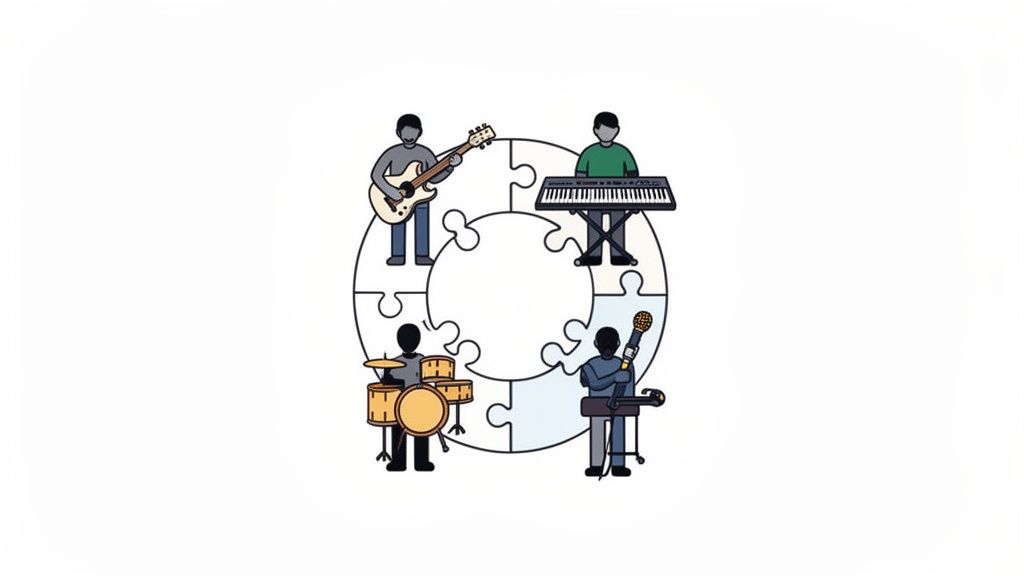
This format is vital for bands, duos, and ensembles because it gives fans, journalists, and bookers a reason to invest in the group, not just the music. It answers key questions: Who are these people? Why are they together? What shared vision drives them? A well-crafted band bio makes the group's chemistry tangible and is one of the most compelling musician bio examples for fostering a deep connection with an audience.
Strategic Breakdown & Analysis
Let’s look at how successful bands build their collective identity. The bio for boygenius often highlights not their individual successful careers first, but the fact that they were fans of each other's work before forming a supergroup. This frames their collaboration as an event born of mutual artistic respect. Similarly, HAIM's narrative is inseparable from their sisterhood, a core element that explains their intuitive chemistry on stage and in the studio. Paramore’s official story doesn’t shy away from their evolution and lineup changes, turning it into a story of resilience and the enduring creative partnership at its core.
This approach transforms the band's history from a simple timeline into a compelling narrative of creativity and connection. It gives context to the music itself.
Key Insight: This bio establishes the band as a character in its own right. The central story isn't just one person's journey but the group's collective arc-its formation, creative process, and shared mission.
Actionable Takeaways & Implementation
Craft a narrative that showcases your band's unique synergy and story. This is a foundational piece of content you'll host on your main artist website.
- Tell your origin story: Start with how the members met. Was it a chance encounter, a Craigslist ad, or a lifelong friendship? This is the hook.
- Define the roles: Briefly introduce each member and their primary contribution (e.g., "Jane Doe provides the rhythmic foundation on bass, while John Smith crafts the melodic textures on synth").
- Explain your creative process: Give a glimpse into how a song comes to life. Does one person bring a riff, or do you jam until something clicks? This reveals your group's dynamic.
- Showcase individual personalities: Have each member contribute one sentence in their own voice. This adds authenticity and helps fans connect with each person.
- Structure for clarity: Use a main paragraph for the group's story, and then consider adding short, distinct sections or callouts for each member's background. For artists building their own site, many of the best website builders for musicians offer layouts that are perfect for this structure.
- End with a unified vision: Conclude by stating the band's collective goals, the message behind your upcoming album, or your shared artistic philosophy.
7. The Evolution/Career Phase Bio (Varying lengths, Reflective Tone)
For artists with a long and varied career, a single bio can feel restrictive. The evolution bio addresses this by framing an artist’s journey as a series of distinct, intentional chapters. It tells a story of growth, change, and artistic progression, appealing equally to loyal fans who appreciate the history and new listeners who need context for the current work. This format is a living document, updated with each new album era or stylistic shift.
This bio is less about a single snapshot and more about a narrative arc. It acknowledges and honors past work while positioning the current phase as the logical next step. For artists like Miley Cyrus, who has navigated multiple genres, or Radiohead, whose sound has famously morphed over decades, this approach provides clarity. It’s one of the most compelling musician bio examples for established artists because it turns a potentially confusing history into a powerful story of creative integrity.
Strategic Breakdown & Analysis
Let's examine how this works in practice. James Blake's career bio doesn't ignore his early, influential dubstep roots; it frames them as the foundation for his later, more soul-influenced and vocally-driven work. Similarly, The National's story is often told as a progression from indie-rock darlings to mature, stadium-filling songwriters. Each era is given its own weight and purpose.
This strategy adds depth and invites listeners to explore the entire catalog, not just the latest single. It builds a legacy, showing that every step was part of a deliberate artistic journey.
Key Insight: This bio transforms your career timeline from a simple list of releases into a curated narrative. It shows you are not just an artist who changes, but an artist who evolves with purpose.
Actionable Takeaways & Implementation
You can structure your own story of evolution, even if your career is just beginning to unfold.
- Define your eras: Create 2-3 distinct "chapters" for your career. This could be "The Acoustic EP Years," "The Full-Band Rock Era," and "The Current Synth-Pop Project." Give them clear markers.
- Lead with the present: Always start your bio with your current phase to show what you're focused on now. Then, you can introduce previous eras as the backstory.
- Show intentionality: Use language that reflects deliberate choices. Instead of "the band broke up," try "after exploring a raw, punk sound, the members pursued new sonic directions."
- Visually separate eras: On a website or EPK, use different text blocks, headings, or even subtle background changes to visually distinguish between career phases.
- Archive old bios: Keep past versions of your bio accessible. A journalist covering your new album might find it invaluable to reference the official bio from your previous era for historical context. Conclude by guiding fans to experience this journey on your link-in-bio page, where content can be organized chronologically.
8. The Visual/Multimedia Bio (Images + Text, Immersive Tone)
This bio type trades lengthy paragraphs for a curated sensory experience. It uses powerful images, performance videos, and graphic design to communicate your aesthetic and atmosphere first, with text acting as a supporting element. Popularized by artists with strong visual identities like FKA twigs and Tyler, The Creator, this approach builds a world for the listener to step into before they even press play.
The goal of a visual bio is to create an immediate emotional connection. Instead of telling people your music is "atmospheric and introspective," you show them with moody studio photography and behind-the-scenes clips. This is one of the most compelling musician bio examples for artists whose brand is deeply tied to a specific aesthetic, making it perfect for platforms like Instagram, TikTok, and visually-driven websites.
Strategic Breakdown & Analysis
Let’s look at artists who master this. Solange's digital presence often integrates high-concept photography and minimalist design, making her website feel like an art installation. Similarly, SZA’s branding uses a consistent color palette and ethereal visuals across all platforms to reinforce the themes of her music. They create an immersive environment that communicates their artistic vision non-verbally.
This method works by establishing a powerful mood that primes the audience for the music. The visual story becomes inseparable from the sonic one, creating a much more memorable and cohesive artistic identity.
Key Insight: This bio format proves the old adage: "show, don't tell." It trusts the audience to feel the artist's identity through carefully selected media, creating a stronger and more intuitive bond than text alone can achieve.
Actionable Takeaways & Implementation
You can build your own immersive bio by focusing on visual storytelling.
- Invest in high-quality media: Professional photography and a short, 15-60 second intro video are foundational. They act as the hero elements of your visual brand.
- Create visual anchors: On your website or link-in-bio, use large image and video blocks to guide the viewer's eye. Intersperse these with short, minimal text blocks for rhythm.
- Maintain aesthetic consistency: Apply a consistent color grade, filter, or compositional style to all your visuals. This makes your brand instantly recognizable.
- Optimize for performance: Compress images to ensure your page loads quickly without sacrificing too much quality. Use video autoplay sparingly to create an immersive effect without overwhelming the user.
- Integrate your sound: Don't forget the music. A multimedia bio is the perfect place to feature your work directly. By adding a playlist, you can create a full audio-visual experience, and it's easy to embed a Spotify playlist directly onto your page.
- Ensure accessibility: Always use alt text for images to make your visual bio inclusive for all audiences.
8-Format Musician Bio Comparison
| Bio Type | Implementation Complexity 🔄 | Resource Requirements ⚡ | Expected Outcomes 📊 | Ideal Use Cases 💡 | Key Advantages ⭐ |
|---|---|---|---|---|---|
| The Concise Professional Bio (150–200 words) | Low — straightforward chronological structure | Low–Medium — needs verified stats and occasional PR input | ⭐⭐⭐ Establishes industry credibility and press readiness | Press kits, booking agents, festival submissions, Taap.bio intro | Instant credibility; easy to repurpose; professional tone |
| The Narrative Personal Bio (300–500 words) | Medium — requires storytelling and editorial work | Medium — time for anecdotes, editing, and possible imagery | ⭐⭐⭐ Builds emotional connection and loyal fanbase | Personal websites, Bandcamp, social sharing, indie artist profiles | Differentiates artist; authentic voice; highly shareable |
| The Minimalist Artist Statement (50–100 words) | Low–Medium — challenging to be concise and evocative | Low — minimal text but may need typographic design | ⭐⭐ Memorable positioning; creates intrigue and mystique | Experimental/ambient artists, social slots, Taap.bio hero block | Highly shareable; fits tight spaces; strong artistic tone |
| The Genre-Specific Technical Bio (200–300 words) | High — needs genre knowledge and precise terminology | Medium — research and accurate technical detail required | ⭐⭐⭐ Signals niche credibility and attracts genre fans | Electronic, jazz, metal, classical communities, niche platforms | Demonstrates expertise; appeals to dedicated genre audiences |
| The Social Media-Optimized Bio (≤280 characters) | Low — concise but strategic and iterative | Low — quick to produce; benefits from A/B testing | ⭐⭐ Drives clicks, discoverability, and platform engagement | Twitter/X, Instagram, TikTok profiles, Taap.bio headline | Highly discoverable; drives traffic; quick to update |
| The Collaborative / Band Bio (400+ words) | High — coordinating multiple member narratives | Medium–High — interviews, photos, and consensus work | ⭐⭐⭐ Deepens audience understanding of group dynamics | Bands, ensembles, press kits, documentaries, collective pages | Showcases chemistry; highlights individual roles; rich narrative |
| The Evolution / Career Phase Bio (varying lengths) | High — ongoing maintenance and era structuring | Medium–High — archival work, era-specific writing, updates | ⭐⭐⭐ Preserves legacy while promoting current work | Established artists, retrospectives, career-spanning sites | Demonstrates growth; appeals to longtime fans and newcomers |
| The Visual / Multimedia Bio (images + text) | High — requires visual curation and layout skills | High — photography, videography, editing, hosting | ⭐⭐⭐ High engagement, longer sessions, strong brand identity | Visually-driven artists, Gen Z audiences, Taap.bio visual grid | Immersive and memorable; showcases production value and aesthetic |
Turn Your Bio into a Destination with Taap.bio
Throughout this guide, we've moved beyond simple templates and into the strategic core of what makes a musician's story connect. We dissected everything from the formal Professional Bio required for a grant application to the short, punchy copy designed for a fleeting glance on social media. You now possess a detailed map for crafting narratives that not only inform but also intrigue, building a genuine connection with anyone who discovers your music.
The crucial takeaway is that a bio is not a one-size-fits-all document. It is a dynamic asset that must adapt to its environment. The poetic flair of a Minimalist Artist Statement would feel out of place in a formal press kit, just as a dense, Collaborative Band Bio would be impossible to consume in a Twitter profile. Your task as an artist is to become a storyteller, selecting the right narrative and tone for each specific platform and audience.
From Static Text to an Interactive Experience
You've learned how to build compelling musician bio examples, but the final, critical step is presentation. A powerful bio buried at the bottom of a long, cluttered page loses its impact. Your story deserves a stage, not just a space. This is where you can fundamentally change how your identity is perceived online.
Think of the different bio types we explored:
- The Narrative Personal Bio: Instead of just text, imagine this story presented alongside a gallery of candid, behind-the-scenes photos from your writing sessions.
- The Genre-Specific Bio: Place this informative text next to an embedded playlist of your influences, giving critics and fans immediate context for your sound.
- The Visual/Multimedia Bio: This concept becomes reality when you can actually arrange video clips, artwork, and short text blocks into a beautiful, organized grid that tells a story at a glance.
This is the difference between telling someone who you are and showing them. A static document forces an audience to work; an interactive layout invites them to explore.
Your Bio as the Central Hub
Your bio is the glue that holds your entire artistic presence together. It's the central narrative that gives context to your music, your visuals, your social posts, and your live shows. When a journalist, A&R rep, or potential new fan lands on your page, they are looking for a quick, compelling reason to invest their time and attention. A well-presented bio delivers that reason instantly.
By applying the strategies from the examples in this article, you’ve already won half the battle. You have the words. Now, it's time to give them the visual and interactive power they deserve. Don't let your carefully crafted story get lost. Make your bio the centerpiece of your digital identity, a destination that captures attention and encourages deeper engagement with your work. The goal is no longer just to have a link-in-bio; it is to have a bio that is the destination.
Ready to transform your collection of links and text into a dynamic artist hub? taap.bio gives you the tools to build a visually striking 'bento box' page where your music, videos, and story all live in perfect harmony. Showcase the best musician bio examples by bringing them to life on a page designed for artists at taap.bio.