So, you've poured your heart and soul into creating an amazing podcast. Now comes the hard part: getting people to actually listen.
Promoting a podcast today isn't just about shouting into the void. It’s about creating a smooth, inviting path that turns a casual scroller into a dedicated subscriber. This means building a central, visually stunning home for your show, getting smart about repurposing your content for social media, and genuinely connecting with your audience.
This isn't just another list of tips; it's a modern playbook built on strategy over scattered tactics—the kind that leads to real, sustainable growth.
Table of contents
Your Modern Podcast Promotion Playbook
Let’s be honest, the old advice to just "share on social media" is completely useless now. With millions of podcasts out there, just dropping a link is like throwing a message in a bottle into the ocean.
The real challenge every podcaster I know faces isn’t just making great audio—it's getting found. How do you grab someone's attention in the three seconds they’re scrolling their feed and convince them your show is the one they need to hear?
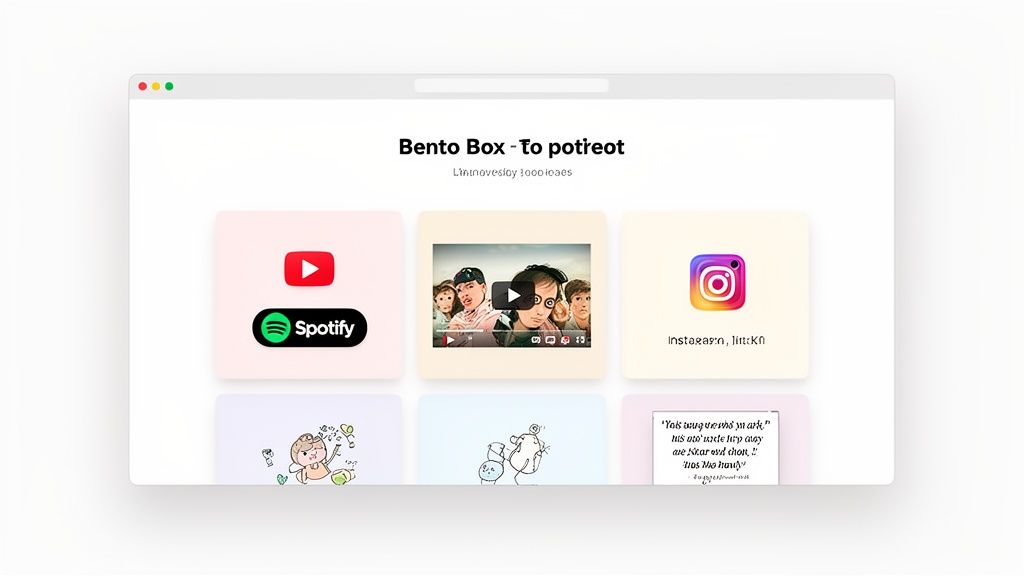
The answer isn't to spam links everywhere. It's to create a single, powerful destination—a digital home base that makes an unforgettable first impression. This playbook is all about building a visually compelling hub, sometimes called a "bento box" page, where new listeners can instantly dive into your best stuff.
The Landscape of Podcast Promotion
The podcasting world is crowded, which means presentation and ease of access are your secret weapons. As of 2025, there are somewhere between 4.5–5 million podcasts fighting for attention. At the same time, about 30% of all shows fizzle out before reaching 10 episodes. Simply by being consistent and making your show look and feel professional, you’re already ahead of the game.
Here's another crucial stat: 79% of all podcast listening happens on a phone. This means your show's first impression is almost always made on a small screen. A visually rich landing page that lets someone listen to your latest episode, watch a recent TikTok clip, and see rave reviews—all in one scroll—dramatically increases the odds that a curious tap from Instagram turns into a genuine listen. You can find more podcasting statistics over at tveyes.com.
This approach transforms your "link in bio" from a boring list into an interactive portfolio. It's a place where potential fans can:
- Listen instantly with an embedded player from Spotify or Apple Podcasts.
- Watch clips from your video episodes or social media shorts.
- See social proof through featured testimonials or links to your community.
- Subscribe easily to your newsletter or follow you on other platforms.
By removing all the barriers and offering a rich, multimedia experience, you guide a visitor from discovery to subscription in one seamless journey.
This entire playbook is built on four core pillars. Getting these right is the key to building a show that doesn't just launch, but lasts.
Your Podcast Promotion Pillars
| Pillar | Key Action | Why It Matters |
|---|---|---|
| Centralized Hub | Create a single, visually rich landing page for all your podcast content. | It slashes the friction for new listeners and focuses all your promotional energy in one place. |
| Content Repurposing | Turn one episode into a dozen pieces of content (video clips, quotes, audiograms). | This is how you get discovered on platforms like TikTok, YouTube, and Instagram, where your future audience is already hanging out. |
| Community Building | Actively engage with listeners and collaborate with other creators. | This is what turns passive listeners into true fans who will evangelize your show for you. |
| Growth & Measurement | Use data to refine your strategy and experiment with new promotional tactics. | It ensures your hard work is actually paying off and helps you build a loyal audience over the long haul. |
Mastering these four areas will give you a complete roadmap for growing your podcast in a way that feels authentic and, most importantly, actually works.
Create a Central Hub for Your Podcast
Before you even think about slicing up social media clips or running ads, you need to answer a fundamental question: where do you send people? If your answer is a messy list of links to Spotify, Apple Podcasts, YouTube, and your newsletter, you're creating friction. And friction is a conversion killer.
The first, most crucial step in promoting your show is building a single, visually stunning hub that does the heavy lifting for you.
Think of it as your podcast’s digital storefront. When someone stumbles upon you on TikTok or X, you have one shot to reel them in. Your goal is to send them to a place that makes it incredibly easy to sample your content, see who you are, and subscribe on the spot. This is where a modern, grid-style "bento box" page comes into play.
By cutting out unnecessary clicks and decision fatigue, you seriously boost the odds of turning a casual browser into a loyal listener.
Building Your Podcast's Home Base
Let's be honest, traditional link-in-bio tools are just lists. They get the job done, but they’re boring and do nothing to sell your show. Your podcast deserves a real home, a space that actually reflects your brand’s personality and immediately shows people what you're all about.
This is why tools built specifically for creators, like the customizable pages from Taap.bio, are so powerful. They let you move beyond a simple list into a dynamic, grid-based layout. You can arrange different content blocks—your latest episode, a YouTube video, listener reviews—into a visual dashboard for your entire brand.
Key Takeaway: Your central hub isn't just a collection of links; it's an interactive portfolio for your podcast. It should instantly answer a new visitor's unspoken questions: "What is this show about?" "Is it for me?" and "Why should I bother listening?"
Instead of just telling them, you can show them.
Designing a High-Conversion Hub
The real magic of a central hub is its ability to present multiple entry points into your world at a single glance. Someone might not be ready to commit to a full audio episode, but a 60-second video clip? That just might hook them.
Here’s a practical layout you can build right now to grab new listeners:
Embed Your Audio Player: This is the most important piece. Use a widget that allows for inline playback directly from Spotify or Apple Podcasts. A visitor should be able to hit play and listen to your latest episode without ever leaving your page. This one feature tears down the biggest barrier to getting someone to listen.
Showcase Your Best Video Content: With 47% of podcast listening now happening on YouTube, video is no longer optional for growth. Add a widget that pulls in your latest YouTube videos or a grid of your recent TikToks. This gives people a visual taste of your style and personality.
Display Social Proof: Nothing builds trust faster than seeing that other people already love your show. Add simple text blocks featuring glowing reviews from Apple Podcasts or testimonials from your listeners. That little bit of validation can be the final push someone needs to hit "subscribe."
This mix of audio, video, and social proof creates a rich, multimedia experience that feels less like a list of links and more like a personal welcome mat.
Turning Visitors Into Subscribers
Finally, your hub’s most important job is to turn interest into action. Once a visitor has sampled your content, the next step needs to be obvious and effortless. Don't make them scroll to the bottom of a long list to find what they're looking for.
Weave these essential elements right into your layout:
- Newsletter Signup: Add a prominent link or an embedded form for your email list. This is the only audience you truly own.
- Community Links: Make it easy for people to join the conversation with buttons that go directly to your Discord, Patreon, or private Facebook group.
- Social Follow Buttons: Include clean, simple widgets for your primary social platforms (like Instagram or X) so visitors can follow you with a single click.
By pulling every touchpoint into one cohesive page, you create a powerful engine for audience growth. You're not just learning how to promote a podcast; you're building a sustainable system that works for you 24/7, turning every click into a potential lifelong fan.
Turn One Episode Into a Week of Content
The most effective podcasters I know don't spend their time creating more content. They get more mileage out of what they already have. They operate like content recycling plants, transforming a single episode into an entire week's worth of promotional assets. This isn't about working harder; it’s about having a smart system that maximizes the reach of every single recording.
Let's be blunt: the engine of modern podcast discovery is video. While audio-only shows certainly have their place, the creators seeing explosive growth are the ones who’ve embraced the camera. The numbers don't lie. The global podcast audience is on track to hit 584.1 million listeners in 2025 and is projected to soar past 651 million by 2027.
But here's the kicker: 47% of all podcast listening now happens on YouTube. That makes it the undisputed king of podcast discovery. If you're not recording video alongside your audio, you're leaving a massive fountain of promotional material on the table. For a deeper dive into these trends, check out this comprehensive podcast statistics report.
This workflow shows exactly how your audio, video, and social content can all feed back into one central hub, creating a powerful, cohesive promotion system.
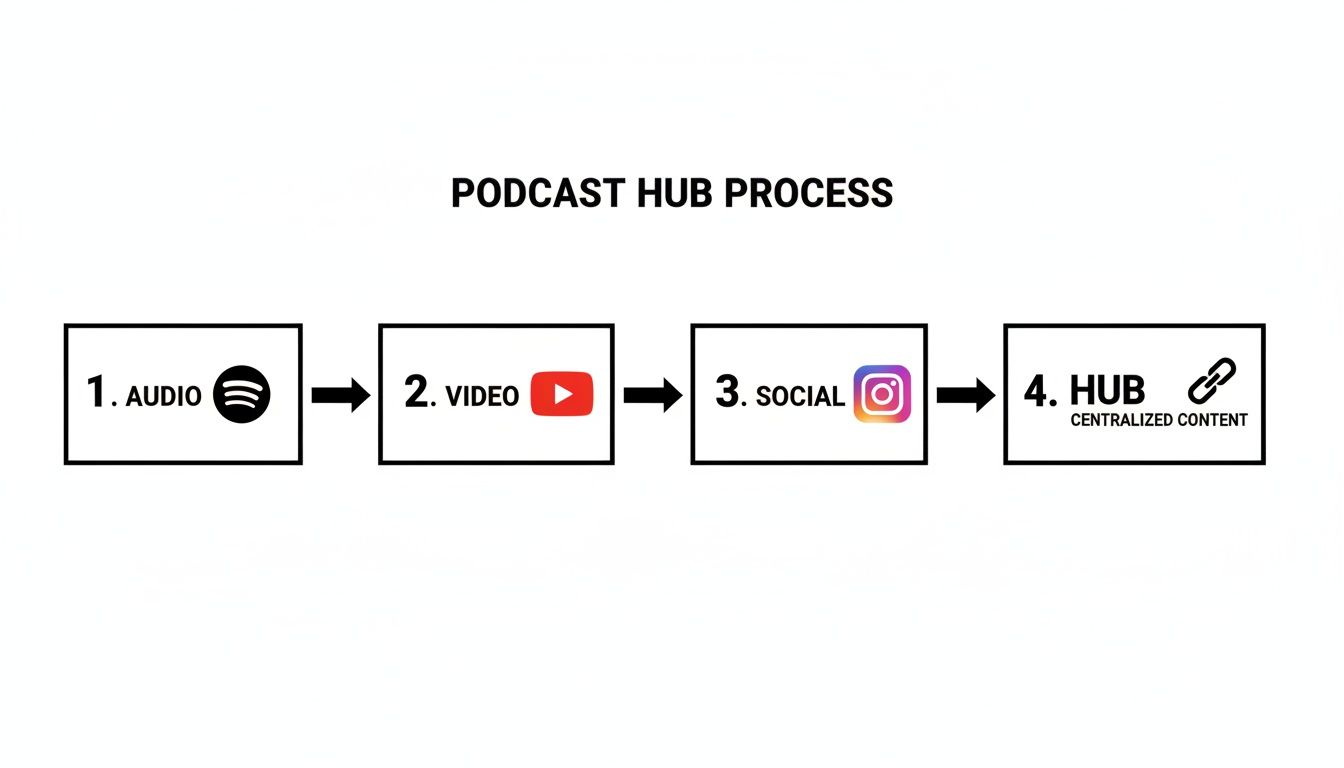
The real insight here? Every piece of content you create, no matter the platform, should be a signpost pointing back to your main destination.
The Repurposing Workflow in Action
Let’s walk through a simple, repeatable process for turning one recording into a full-blown promotional campaign. This isn't about adding hours to your workload; it’s about building a system you can rely on.
First, always record video with your audio. You don’t need a professional film studio—a good webcam and some decent lighting will do the trick. The goal is simply to capture the conversation visually so you have raw material to work with later.
Once your episode is edited, comb through it and identify 3-5 "golden moments." Think of these as the most compelling, insightful, funny, or even controversial snippets from the discussion. They need to be short, punchy, and able to grab attention on their own.
These moments are the foundation of your entire promotional push:
- The Full Video Episode: Post the entire video recording on YouTube. This immediately caters to the huge audience that prefers to watch, not just listen.
- Vertical Short-Form Clips: Take your "golden moments" and reformat them into vertical videos (a 9:16 aspect ratio) for TikTok, Instagram Reels, and YouTube Shorts. Always add captions—so many people watch with the sound off.
- Quote Graphics: Pull out the most powerful one-liners and turn them into shareable graphics for Instagram, X, or LinkedIn.
- Audiograms: For audio-only snippets, an audiogram (a static image with an animated waveform) is perfect for platforms where video isn't the main event.
Each of these assets hits a different platform and appeals to a different type of user, dramatically increasing your odds of being discovered.
Pro Tip: Don't just post and ghost. When you share a clip, ask a question in the caption to get a conversation going. If the clip is about a productivity hack, you could ask, "What's one hack you can't live without?" This drives engagement, which is exactly what platform algorithms love to see.
Unifying Your Content on a Single Page
So where do all these different pieces of content lead? They should all point back to your central hub. This is where the strategy really comes together. When someone discovers one of your TikTok clips, you can't send them on a scavenger hunt to find the full episode.
A well-designed hub page, which you can easily create with a tool like Taap.bio, lets you build a rich, multimedia destination for your audience.
Imagine someone lands on your page and instantly sees:
- An embedded player for your latest audio episode, ready for instant playback.
- A widget showcasing your full-length YouTube video.
- A visually appealing grid of your best, most engaging short-form clips.
This "bento box" approach gives people the power to consume your content in whatever format they prefer. They might get hooked by a 30-second clip, decide to watch the full video, and then subscribe to the audio version for their commute.
By presenting every option in one clean, frictionless layout, you're doing more than just promoting a podcast. You're showcasing a complete content ecosystem, making it incredibly easy for a casual browser to become a loyal fan.
Build an Engaged Listener Community
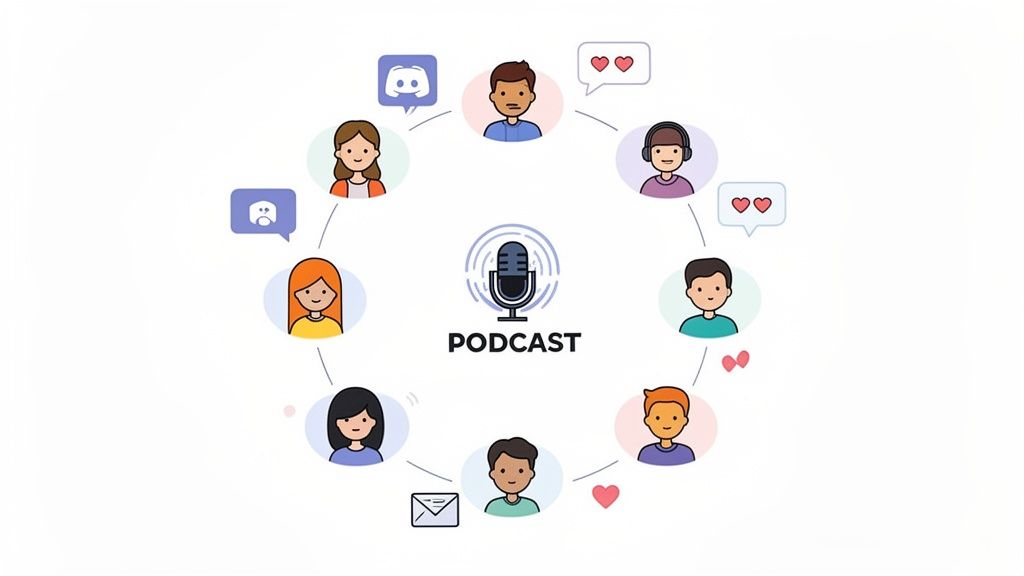
Downloads are a good starting point, but let’s be real—they don't tell the whole story. The true secret to a podcast that actually lasts is shifting your focus from chasing vanity metrics to building a real, thriving community. A community is what turns casual listeners into die-hard fans. These are the people who share your episodes, buy your merch, and become your most powerful marketing engine.
This is all about moving beyond one-way broadcasting and creating genuine spaces for connection. It means collaborating with other creators, talking with your audience (not just at them), and making them feel like they're part of the show's journey. Your central hub is the perfect place to start.
Leverage the Power of Cross-Promotion
One of the quickest ways to grow your audience is to get in front of someone else's. Appearing as a guest on other podcasts in your niche is a classic, high-impact strategy for a reason. You get to share your expertise with a whole new group of people who are already primed to love what you do.
But don't just stop there. Make every collaboration a two-way street. When you have a guest on your own show, use your hub to promote their work in a way that truly adds value.
- Create a Guest Spotlight: After the interview, pop a dedicated link block on your Taap.bio page that points directly to their podcast or website.
- Feature Their Content: You could even embed one of their YouTube videos or a link to their latest project. It’s a great look.
- Offer a Warm Hand-off: This simple act of generosity makes the experience memorable for your guest and shows your audience that you’re a genuine, connected player in your industry.
Suddenly, a simple interview becomes a powerful networking opportunity that benefits everyone involved.
Turn Listeners Into Active Members
Your most dedicated fans are always looking for ways to connect more deeply with you and your content. Your central hub is the perfect place to organize these invitations, transforming passive listeners into active community members.
Instead of rattling off a dozen different links at the end of an episode, you can visually guide visitors to the exact next step you want them to take.
A great community hub removes all the guesswork. It should be immediately obvious how a listener can join the conversation, support the show, and become more than just a number on a download chart.
Think about the community you want to build and make those entry points impossible to miss.
Design a Community-Focused Hub
Let's put this into practice. A community-focused layout on your hub might feature prominent, visually appealing blocks for:
- Your Discord Server: A direct link that invites people to jump into the daily conversation.
- Newsletter Signup: An embedded form or a bold button to capture email addresses—your most valuable communication channel.
- "Leave a Review" Button: A simple link that whisks listeners directly to the review section on Apple Podcasts or Spotify.
- Support the Show: Clear, can't-miss-it links to your Patreon, Buy Me a Coffee page, or merch store.
Global data shows just how invested podcast audiences are. Across 49 markets, 41% of consumers listen for at least an hour per week, and a staggering 9% listen for more than 10 hours weekly. This deep engagement is exactly why tapping into other shows is so effective—you're reaching people who already dedicate serious time to the medium. Find more fascinating stats about podcast listener behavior at podcastatistics.com.
By routing all this potential traffic through a single, well-designed hub, you can convert that built-in enthusiasm into tangible community growth. You're not just learning how to promote your podcast more effectively; you're building an entire ecosystem. You’re creating clear pathways that guide someone from being a casual listener to an invested, enthusiastic member of your community—and that's the ultimate engine for your show's long-term success.
Implement Advanced Growth Strategies
Alright, once your promotional engine is humming—you're consistently turning new episodes into great content and building a real community—it's time to pour some fuel on the fire. This is where we move past the daily hustle and start building intentional, scalable systems for growth. Think of it as shifting from being a podcaster to being a media brand, using data and targeted tactics to reach new audiences with absolute precision.These strategies aren't about reinventing the wheel. They’re all about adding leverage to the foundation you’ve already built, making sure every dollar you spend and every minute you invest delivers a real, measurable return.
Run Targeted Social Media Ad Campaigns
Running paid ads can feel like a huge leap, but honestly, it's one of the most direct ways to find your perfect listeners. The biggest mistake I see people make is sending ad traffic to a generic Spotify or Apple Podcasts link. That approach gives you zero data on what's working and scatters your potential audience to the winds.
Instead, every single ad you run should point directly to your central hub page. By sending high-intent traffic to your Taap.bio page, you accomplish several critical goals all at once.
- You control the entire experience. Visitors land in your world, a branded environment where they can immediately sample your audio, watch video clips, and get a feel for your community.
- You capture incredibly valuable data. With tracking pixels installed on your page, you can see exactly which ads are driving clicks and conversions. This lets you stop guessing and start optimizing your campaigns for better results.
- You give people more ways to connect. A visitor who isn't ready to subscribe on the spot might sign up for your newsletter or follow you on YouTube instead. You give yourself more chances to win them over.
Real-World Scenario: Let's say you have a podcast about sustainable gardening. You could run a targeted Instagram ad to people interested in "organic gardening" and "permaculture." The ad's call-to-action isn't "Listen on Spotify," but something more engaging like "Explore the Show." This simple change sends them to your hub, where they're greeted with your latest episode, a grid of your best TikTok garden tours, and a link to download your free "Beginner's Planting Guide."
This strategy completely transforms an ad from a simple listen-or-leave proposition into a rich, interactive introduction to your entire brand.
Optimize for Podcast Directory SEO
While we can't control the secret algorithms inside Apple Podcasts and Spotify, we can give them powerful signals to help them understand what your show is about. This is often called podcast SEO, and it’s all about tweaking your show’s metadata to improve your chances of being discovered organically.
Put yourself in your listener's shoes. What words would they actually type into a search bar? Are you a "true crime" podcast? Or are you a "historical true crime podcast focusing on unsolved mysteries"? The more specific you can be, the better.
Here’s where to focus your efforts:
- Your Podcast Title: If it makes sense for your brand, bake your main topic right into the title. A show named "Market Movers" is fine, but "Market Movers with Jane Doe | Weekly Stock Market Investing Tips" is so much better for search.
- Your Episode Titles: Please, don't get cute with titles like "Episode 47." Be descriptive. "How to Analyze a Balance Sheet for Beginners" is a title that will attract new listeners for years to come.
- Your Show Description: This is prime real estate. Use the first few sentences to clearly state who your podcast is for and what problems you solve. Weave your primary and secondary keywords naturally throughout the rest of the description.
These small tweaks can have a massive impact on how easily new listeners find you when they're actively looking for content just like yours.
Create a Digital Media Kit
As your show grows, you'll find that other creators, journalists, and potential sponsors will start sniffing around. A digital media kit makes it dead simple for them to get the information they need, which in turn makes it far more likely they’ll actually feature you.
You don't need a fancy, over-designed PDF. You can build a simple, clean, and effective media kit right on your central hub using text and link blocks. This keeps everything in one place and ensures it’s always up to date.
Your media kit should include:
- A short, compelling bio for you and the show.
- Key stats like your monthly downloads and listener demographics (if you're comfortable sharing).
- Links to a few of your most popular or representative episodes.
- Clear information on how to contact you for collaborations or interviews.
- High-resolution photos of your cover art and host headshots for them to download.
By making this information publicly accessible on your Taap.bio page, you remove all the friction for anyone who wants to promote your podcast. It’s a professional touch that signals you’re serious about growth and collaboration. This is how you go from being just another show to an unmissable one.
Unpacking the Big Podcast Promotion Questions
Alright, so you're ready to put all this into practice. As you start rolling out these strategies, some questions are bound to bubble up. It's totally normal. Knowing how to promote a podcast isn't just about following steps; it's about getting a feel for growth, content, and what's actually working. Let's dig into the questions I hear most often from fellow podcasters.
How Long Until I Actually See Results?
This is the big one, isn't it? The honest, no-fluff answer is: it depends. But with a consistent, focused effort, you should start seeing real, meaningful traction within three to six months.
Real growth isn't about a single episode going viral. It's about building a promotion system that works for you week in and week out. The magic ingredient is consistency. By sticking to the playbook—creating that central hub on Taap.bio, repurposing every episode—you build momentum over time.
Early wins aren't always a huge spike in downloads. Look for the other signs: more comments on your social posts, a few new newsletter sign-ups every week, or more clicks on the links in your podcast hub. Nail your process first, and the audience growth will naturally follow.
Do I Really Need a Video Version of My Podcast?
Need? No. Should you seriously consider it? Absolutely. Right now, video is probably the single most powerful tool you have for growing your show. So much podcast discovery is happening on visual platforms like YouTube and TikTok now.
A video version of your show gives you the raw material to create short, shareable clips that can pull in brand new listeners—people who might never stumble across an audio-only podcast. You don't need a high-end studio, either. A decent webcam and a good mic will get you started. The real value comes from those repurposed clips, making that small initial investment in video an incredibly effective way to grow your audience.
The most insightful growth metric isn't your all-time download count. It's the downloads per episode within the first 30 days. This number shows you the size of your loyal, core audience—the people who show up for every new release.
What's the Most Important Metric to Track?
Downloads can be a vanity metric. It feels good to see a big number, but it doesn't tell the whole story. As I mentioned, your 30-day download count is a much better indicator of your active, engaged audience.
Beyond that, you have to look at how people are interacting with your promotional content. Are they clicking, sharing, and commenting on your social media clips? Are they signing up for your newsletter from your hub page? Tracking these actions gives you a complete picture. It shows you not just how many people are listening, but how many are becoming genuine members of your community—and that is the key to long-term success.
Should I Be on Every Single Social Media Platform?
Please don't. That's a classic rookie mistake, and it's a fast track to burnout with very little to show for it. You are far, far better off mastering one or two platforms where you know your ideal listeners hang out.
For most podcasters, this usually means zeroing in on two key channels:
- YouTube: This is your home for full-length video episodes and longer, more detailed clips.
- A vertical video platform: Think TikTok or Instagram Reels. This is where your short, attention-grabbing clips will find new people.
Focus on creating great, native content for those platforms and use them to drive everyone back to your central hub. Spreading yourself thin by copy-pasting the same generic post everywhere is a waste of time. Dominate a couple of channels, build a real connection, and you'll see much better results.
Ready to build a central hub that turns casual listeners into devoted fans? Taap.bio lets you create a beautiful, interactive "bento box" page for your podcast in minutes. You can embed your audio player, show off your best video clips, and grow your email list—all from one powerful link. Start building your free page today on Taap.bio.