Saturday in Harlem, the line outside a comfort-food spot curled past the block, and nobody in it looked impatient. People were buying dinner, yes, but they were also protecting a neighborhood institution with every order. That’s the spirit behind this guide to black owned businesses in new york city.
Spending locally can keep a storefront active, a staff employed, and a piece of neighborhood culture visible for the next generation. New York City saw Black-owned firms rise from 5,532 to 7,191 between 2012 and 2017, a 30 percent increase, yet those businesses still represented only 3.5 percent of all city businesses as of 2017, even though Black residents made up 21.9 percent of the population, according to Center for an Urban Future’s NYC minority business analysis. That gap is exactly why deliberate support matters.
This guide moves fast and stays practical. You’ll get where to go, what each business does well, what trade-offs to expect, and how to verify you’re supporting the business directly. If you’re planning a neighborhood day, gifting intentionally, or building a habit of buying better, these seven spots give you strong places to start. If you’re thinking about how neighborhoods themselves are changing, US Real Estate Market Outlook 2026 is a useful visual reminder that storefront survival never happens in a vacuum.
Table of contents
1. Melba’s Restaurant
If you want a Harlem meal that feels like an event without becoming fussy, Melba’s is one of the safest bets in the city. It’s the kind of place you send first-time visitors, family groups, and people who think they only want fried chicken but end up talking about the sides for days.
The menu’s center of gravity is modern Southern comfort food, and that matters because some restaurants trade on nostalgia while letting execution slip. Melba’s has held onto neighborhood-icon status by staying dependable. You can reserve ahead, order online, sit down with a group, or plan around catering and private events through Melba’s Restaurant.
What works best here
Melba’s shines when you lean into the dishes it’s known for instead of trying to order like you’re in a tasting room. The chicken and eggnog waffles are the obvious move for a reason, and the broader comfort-food lineup is built for shared tables rather than tiny plates and constant decision fatigue.
For out-of-towners, this is also a useful anchor stop in Harlem because the experience is legible. You don’t have to decode a concept. Show up hungry, expect energy, and plan for a lively room.
- Best use case: Bring visiting friends who want a classic Harlem dining experience.
- Smart order strategy: Mix one signature entrée with a few sides for the table instead of everyone ordering in silos.
- Support move: If the dining room is packed, use direct online ordering instead of defaulting to a third-party app.
Practical rule: At places like this, reservations solve half the frustration. If you want peak dinner hours, book ahead or shift to a slightly earlier slot.
Verification and seasonal support tips
With popular restaurants, the easiest mistake is ordering through a reseller page that buries the actual business. Use the links on the official site first, and check that your reservation confirmation or ordering flow clearly points back to Melba’s branding.
Seasonally, restaurants like Melba’s are especially useful during holiday catering, graduation dinners, family reunions, and neighborhood celebrations. If you don’t need a full sit-down meal, gift cards and catering inquiries can still put money into the business during high-demand periods.
For travelers building a food-first day trip, this works well paired with other regional dining stops. A smaller-town contrast appears in this roundup of coffee shops in Lambertville, NJ, but Melba’s is the opposite energy. Bigger room, broader menu, more unmistakably Harlem.
The trade-off is simple. Peak hours can mean a wait, and some entrées sit at the higher end of casual dining. Still, if your goal is to support black owned businesses in new york city with a purchase that feels communal, Melba’s makes that easy.
2. FIELDTRIP
FIELDTRIP is for the days when you want flavor and speed, not a long sit-down. Chef JJ Johnson built it around heirloom rice bowls, and the concept is tighter than most fast-casual brands because it knows exactly what it is.
That focus is a strength if you’re hungry, in motion, and still care about where your money goes. It’s less useful if your group wants a sprawling menu with lots of appetizers and desserts. The official ordering, catering, and location details live at FIELDTRIP.
Why the bowl-first model works
A lot of fast-casual spots flatten into sameness. FIELDTRIP doesn’t, because the rice is the point, not just the base. The bowls pull inspiration from the African diaspora, the Caribbean, and other global influences without feeling like a branding exercise.
The practical upside is consistency. Bowl concepts travel better than delicate plated food, and they hold up for lunch pickups, office meals, and quick dinners. Jerk salmon, braised beef, roast chicken, and fried chicken all make sense within that format.
Fast-casual works best when the menu is disciplined. FIELDTRIP keeps enough variety to stay interesting without turning ordering into a five-minute traffic jam.
How to order and support it well
If you’re visiting with a group, don’t expect the rhythm of a long restaurant hang. This is counter-service and built for flow. Order directly through the business, use loyalty options if they’re offered to you, and consider catering if you’re feeding a team or event crowd.
A few practical notes help:
- Go at the right time: Lunch rush can feel compressed, so off-peak pickup is smoother.
- Order for the format: Bowls travel well. If you’re carrying food across town, this is a better bet than more fragile options.
- Use it for repeat support: Fast-casual businesses benefit from habit. Weekly lunch counts.
For verification, make sure you’re on the official site before placing an order, especially if you searched through maps or social media first. With multi-location brands, stale menu pages and duplicate listings can create confusion. The official site is the cleanest starting point.
There’s also a larger reason businesses like FIELDTRIP matter. In the New York-Newark-Jersey City metro area, Black-owned businesses represented only 3.0 percent of employer firms while Black residents made up 19.1 percent of the population, according to the BE NYC briefing paper from NYC SBS. Supporting businesses that build recognizable, repeatable concepts is part of how local ecosystems get stronger.
The main limitation is obvious. If you don’t want a bowl, the menu won’t magically become something else. But if you do want a chef-driven fast meal with a clear point of view, FIELDTRIP delivers.
3. Brooklyn Tea
Brooklyn Tea is what I recommend to people who say they want a coffee-shop vibe but don’t want coffee. It gives you a retail wall of teas, room to learn what you like, and a community feel that doesn’t require preexisting tea knowledge.
The strongest part of the business is how approachable it is. More than 100 curated loose-leaf teas, a Tea Finder, classes, tastings, subscriptions, teaware, and a Bed-Stuy storefront give it real depth, while the JFK Terminal 4 presence makes it one of the more convenient gift stops for travelers. You can browse directly through Brooklyn Tea.
Best reasons to visit in person
Some specialty drink shops become intimidating because they assume everyone already knows the jargon. Brooklyn Tea avoids that trap. Beginners can ask basic questions, sample thoughtfully, and leave with something more personalized than a generic grocery-store blend.
This is also one of the better options on this list for gift buying. Tea travels easily, has a wide range of price points, and works for hosts, coworkers, and long-distance mailing.
- Best first purchase: Start with a blend that matches how you already drink. Bright, floral, spiced, or caffeine-free.
- Best in-person move: Ask about tastings or classes if you want context, not just a bag on a shelf.
- Best travel move: If you’re flying through JFK, check whether the airport kiosk suits a last-minute gift run.
Verification and direct-purchase tips
Popular blends can sell out, and the business notes that fulfillment can take several days. That’s normal for an independent brand with a strong following, but it means holiday gifting should be planned earlier than you’d plan a marketplace purchase.
Verification is straightforward. Buy from the official store, confirm the Bed-Stuy address through the company’s own channels, and use the site’s tea quiz or category navigation instead of relying on a reseller’s product copy. If you’re trying to build a wider habit of direct spending, this broader roundup of Black-owned businesses is a useful companion.
The category context matters, too. Brooklyn has a dense concentration of Black-owned firms, with 2,445 firms placing the borough fifth nationally by concentration, according to Center for an Urban Future’s borough breakdown. That doesn’t mean these businesses are easy to sustain. It means shoppers have meaningful choices, and where they buy has real weight.
The trade-off with Brooklyn Tea is simple. It’s stronger on tea and education than on a full café food program. If you want a substantial meal, pair it with another neighborhood stop. If you want a thoughtful drink business with a clear identity, it’s one of Bed-Stuy’s easiest yeses.
4. The Lit. Bar
The Lit. Bar does something New York desperately needs more of. It sells books in a way that also builds local cultural life. Bookstore, wine bar, event space, and community room all live together here, which is why it feels less like a retail errand and more like a recurring neighborhood habit.
Founded by Noëlle Santos in the Bronx, it’s a destination even if you don’t live nearby. The selection spotlights Bronx and Black authors, and the event programming gives people a reason to keep returning. Browse books, signed editions, and current details at The Lit. Bar.
How to get the most out of a visit
Go with intent. If you just want one paperback and silence, visit outside event hours. If you want the place at full strength, plan around a reading, signing, or community event and stay for the atmosphere.
The wine bar format changes the energy. People linger. They talk. That’s the point, but it also means event nights can be crowded and seating can get tight.
A good independent bookstore doesn’t just move inventory. It creates repeat reasons for people to gather, and The Lit. Bar understands that better than most.
Verification, event strategy, and digital presence
For bookstores with strong event calendars, the most common friction point is outdated third-party listings. Check the business’s own website and event links before heading out, especially if you’re making a trip from another borough.
A few support moves work especially well here:
- Buy the event book directly: If you’re attending a reading, purchase through the store instead of showing up with an online discounter copy.
- Use the online shop for gifts: Signed editions make better gifts than generic bestseller links.
- Watch the calendar seasonally: Author events and literary gatherings often cluster around launches, themed months, and holiday shopping stretches.
For owners trying to make a cultural business easier to explore online, a clean landing page matters. A practical starting point is this guide on how to create a business page, especially if you need one place for events, store links, and social channels.
The Bronx deserves that digital clarity. The borough had 1,124 Black-owned firms and ranked eighteenth nationally by concentration in the same city analysis cited earlier. The opportunity is real, but so is the need for businesses to stay visible and easy to support.
The only real downside here is popularity. On event nights, expect a fuller room and less personal space. That’s not a flaw in the concept. It’s evidence the place is working.
5. BLK MKT Vintage
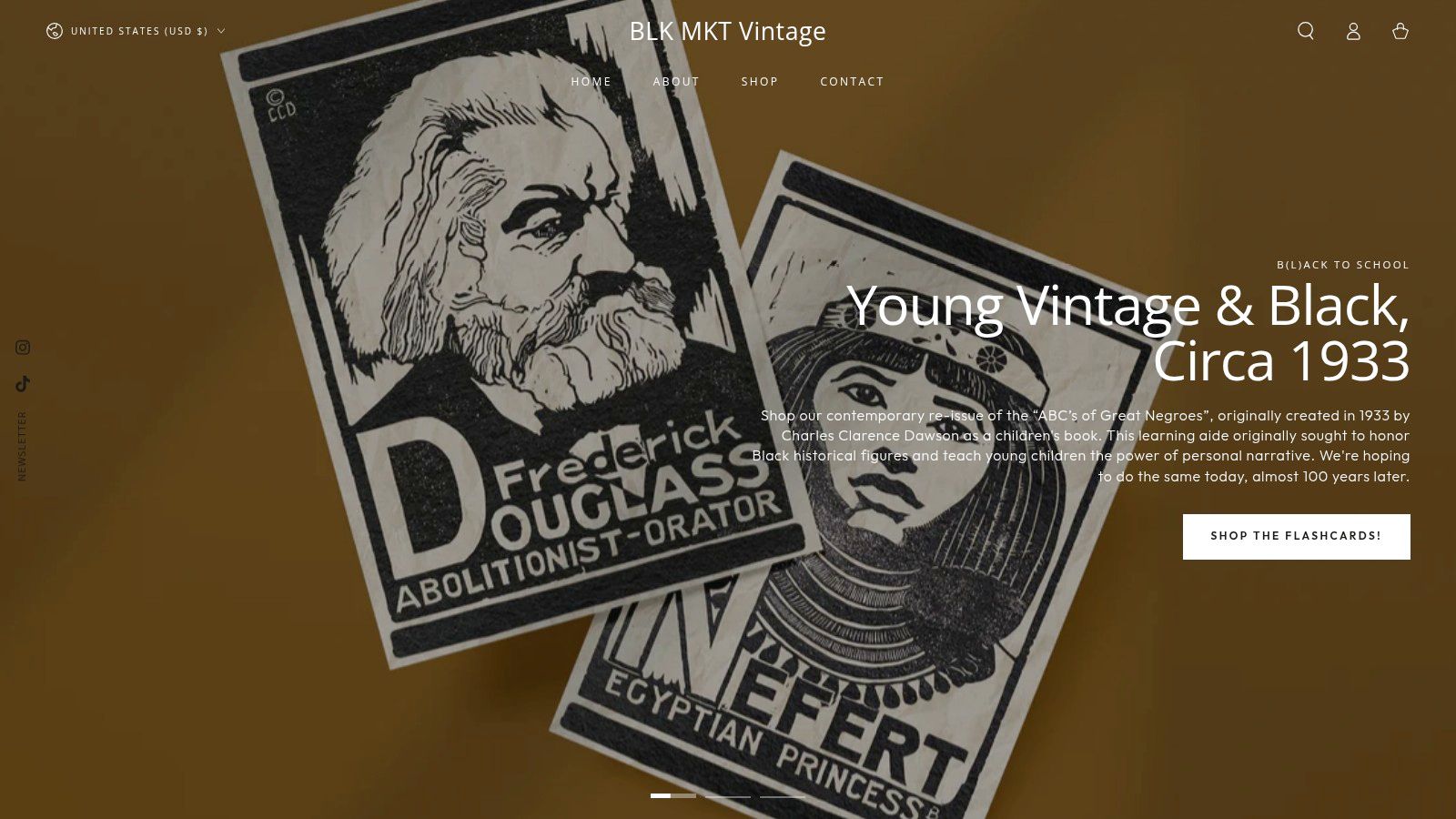
BLK MKT Vintage isn’t for casual browsing if by casual you mean “I want the cheapest decorative object possible.” It’s for people who care about story, provenance, Black material culture, and the difference between curation and clutter.
That distinction matters. A lot of vintage retail is just accumulation with mood lighting. BLK MKT Vintage feels researched. The catalog spans decor, furnishings, art, vinyl, books, and ephemera, while the founders’ curatorial approach carries into styling, rentals, and exhibition loans through BLK MKT Vintage.
Why collectors and designers keep watching it
One-off inventory changes everything about how you should shop here. If you see a piece that fits your home, your set design brief, or your collection, hesitation usually costs you. This isn’t mass-market stock that will sit around waiting for next payday.
The upside is that the pieces carry context. You’re not just buying an object. You’re buying an object that has been selected and framed with cultural intelligence.
- Best for home buyers: Choose one anchor piece with real presence instead of trying to mimic a showroom.
- Best for professionals: Interior stylists, prop teams, and exhibition planners should ask about services early.
- Best support habit: Follow new drops closely, because inventory moves fast.
Verification and buying discipline
Vintage businesses attract reposting, screenshot resales, and detached image circulation. Verify through the official website or the company’s own social channels before assuming an item is available. If you’re buying remotely, ask the practical questions first. Condition, dimensions, shipping method, and return terms all matter more here than in standard retail.
For business owners in retail, BLK MKT also shows why a stronger digital hub helps. A standard link list often undersells a visual catalog business. If you sell products across a shop, social feed, editorial mentions, and inquiry forms, this guide to link in bio for ecommerce is relevant because presentation affects discovery.
Queens offers another reminder that geography alone doesn’t solve visibility. The borough had 1,633 Black-owned firms and ranked twelfth nationally by concentration in the city report already noted. A healthy ecosystem still requires customers who intentionally buy from the businesses they say they value.
The trade-off here is price and scarcity. Pieces sell quickly, and curated rarity costs more than mass-produced decor. If you want throwaway trends, go elsewhere. If you want your home or project to say something specific, BLK MKT Vintage is worth the extra care.
6. Harlem Candle Co.
Harlem Candle Co. understands that fragrance is part product, part storytelling. That sounds airy until you smell how tightly the brand connects Harlem Renaissance references, packaging, and scent names into something giftable and memorable.
This is one of the stronger options on the list for people who want a polished purchase without defaulting to a giant luxury chain. Candles, diffusers, room sprays, and related design goods all sit within a coherent world, and the company also supports gifting and wholesale through Harlem Candle Co..
What it does better than generic luxury gifting
Some home-fragrance brands sell a scent and stop there. Harlem Candle Co. sells a point of view. Collections such as Speakeasy, Josephine, and Langston are strong because they give buyers a narrative handle, not just fragrance notes.
That makes shopping easier for both personal use and gifts. You can choose by mood, by inspiration, or by room. Travel, single-wick, double-wick, and ceramic options also give buyers flexibility if they’re testing the brand or committing to something more substantial.
Buy fragrance as a use case, not a label. Entryway, bedroom, desk, host gift, and holiday table all need different intensity and presentation.
Seasonal buying and direct-support tips
This is a particularly good business to support during gift-heavy periods. Housewarmings, birthdays, holidays, and corporate gifting all fit the catalog naturally. Seasonal items can sell out, so don’t assume your preferred vessel or scent will still be there if you wait too long.
When you’re verifying, go to the official site first and watch for any differences between limited-edition releases and core products. Fragrance is subjective, so read scent descriptions carefully instead of buying by name alone. Sample options are limited compared with some fragrance-first brands, which means thoughtful selection matters.
Harlem itself has seen especially strong growth in Manhattan, where Black-owned businesses increased by 45 percent during the 2012 to 2017 period covered in the city analysis. Yet growth alone doesn’t erase fragility. Businesses still need repeat buyers, gift purchasers, and customers willing to shop direct instead of treating independent brands like inspiration boards.
The only serious caution is fit. Premium presentation brings premium pricing, and scent preference is personal. If you’re the kind of shopper who resents paying for design and story, this may not be your lane. If you value both, Harlem Candle Co. is one of the cleaner gift recommendations in New York.
7. Nicola Vassell Gallery
Nicola Vassell Gallery belongs on this list because support doesn’t only mean buying food, books, or home goods. It also means showing up for Black-owned cultural infrastructure in places where power, access, and visibility still concentrate unevenly.
The gallery operates in Chelsea with a museum-level feel, serious artists, and a program that speaks to collectors and casual visitors differently but effectively. Exhibitions are free to view during open hours, which lowers the barrier to entry for anyone trying to engage contemporary art without pretending they’re shopping for a collection. Current shows and details are posted at Nicola Vassell Gallery.
How to visit if you’re not a collector
Treat it like you would a small museum visit. Check exhibition dates and open hours before heading over, because galleries can close between installs or shift schedules around fair participation and exhibition changes.
If you’re new to Chelsea galleries, start here and let yourself look slowly. Read the wall text. Ask polite questions if staff are available. You don’t need to buy anything to support the space. Attendance itself matters, especially when people say they value diverse cultural ecosystems but only show up to the same established institutions.
- Best first visit: Go during a current exhibition, not between installs.
- Best support move: Share the show responsibly after visiting, with the gallery tagged correctly.
- Best collector move: Expect inquiry-based pricing and come prepared for that format.
Verification, audience fit, and digital tools
Art spaces often get tripped up by stale listings on third-party guides. The official website is the first stop, full stop, because open hours are tied to active shows. If you’re traveling specifically to see a particular artist, verify that the exhibition is still on view.
For artists, galleries, and cultural workers, a simple website often isn’t enough to connect all the moving parts. Press, exhibitions, available works, social channels, and video can live more coherently through a visual hub. That’s where a resource on link in bio for artists becomes practical rather than cosmetic.
One more citywide reality belongs here. Nationally, there were 194,585 Black-owned businesses in the United States in 2022 generating $211.8 billion in revenue, yet they represented only 3 percent of all classifiable U.S. firms and accounted for just 1 percent of gross revenue, according to the same NYC SBS briefing on Black entrepreneurship. Supporting Black-owned galleries is part of that bigger economic picture, not separate from it.
The trade-off is accessibility in the consumer sense. This isn’t a casual retail environment with price tags on every wall. But as a free cultural stop with a strong curatorial voice, Nicola Vassell Gallery is a powerful inclusion in any serious guide to black owned businesses in new york city.
7 Black-Owned NYC Businesses Comparison
| Item | 🔄 Complexity | ⚡ Resources | 📊 Expected outcomes | 💡 Ideal use cases | ⭐ Key advantages |
|---|---|---|---|---|---|
| Melba’s Restaurant | 🔄 Medium, full-service kitchen, reservations and catering logistics | ⚡ High, staffing, inventory, prime Harlem location | 📊 Reliable foot traffic, strong group/event revenue; peak waits possible | 💡 Family dining, large-group meals, catered events | ⭐ Neighborhood icon with consistent comfort‑food favorites |
| FIELDTRIP | 🔄 Low, fast-casual counter operations, focused menu | ⚡ Moderate, streamlined kitchen, multiple locations, online ordering | 📊 Quick turnover, repeat business, scalable fast‑casual model | 💡 Fast lunches, casual catering, loyalty-driven visits | ⭐ Distinct global flavors at an approachable price |
| Brooklyn Tea | 🔄 Low, retail operations plus tastings/classes; SKU management | ⚡ Moderate, curated sourcing, teaware inventory, fulfillment | 📊 Subscription and retail revenue, strong local loyalty; occasional sellouts | 💡 Tea education, gifting, travel retail (JFK kiosk) | ⭐ Clear sourcing and educational approach for beginners |
| The Lit. Bar | 🔄 Medium, hybrid bookstore + wine bar with event programming | ⚡ Moderate, inventory, bar operations, event coordination | 📊 Cultural draw and event-driven sales; variable busy nights | 💡 Author readings, community gatherings, intimate social nights | ⭐ Singular cultural destination spotlighting local creators |
| BLK MKT Vintage | 🔄 Medium–High, sourcing, provenance research, rentals/loans | ⚡ High, acquisition costs, storage, curation and logistics | 📊 High-value one-off sales and B2B styling/rental income; inventory fluctuates | 💡 Interior styling, set/prop rentals, collectors seeking provenance | ⭐ Hard-to-find, story-rich curated pieces with contextual curation |
| Harlem Candle Co. | 🔄 Low–Medium, product development, small-batch production | ⚡ Moderate, manufacturing, premium packaging, wholesale channels | 📊 Strong editorial recognition, gifting and wholesale revenue; seasonal demand | 💡 Luxury gifting, home fragrance retail, corporate gifting | ⭐ Compelling storytelling and premium presentation |
| Nicola Vassell Gallery | 🔄 High, curatorial programming, exhibitions and fair participation | ⚡ High, gallery space, artist support, PR, shipping and insurance | 📊 High cultural impact, collector sales, critical coverage; significant overhead | 💡 Serious collecting, institutional collaborations, museum‑level exhibitions | ⭐ International curatorial reach with strong critical recognition |
Make Your Support a Lasting Habit
A good directory should change behavior, not just fill a bookmark folder. The best outcome from a list like this is simple. You start building repeat patterns. Friday lunch at a Black-owned counter-service spot. A gift order from a Black-owned fragrance brand instead of a department store default. A bookstore event on your calendar instead of another passive scroll.
That habit matters because scale and stability are still uneven. Only 3 percent of Black-owned firms in New York have employees, and half of all Black-owned firms in New York have operated for less than five years, compared with 36 percent of all firms citywide, according to the BE NYC briefing paper. So when people say support matters, they shouldn’t mean one ceremonial purchase in February. They should mean recurring revenue, referrals, reviews, and direct orders that help a business stay visible and durable.
The practical ways to help aren’t complicated.
- Buy direct when possible: Order through the business’s own site before using a delivery marketplace or reseller.
- Leave useful reviews: Mention what you bought, how the process worked, and what another customer should know.
- Give with intention: Gift cards, books, tea, candles, and event tickets all create support beyond your own immediate use.
- Share accurately: Tag the right account, use the correct location, and link to the official site so attention converts into sales.
- Return consistently: One repeat customer is often more valuable than a burst of one-time hype.
There’s also a discovery problem that many small businesses still face. New York City launched the Shop Black NYC directory in connection with BE NYC, and it includes more than 3,000 businesses with borough filtering, according to the BE NYC initiative page. That kind of directory matters because people often want to support local businesses but lose momentum when information is scattered across outdated bios, inconsistent map listings, and half-maintained social profiles.
For owners, tightening that digital path is one of the clearest wins. A customer shouldn’t have to hunt for your menu, event page, booking form, store link, and location. They should find one well-organized destination and act. That’s why businesses keep spending time on simple landing pages and on optimizing their Google My Business listings for local success. Clean discovery reduces drop-off.
A tool like taap.bio can fit naturally into that stack because it lets a business combine multiple links and content blocks into one shareable page. Its modular grid approach is useful when a brand has more to show than a plain list can communicate, such as a menu, Instagram feed, map, booking link, YouTube content, or Spotify audio. For a restaurant, that can mean one page for reservations, catering, and directions. For a bookstore, it can mean events, signed editions, and community updates. For an artist or gallery, it can hold press, current work, and social channels in one place.
Customers have a role in this too. If a business makes it easy to book, order, visit, and share, use those tools. Click through the official page. Subscribe to the newsletter. Save the location. Send a gift. Show up again. Black-owned businesses in New York City don’t need vague applause. They need transactions, repeat visits, and local loyalty that lasts longer than a trend cycle.
The list above isn’t exhaustive, and it shouldn’t be your endpoint. Let it become your starting route through Harlem, Bed-Stuy, the Bronx, Chelsea, and beyond. Spend with intention often enough, and your support stops being symbolic. It becomes part of how the city holds on to what makes it itself.
If you run a local business, creative brand, or cultural project and want one clean place to send people, taap.bio gives you a way to combine your links, media, maps, and platform widgets into a single shareable page that’s simpler to browse than a scattered bio.