You're posting Reels, getting a few saves, maybe even some DMs, and still not seeing real money. That's the trap. Most creators think how to monetize Instagram means finding the next hidden feature, bonus program, or “hack,” when the job is much simpler and much harder, build a conversion path that turns attention into sales.
Instagram sits inside a massive creator economy. Independent industry reporting puts the global creator economy at about $250 billion in 2025 and projects it near $480 billion by 2027, while the global influencer marketing segment was estimated at $32.55 billion in 2025. U.S. Instagram influencer marketing spend was estimated at $2.21 billion in 2024 and projected to rise to $3.2 billion in 2026 as reported in this industry breakdown. That's the signal. Brands already spend heavily on creator-led promotion, and creators who own the checkout path win more often than creators who wait for platform paydays.
The mistake is treating follower count like the business model. It isn't. Sponsored posts, affiliate sales, subscriptions, digital products, and paid bookings all exist, but they work best when your profile, content, and offer all point to one place that can capture the sale. If your traffic lands in five different apps and three different link lists, you're leaking money before the buyer even sees your offer.
Practical rule: Monetization is trust plus conversion path plus offer fit. If one of those is weak, the money gets stuck.
Table of contents
Why Most Instagram Monetization Advice Falls Short
Most advice starts with features. “Turn on badges.” “Apply for gifts.” “Wait for bonuses.” That's lazy guidance for creators who need revenue now. Native payouts can help, but they're not a dependable core strategy for most accounts, and invite-only or eligibility-based programs leave too many people stranded.
The better model is to think like a sales operator. A follower is not income. A follower is only valuable if the person sees the right content, takes the right next step, and lands on an offer that matches intent. That's why smaller creators can often monetize faster than bigger creators who post broad entertainment content. Their audience is tighter, their message is clearer, and the conversion path is shorter.
Brand deals still dominate a lot of creator income on Instagram, with one 2026 report estimating about 65% of total creator income coming from brand deals rather than platform programs in this summary. That matters because it tells you where the market already pays. It also tells you not to build your plan around payouts you can't control.
The real monetization equation
If your niche is clear, your audience trusts you, and your link path is simple, you can earn without chasing every shiny feature. If your niche is fuzzy, your content is scattered, and your bio is a dead end, no payout program will save you. The strongest creators build around owned actions, things like bookings, email capture, direct sales, and affiliate clicks.
Don't ask, “What Instagram feature can pay me?” Ask, “What action should this post trigger?”
That change in thinking is the whole game. A creator economy this large rewards people who treat Instagram like the top of a funnel, not the entire business. Once you stop waiting for the app to hand you money, you can build a system that makes money on purpose.
Build a Profile and Content System That Converts
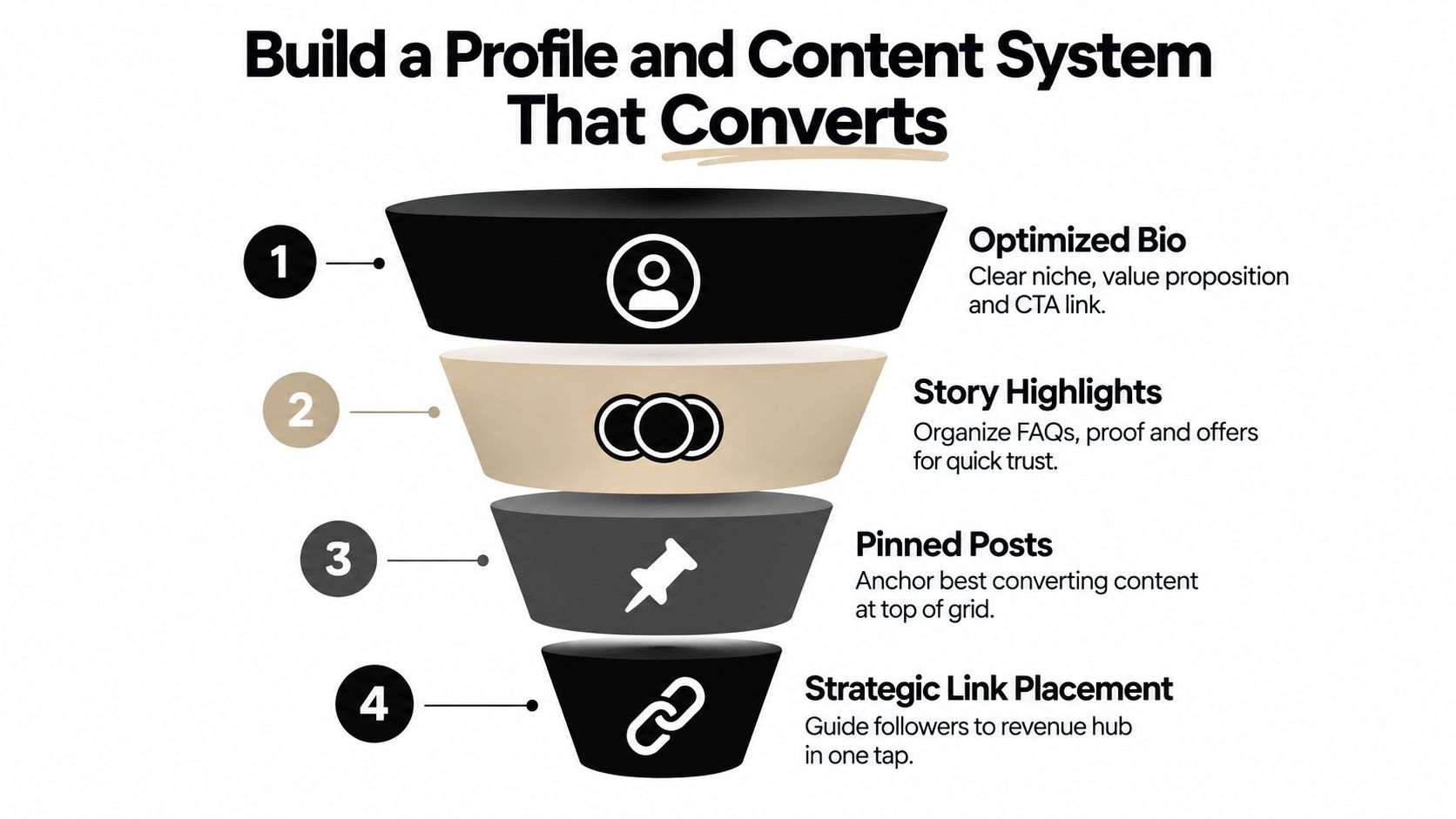
Your profile has one job, get the right person to click. Everything else is decoration. A bio that sounds clever but never says what you sell wastes space, and a grid full of polished posts with no clear path to action leaves money in plain sight.
Start with the basics that drive clicks. Your bio should say who you help, what you help them do, and where they should click. Your Story Highlights should answer objections, show proof, and make the next step feel low risk. Your pinned posts should work like sales assets, not random favorites. If someone lands on your page after watching a Reel, they should understand your niche fast.
Use the structure in things to put in your IG bio. Keep it practical. Cut the jargon, cut the vague self-description, and make the call to action obvious.
Match content format to funnel stage
Reels drive discovery. Use them to introduce the problem, the outcome, or the product angle quickly. If you need a reference for short-form output, Reels for brand growth is useful for thinking about format and momentum.
Carousels are for saves and shares. They work best when the topic needs structure, proof, or comparison. Stories are where you ask for action, especially with link stickers, urgency, or a direct question that pushes people toward a reply. Reels usually earn attention, while Stories often convert better for direct response.
Use the signals that matter. Benchmark data suggests Reels should aim for roughly 3% to 7% engagement per reach for nano and micro accounts, and saves plus shares above 1.5% of reach are a baseline sign of monetizable intent per this benchmark guide. Story completion rates often sit around 50% to 70% for 3 to 5 frames in that same guide, which tells you short sequences work better than bloated storytelling. Sponsored posts can see 25% to 35% lower engagement than organic posts on the same account as noted here, so do not let brand content take over your whole feed.
Set a weekly rhythm and stick to it:
- One discovery post: a Reel that starts the conversation.
- One trust builder: a carousel, case example, or proof post.
- One conversion sequence: Stories that push to a link, DM, or booking page.
- One recap or FAQ post: something that reduces hesitation and answers objections.
That rhythm matters more than raw posting volume. A creator who routes Reels and Stories traffic into a single revenue-focused link-in-bio page, one that can handle a storefront, paid bookings, email capture, and checkout, keeps more value from the attention already earned. If you want the page to pull its weight, build it around the action you want most, not around whatever looks busy.
Choose Your Revenue Streams Without Spreading Thin
Trying to monetize six ways at once is how creators stay busy and broke. Pick one primary stream and one secondary stream, then build around them until the numbers justify adding more. The right mix depends on your audience size, trust level, and how much control you want over pricing and fulfillment.
| Revenue Stream | Best For | Typical Payout Control | Key Requirement |
|---|---|---|---|
| Sponsored Posts | Creators with clear niche fit and brand-safe content | Low to medium, brands set the brief and timing | Strong engagement and a media kit |
| Affiliate Marketing | Creators with trust and product relevance | Medium, commission depends on conversions | Tight offer match and tracked links |
| Physical Products | Creators with loyal buyers and visual products | High, you control pricing and fulfillment | Inventory, shipping, or a supplier |
| Digital Products | Creators who can package expertise | High, direct margin after setup | A clear outcome and simple delivery |
| Paid Bookings and Coaching | Experts, consultants, and service providers | Very high, you set the rate and scope | Proof, calendar flow, and clear offer |
| Subscriptions and Tips | Fans who want ongoing access | Medium, platform rules can limit reach | Consistent value and audience habit |
Micro creators usually should not start with sponsorships alone. Benchmark data in this benchmark set shows micro creators, typically 10K to 50K followers, often earn about $200 to $1,500 per sponsored post, but that money can be uneven and tied to inbound brand interest. Smaller accounts also tend to see stronger affiliate conversion than larger ones, which is why affiliates and owned products usually make more sense early on.
My blunt recommendation by account stage
If you need revenue soon, start with affiliate + digital product or affiliate + paid booking. If you already have proof, start with digital product + booking and add sponsorships only when the fit is obvious. If you have a loyal audience but no offer yet, build the offer first and let sponsorships come later.
Use one simple rule. If your audience buys recommendations, use affiliate offers. If your audience wants your expertise, charge for time or packaged knowledge. If they trust your taste and process, sell the thing you created.
For a direct framework on offers and creator income paths, the creator monetization guide is a useful reference.
Set Up Your Revenue Hub and Link in Bio for Sales
A link in bio should not behave like a directory. It should behave like a revenue hub. The goal is to keep people on one page long enough to buy, book, or join your list without bouncing through a messy stack of apps.
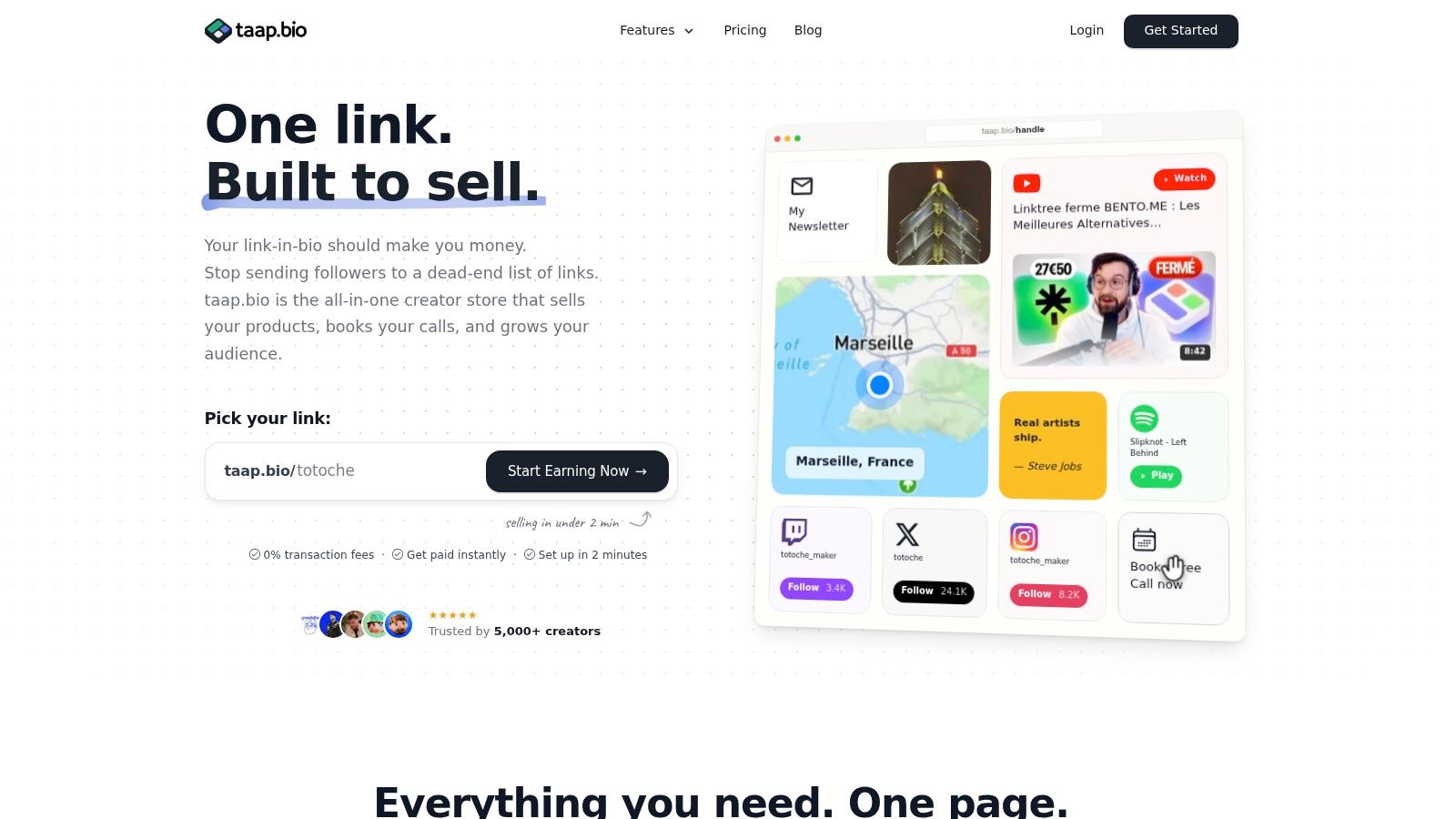
Start with a bento layout. Put the most profitable action at the top, then stack the rest in order of intent. A storefront block can handle physical and digital products with checkout and instant delivery. A bookings block can take payment before the call is confirmed. An email block can capture a lead before they disappear back into the feed. Real-time analytics should sit behind all of it so you know what's moving.
The reason this matters is simple. Every extra redirect lowers the chance of conversion. A single-page flow keeps people moving, which is exactly what Instagram traffic needs. If you're comparing setup approaches, this guide to an Instagram link in bio landing page gives a useful mental model for why the page itself has to sell, not just point somewhere else.
Build the page in this order
- Lead with the highest intent offer. If you sell something obvious, put it first. If you sell services, lead with bookings.
- Add proof near the top. A short testimonial, result, or portfolio sample reduces hesitation.
- Insert email capture before lower-intent links. Own the audience before they leave.
- Keep secondary links below the money blocks. Don't let “About” and social links crowd out commerce.
- Test the mobile flow. If a thumb can't find the next step in a second or two, the page needs work.
If you need a platform that combines storefront, booking, and list building in one page, taap.bio is one option to consider because it combines a built-in checkout, paid bookings, email capture, and analytics in a single link-in-bio page. That setup is useful when you want to route Instagram traffic into sales without making people jump between tools.
Why the hub beats a scattered stack
Most creators lose money in the gaps between tools. A shopper clicks a link, gets sent to a storefront, then to a booking page, then to a separate email signup, and the sale dies somewhere in the middle. One page fixes that. It also makes tracking easier, because you can see which block got the click and which action paid.
The page should also feel fast on mobile. If you're rebuilding from scratch, keep your headline clear, your offer block visible, and your CTA phrased as an action. No clutter. No mystery. No extra taps.
Pricing Launch and Conversion Tactics That Actually Sell
Creators lose money when they treat pricing like a guess. They undercharge for services, drop products with no launch plan, and then act surprised when sales stall. Set the price from the value the offer creates, then build the page and content around one job, getting the click to convert.
For sponsored posts, use market benchmarks instead of making up a number. Typical Instagram post pricing sits around $25 to $150 for nano-influencers, $250 to $5,000 for micro-influencers, and $5,000 to $15,000 for macro-influencers, with top-tier creators reaching six figures per deal per this pricing guide. Treat that as a ceiling and a floor, not a rule. If your audience buys and your content moves people, charge toward the high end of your niche. If it does not, lower the pitch and improve the offer.
Affiliate offers need focus. Broad entertainment audiences usually produce weak affiliate response, while tightly matched commercial niches perform better in the affiliate guide. Stop posting random product mentions. Pick one problem, one product, one CTA.
A launch that sells follows a simple sequence:
- Show the result first. Lead with the outcome, not the feature list.
- Use a short Story sequence. Keep the path tight and easy to follow.
- Give people a real reason to act. Use a bonus, deadline, or limited slot only if it is true.
- Reply in DMs only when invited. Do not chase people who tapped once.
- Change one thing at a time. Test one CTA, one headline, or one page block.
For digital products and bookings, price the outcome, not the effort. Buyers pay for speed, clarity, and confidence. They also pay for access and judgment when the offer is a call. The digital product pricing strategy guide is useful if you are turning expertise into something people can buy without a sales call.
Conversion rule: If the offer needs a long explanation, the page is too weak or the product is too broad.
Reels can bring attention, but Stories usually close the sale. Use the Expressify AI playbook overview if you want a cleaner view of audience flow and launch sequencing. The goal is not louder promotion. It is a tighter route from content to checkout, with fewer places for revenue to leak.
Track Optimize and Keep Your Monetization Compliant
Once the funnel is live, stop guessing. Track the click on each block, the email signup rate, the booking rate, and the checkout completion rate. If a post gets attention but nothing converts, the problem isn't always the content. Sometimes the page is weak. Sometimes the offer is wrong. Sometimes the CTA is buried.
Use metrics that reflect intent. Saves, shares, DM replies, profile clicks, and actual checkout actions matter more than likes because they tell you who's moving toward a purchase. If a Reel drives traffic but the page doesn't move, rewrite the headline. If a Story sequence gets replies but no bookings, make the offer simpler. If email capture gets ignored, move it higher and shorten the form.
Privacy matters too. GDPR-friendly hosting, zero-cookie defaults, and fewer unnecessary banners can reduce friction for visitors, especially when your page is built to convert quickly. That's one reason a single-page revenue hub is easier to run than a patchwork of third-party tools. You get cleaner data, fewer moving parts, and less compliance headache.
If you want a simple 30-day loop, use this:
- Week 1: publish one high-intent offer and one supporting Reel.
- Week 2: tighten the page headline and CTA.
- Week 3: test one Story sequence and one email capture placement.
- Week 4: cut the weakest block, double down on the strongest one.
For a deeper look at what to watch and what to ignore, analytics and tracking is the right place to start. The creators who scale aren't the ones with the prettiest pages. They're the ones who know which action makes money and remove everything else.
If you want one page that turns Instagram traffic into bookings, product sales, and email signups without stitching together a bunch of separate tools, visit taap.bio. Build the revenue hub once, point your Reels and Stories at it, and make every click do a job.