
Nearly half of surveyed creators earned under $500 in 2025, while only about 9% expected to exceed $100,000, according to 2026 creator-economy coverage. That gap exposes the uncomfortable truth about how to make money as a content creator: views create attention, but revenue per fan creates a business.
A monetized audience doesn't need to be enormous. It needs a clear path from a post to an owned relationship, then from that relationship to a product, booking, membership, affiliate recommendation, or sponsorship that fits the audience. The practical system is simple to describe, though it takes discipline to build: choose a focused revenue mix, package offers people understand, and route every important click through one page that can sell, schedule, and capture email addresses.
Table of contents
Why Most Creators Stall Before Real Income
Creators often judge progress by followers, reach, and viral views because those metrics are visible. Buyers respond to different signals: audience fit, trust, intent, and a clear next action. A large audience without an offer or follow-up system can produce less income than a smaller group that buys a template, books a session, or joins a recurring community.
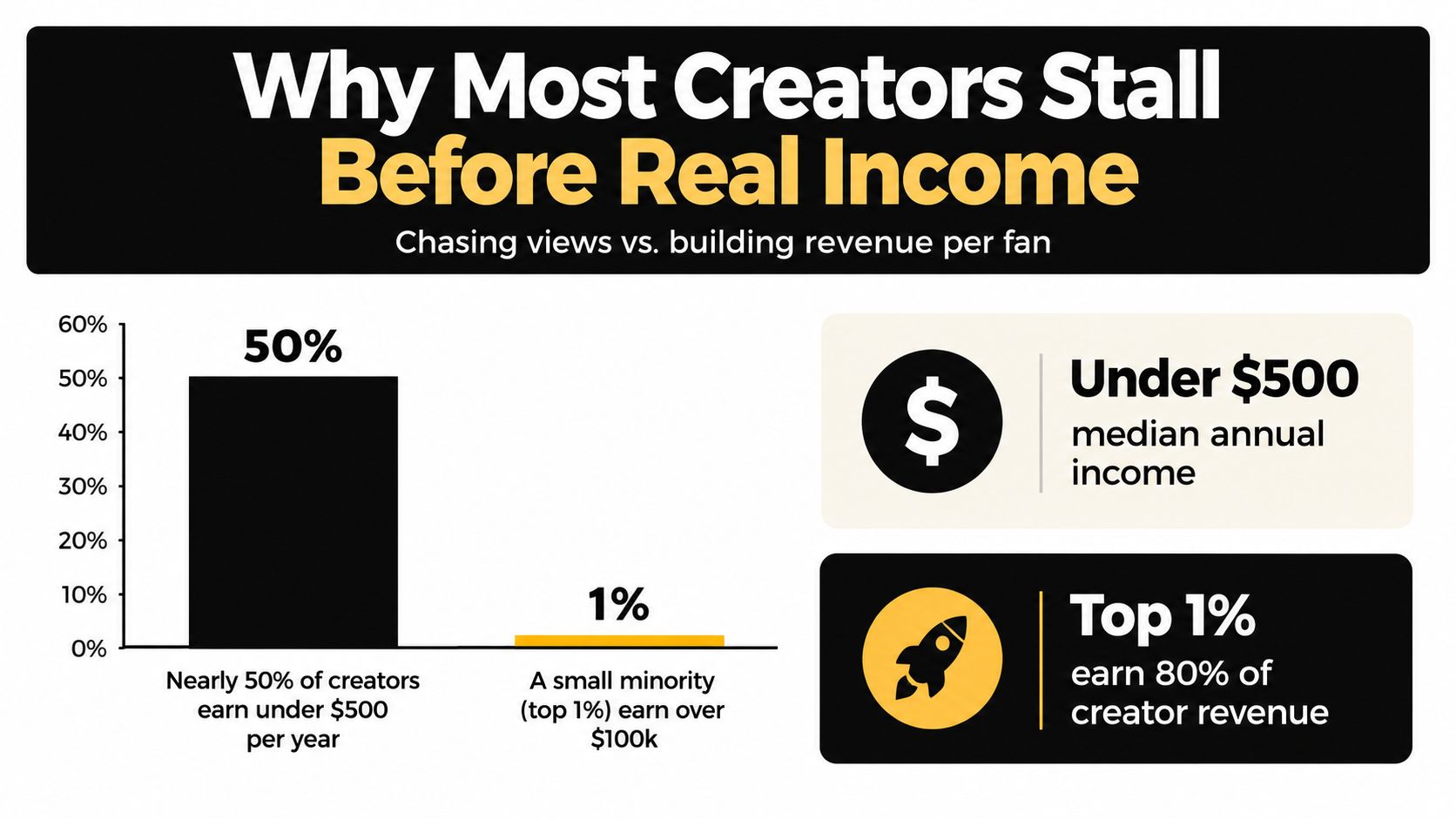
Creator income is concentrated among a small share of the market. A 2026 industry summary reported that the top 1% captured 21% of creator ad-payment volume in 2025, compared with 15% in 2023, while the top 10% captured 62%, compared with 53% previously, as documented by creator-economy distribution data. Publishing more often does not correct that imbalance by itself. Creators need a route from attention to owned revenue.
The barrier isn't reach
Many creators stall near what Creator Spotlight describes as a “Monetization Barrier” around $15,000 in annual revenue. Below that level, income commonly comes from isolated sponsorships, occasional tips, or irregular affiliate commissions. The audience may be active, but the business lacks a repeatable way to turn interest into cash flow.
Three structural weaknesses create the stall:
- One platform owns the relationship. An algorithm controls discovery, and a suspension or reach decline can reduce exposure immediately.
- One income stream carries the business. Sponsorships can pay well, but campaign budgets, audience fit, and creator availability determine when they arrive.
- The next action is unclear. A bio link that sends visitors across scattered destinations creates choice without direction. Visitors browse, hesitate, and leave.
Practical rule: Treat every post as a route to a relationship or transaction, not as an isolated performance.
An owned-revenue mix changes the operating model. Email subscribers, paid members, and direct customers can hear from you without waiting for a platform to distribute the next post. Direct sales also reveal which problem people will pay to solve, information that view counts cannot provide.
A single-page bento storefront can connect those steps in one place. Put the primary offer first, then add checkout, booking, and email capture beside supporting links. That setup closes the reach-does-not-equal-revenue gap by giving each visitor a measurable path instead of a menu of disconnected options.
Build beyond the deal cycle
Brand partnerships still have a role. The global influencer marketing market was estimated at $24.0 billion in 2024, about $31.07 billion in 2025, and is projected to reach $40.51 billion in 2026, with some forecasts extending to $152.56 billion by 2031, according to Mordor Intelligence's influencer marketing market analysis. A growing market creates opportunities, but it does not remove deal volatility. Creators with measurable conversion paths can present stronger cases, while creators who depend only on platform reach remain exposed.
Physical merchandise adds another layer of risk. Before announcing a collection, review margins, production costs, and brand protection through guidance on POD pricing and trademark safety. The operating decision is straightforward: send the next click toward something you control, such as an email address, paid order, or scheduled conversation.
Choosing Your Revenue Mix Without Guessing
You don't need every monetization channel. You need two or three that match your audience's intent and your capacity to deliver. A musician with loyal listeners may combine memberships, digital releases, and bookings. A coach may prioritize paid calls, a focused digital product, and an email list. A niche creator reviewing products may add affiliate links and selective sponsorships without turning every post into an advertisement.
The following comparison is designed to expose trade-offs rather than declare one universal winner.
| Revenue Stream | Best For | Effort Level | Margin and Recurrence |
|---|---|---|---|
| Physical products | Creators with a recognizable identity and merchandise demand | High | Variable margin, repeat purchases depend on product quality |
| Digital downloads | Creators who can solve a narrow problem with a file, guide, template, preset, or resource | Low after creation | High potential margin, usually one-time unless updated or bundled |
| Paid bookings | Coaches, consultants, artists, and specialists with useful personal access | Medium to high | Strong per-sale value, limited by available time |
| Memberships | Communities with recurring questions, shared identity, or ongoing education | High | Recurring revenue, requires consistent member value |
| Sponsorships | Creators with a defined audience and brand-safe content | Medium | Can be valuable, but campaigns are irregular |
| Affiliate revenue | Review, tutorial, comparison, and recommendation creators | Medium | Commission-based, depends on trust and purchase intent |
| Tips | Entertainers, streamers, musicians, and creators with generous fan support | Low | Easy to add, unpredictable and generally non-recurring |
Match the stream to the buying signal
Use digital products when people repeatedly ask for the same explanation. A makeup creator could sell a routine guide, while a music producer might offer presets. The product should remove a specific obstacle, not attempt to contain everything the creator knows.
Use paid bookings when the audience wants an answer specific to its situation. A career creator can offer portfolio reviews, a fitness specialist can provide a consultation, and a musician can sell a remote lesson. Bookings create faster cash, but they don't scale like a downloadable product, so protect your calendar with defined durations, clear boundaries, and upfront payment.
Memberships work when the value continues after the first purchase. That might mean critique sessions, a private community, recurring lessons, or behind-the-scenes access. Sponsorships fit when a brand's product belongs in the creator's existing content. Affiliate revenue fits when recommendations already form part of the audience's buying process.
Creators building knowledge-based products can also compare external training options from T-Shirt Envy when developing workshops or educational merchandise programs. For a broader framework on selecting a sustainable combination, see this guide to creator monetization.
Choose a primary stream and a stabilizer
Pick one stream that can generate meaningful income soon and one that builds durability. A booking offer can provide immediate revenue, while an email list and digital product create lasting value. A sponsorship can fund the month, while a membership gives loyal fans a reason to stay connected.
Don't launch seven offers at once. Every offer requires copy, payment handling, delivery, customer support, and measurement. A small, coherent stack gives you enough information to improve without spreading your attention across a storefront nobody understands.
Pricing and Packaging That Actually Converts
Pricing fails when creators treat it as a guess about what the audience can afford. A stronger approach starts with the transformation, the delivery method, and the amount of access required. A downloadable checklist, a guided course, and a private consultation shouldn't share a price just because they cover the same topic.
Build an offer ladder with a clear progression:
- Starter product: A focused ebook, template, preset, worksheet, or mini-resource gives a new buyer a low-friction first purchase.
- Bundle or membership: Combine related resources, education, or ongoing access for people who want more support.
- Booking or coaching: Sell direct access for buyers who value speed, personalization, and accountability.
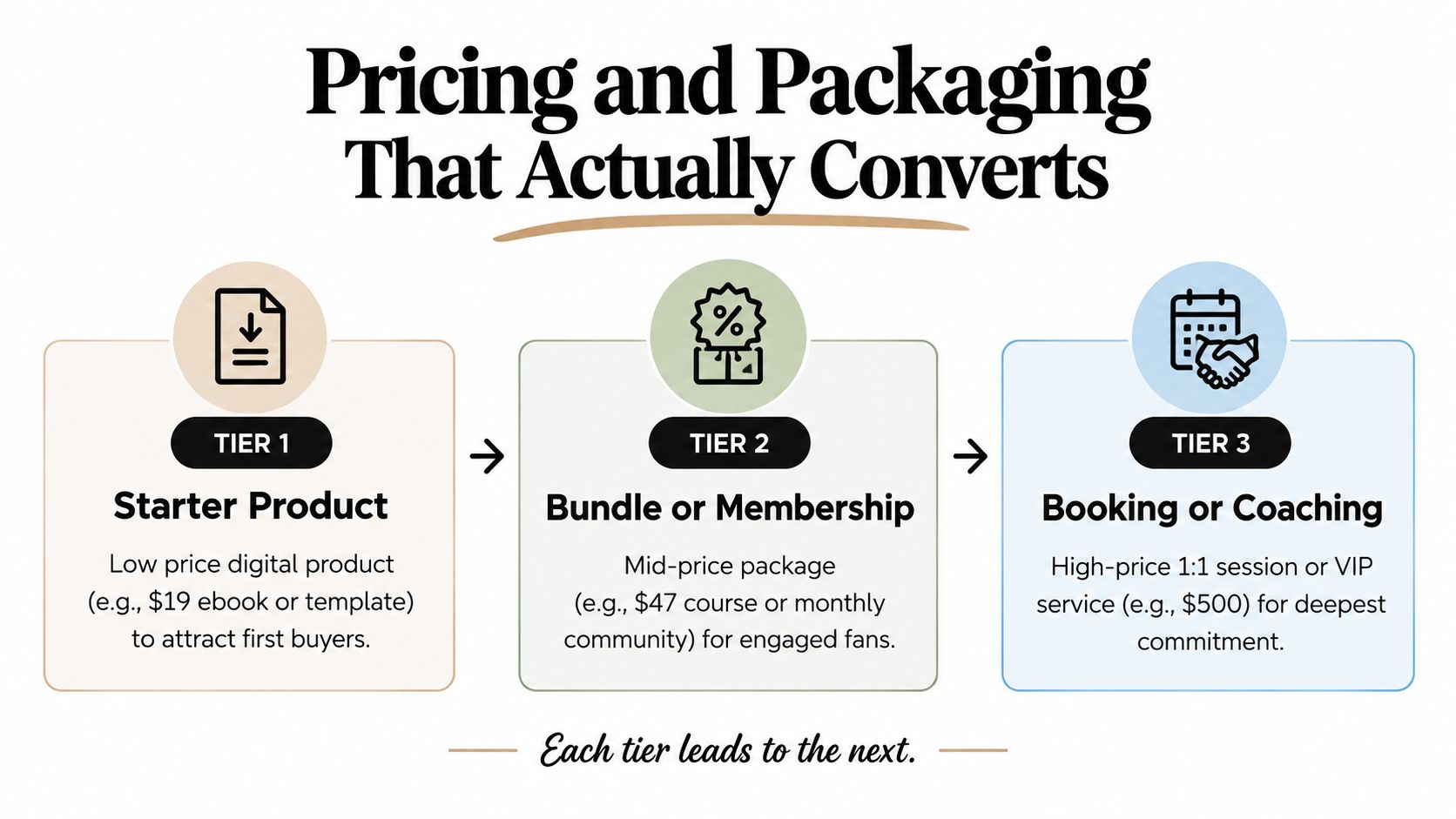
The price anchors in the supplied ladder, such as a $19 ebook or template, a $47 course or community, and a $500 private session, are useful testing examples rather than universal rules. Your audience, niche, proof, and delivery time should determine the final amount. The important design principle is that each tier answers the next natural question: “Can I try this?”, “Can I go deeper?”, and “Can you help me directly?”
Package the outcome, not the inventory
A weak product description lists files. A stronger one names the buyer, the problem, and the result:
For [specific audience] who struggle with [specific problem], [offer name] provides [specific outcome] through [delivery format].
For a booking, define what happens before the call, what the buyer receives during it, and what arrives afterward. “One strategy call” is vague. “A focused review, a prioritized action plan, and a follow-up summary” gives the buyer a reason to pay for access.
Bundles should remove decision fatigue. Group related items around one use case, then make the bundle meaningfully easier to buy than assembling each item separately. A limited-time bonus can help a launch, but don't rely on artificial scarcity for an offer that will remain available. A real deadline, such as a live workshop date or a bonus delivery window, is more credible.
Protect low-ticket margins
Low-priced products can attract first-time buyers, but transaction and platform fees can consume a disproportionate share of the sale. A platform offering 0% fees can preserve more of the listed price, though payment processing, taxes, refunds, and delivery costs still need review.
For tips, use pay-what-you-want only when the audience already understands the value of your work. Otherwise, present a defined product first. People often need a concrete result before they know what amount feels appropriate.
Test one variable at a time. Change the headline, price, bundle contents, or CTA, then observe sales quality and buyer questions. For more detail on structuring an offer, use this guide to digital product pricing strategy.
Building a Link in Bio Storefront That Sells
A link-in-bio page should behave like a compact sales page, not a directory. The visitor arrives from a specific piece of content with a specific expectation. Your layout should make the next action obvious without forcing the visitor through multiple redirects, tabs, and disconnected tools.
Start with the page's primary conversion. If you're launching a template, place the product block near the top. If your business depends on consultations, put the booking widget in the first screen. The page can still contain music, video, social profiles, and secondary offers, but those elements shouldn't compete with the action that pays you.
Assemble the page in conversion order
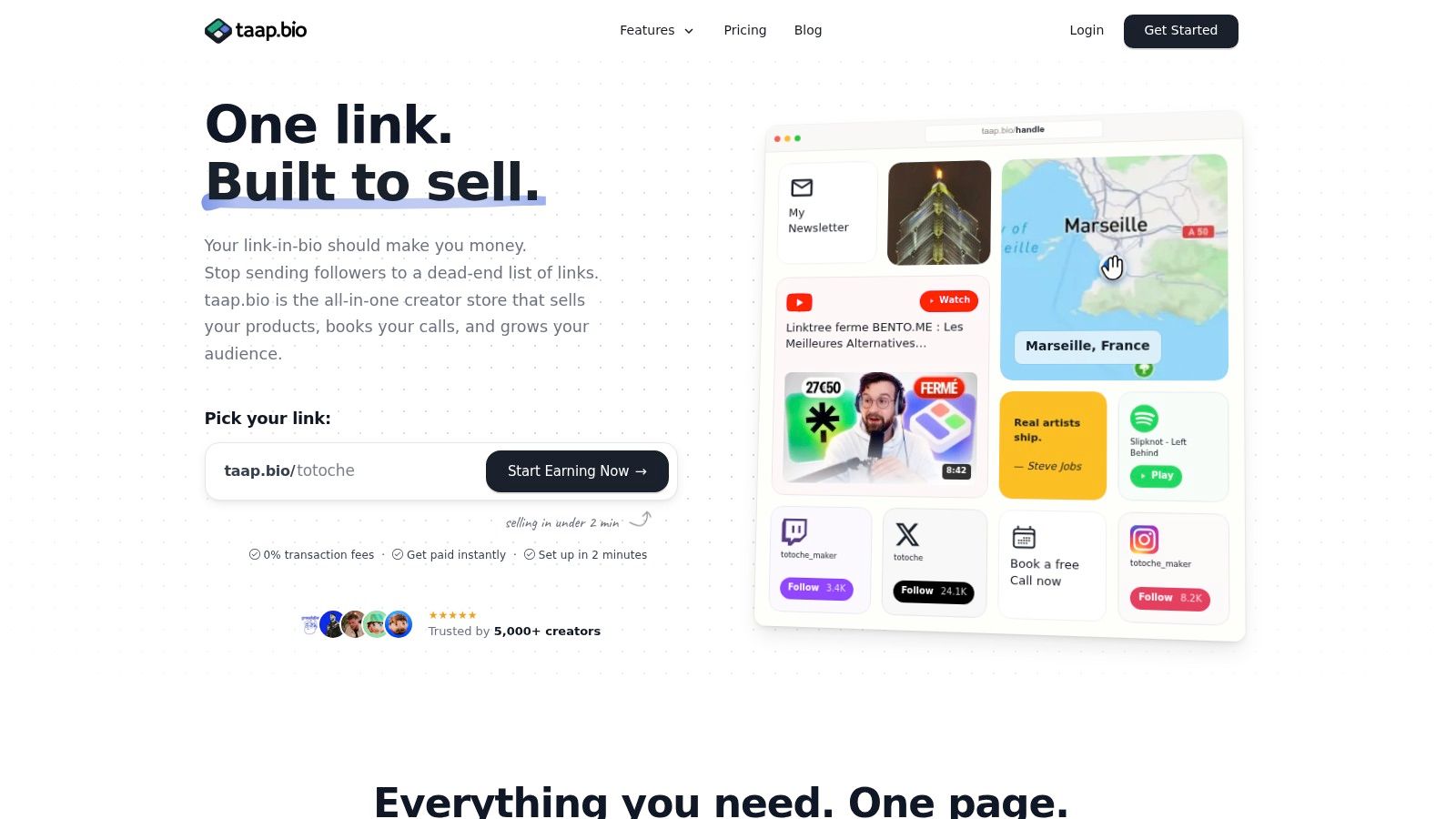
Use a bento-style drag-and-drop layout to arrange blocks by intent:
- Identity block: State who you help and what visitors can get from the page.
- Primary offer: Show the product, booking, or membership with one direct CTA.
- Proof or context: Add a relevant video, image, playlist, testimonial, or sample.
- Owned-audience block: Invite visitors to subscribe for a useful reason, not merely “join my list.”
- Secondary actions: Add supporting products, social channels, YouTube, Spotify, maps, or other rich media.
A creator store such as taap.bio combines these functions in one page, including product blocks, built-in checkout, instant digital delivery, paid bookings with an on-page calendar, email capture with CSV export, and widget-level analytics. Its documented setup also includes optional custom-domain mapping, GDPR-friendly hosting in France, and instant payouts. These features are operational choices, not substitutes for a strong offer or clear copy.
Keep checkout in place whenever possible. Every redirect creates another moment when a visitor can abandon the process, especially on mobile. A single-page flow lets the visitor move from content to product, booking, or signup with less friction. For page architecture ideas beyond a simple link list, review this guide to a social media landing page.
Write the page for a first-time visitor
Your regular followers already understand your personality. A new visitor doesn't. Use the first screen to answer three questions quickly:
- What do you make or help with?
- Who is this for?
- What should I do next?
Avoid placing every destination above the fold. A page with ten equal buttons makes the visitor choose your business model for you. Put the highest-value action first, then use the remaining widgets to support that choice.
Check the page on a phone before publishing. Product images should be legible, booking details should be complete, and the email form should explain what subscribers will receive. Connect a custom domain if your brand relies on memorability, then test the complete payment and delivery process with a real buyer workflow.
The technical setup should disappear from the visitor's experience. They should see a clear offer, understand the exchange, pay or subscribe without confusion, and receive the promised next step immediately.
Driving Traffic and Turning Views Into Sales
Views create potential. Revenue appears when each post sends a visitor toward one clear next action, such as downloading a guide, booking a review, joining an email list, or buying a product. Replace “check the link in my bio” with a specific promise that tells people what they will find and why it matters.
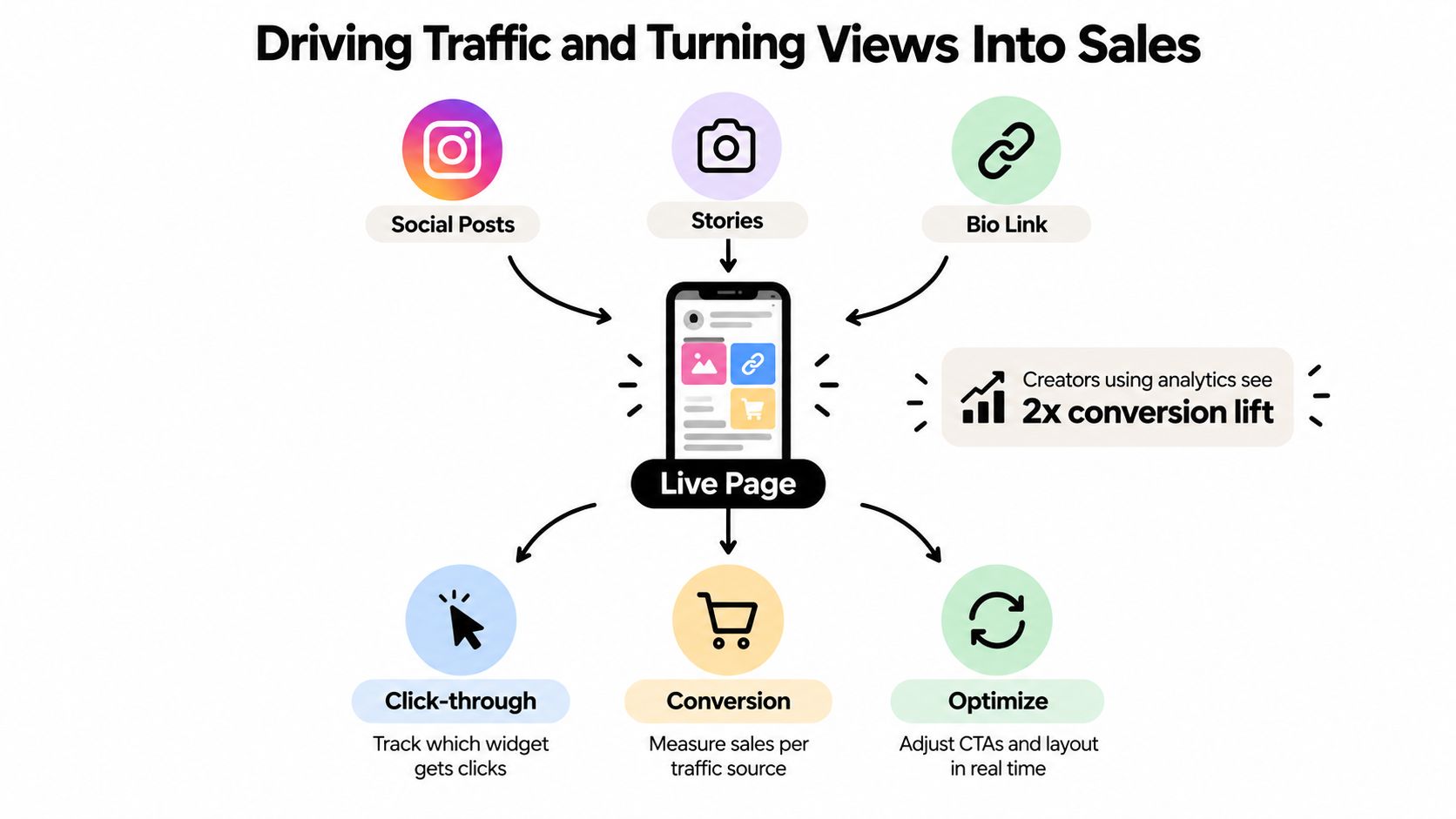
Match the destination to the post that sent the visitor. A video teaching a budgeting method should lead to a related template, consultation, or email sequence, not an unrelated homepage. That message match helps visitors decide faster and shows which topics attract buyers instead of passive viewers. Creators trying to drive traffic from social media to your website should make the first click specific, measurable, and connected to an owned offer.
Review the funnel every week
Analytics matter when they lead to a change. Check five points:
- Traffic: Which posts, stories, videos, or profile visits sent people to the page?
- Click-through: Which widget earned attention, and which one was ignored?
- Conversion: Did the click produce a sale, booking, or email signup?
- Friction: Where did visitors stop, ask questions, or abandon the process?
- Iteration: Which headline, CTA, order, or offer will you test next?
A live visitor count helps separate a traffic problem from a conversion problem. Visitors who do not click need a clearer promise or stronger placement. Visitors who click but do not buy require a closer look at the offer explanation, checkout, price framing, and proof. Posting more will not repair a broken step.
Retention protects the owned-revenue mix. Follow up with new subscribers, clarify what happens after a booking, and remind members about recurring value. Offline promotion can feed the same page for creators working at events, studios, shops, or community spaces. A complete guide to leaflet printing can help plan printed material that sends local audiences to a focused storefront.
The $15k Monetization Barrier becomes harder to cross when every campaign depends on reach or sponsorship. Sponsorship can add revenue, with historical estimates placing influencer marketing at roughly $1.4 billion in 2014, $16.4 billion in 2022, $21.1 billion in 2023, and $24.0 billion in 2024, according to Influencer Marketing Hub's market statistics. Brand partnerships should fit the audience, while direct sales, bookings, and email capture keep revenue under your control.
Launch Checklist and Next Steps to Get Paid Faster
A monetization system becomes real when a stranger can complete the full journey without your help. Before sending traffic, run this checklist:
- Payment test: Complete a purchase yourself and confirm the receipt, delivery, refund path, and customer notification.
- Booking test: Choose a time slot, verify the calendar invite, and make sure the booking description sets boundaries.
- Email test: Subscribe from a separate address, confirm the welcome message, and export the contact list so you understand how portability works.
- Privacy review: Check your consent language, data handling, and regional obligations before collecting subscriber information.
- Analytics review: Confirm that clicks, visits, sales, bookings, and signups appear in the right places.
- Mobile review: Open the page on a phone and remove any block that pushes the primary CTA too far down.
Use a short validation sprint
Don't spend weeks building a large catalog before you know what buyers want. Publish one focused product, open one paid booking slot, and give visitors one clear reason to join your email list. A small launch produces useful objections, questions, and purchase signals that can improve the next version.
The documented taap.bio offer includes a 14-day trial, followed by $19 per month, and 0% platform fees on sales, though payment processing and other business obligations still require your own review. Those details make it possible to test a compact storefront without assembling separate services for checkout, scheduling, email capture, and analytics. Creators comparing launch workflows can also use this digital product launch guide while preparing the first offer.
Track the quality of the funnel, not vanity totals. Watch which content sends qualified visitors, which offer earns purchases, how many buyers return, and whether your email list grows with people who want the next product. The path past the Monetization Barrier starts when you stop asking how to get more views and start asking what each interested fan can do next.
taap.bio gives creators one page for digital products, paid bookings, email capture, rich media, checkout, and analytics, so you can replace scattered links with a focused revenue path. Visit taap.bio, publish one offer, and send your next piece of content to a page built to turn attention into owned income.


