
Choosing the right social media management tool really boils down to what you actually need. A solo creator might just need a straightforward scheduler like Buffer, but a full-blown marketing agency will probably need the heavy-duty analytics found in a platform like Sprout Social. It's all about matching the features—publishing, engagement, reporting—to your real-world goals and budget.
Table of contents
Why the Right Social Media Tool Is Non-Negotiable
Let's be honest: managing social media today isn't just about posting a few updates. It's a full-on strategic operation. Trying to keep up with multiple platforms, each with its own weird algorithm, audience quirks, and content rules, is a recipe for chaos.
That’s exactly the problem social media management platforms were designed to fix. They take all that disjointed effort and turn it into a smooth system for scheduling content, talking to your followers, and figuring out what’s actually working.

For any creator or brand trying to stand out, having a consistent voice across all your channels is crucial. Whether you're on Instagram, TikTok, or LinkedIn, a dedicated tool helps keep your message on-brand. This builds trust with your audience and, just as importantly, saves you a ton of time.
The market numbers back this up. The global social media management market was valued at a whopping USD 20.61 billion in 2023. It’s expected to shoot up to USD 85.06 billion by 2030, which is a compound annual growth rate of 22.8%. You can dig into the data yourself by checking out the booming social media management market on Grand View Research.
That explosive growth shows just how essential these tools have become. They’re no longer a nice-to-have; they're a core part of the modern marketing stack.
And it’s not just about managing the old guard of social media. Fresh reports, like Buffer's State of Social 2024, show a clear shift in where marketing teams are putting their energy. While Facebook and Instagram are still powerhouses, platforms like LinkedIn and TikTok are quickly climbing the priority list.
This just drives home the need for a tool that can handle it all. This guide is here to help you cut through the noise, compare the top contenders, and find the platform that fits your workflow like a glove.
Finding Your Perfect Match: The 5 Key Evaluation Points
Picking the right social media management tool in a sea of options feels overwhelming. It's easy to get lost in endless feature lists. To make a smart choice that will actually stick, you need a solid framework. Let's break down the five core areas that really matter, helping you see past the marketing fluff and focus on what will genuinely move the needle for your brand.
Think of these as the foundation for your decision. They're the non-negotiables that turn social media chaos into a smooth, measurable engine for growth.
How Well Does It Publish and Schedule?
At the most basic level, your tool has to make it dead simple to get your content out there. But we're looking for more than just a "set it and forget it" scheduler. A great platform gives you a visual content calendar where you can drag and drop posts, see your whole strategy at a glance, and easily shuffle things around when plans change.
The best tools take it a step further with optimal post timing recommendations. They analyze your audience's activity and tell you exactly when to post for maximum reach and engagement. This feature alone is a game-changer, boosting your performance without you having to lift a finger.
Can You Genuinely Engage and Monitor Conversations?
Social media isn't a megaphone; it's a conversation. That's why a top-tier tool absolutely must have a unified inbox. This pulls all your comments, DMs, and mentions from every single platform into one streamlined feed. No more missed messages, just faster, more personal responses that build real community.
And what about the conversations happening outside your mentions? Look for robust keyword and hashtag monitoring. This lets you tap into what people are saying about your brand, your competitors, and your entire industry in real time.
A unified inbox is the command center for modern social media. It’s what allows you to stop just broadcasting and start truly participating in the conversations that matter to your brand's growth.
Does It Give You Analytics That Actually Mean Something?
If you're not measuring your efforts, you're just guessing. The analytics dashboard is where the magic happens. A solid platform will track everything from follower growth and engagement rates to clicks and conversions, giving you clear insights into what’s working and what’s not.
But don't stop there. Look for customizable reports and competitor analysis features. The ability to benchmark your performance against your rivals is incredibly powerful. It provides the context you need to spot opportunities and make strategic moves to get ahead. This is a huge differentiator when you're comparing tools.
Is It Built for Teamwork?
If you're working with a team, whether it's an agency or an in-house department, collaboration features are non-negotiable. Check out the user permissions and role assignments. Can you give a junior team member access to draft posts but not hit publish? Can a client approve content without getting bogged down in the scheduling backend?
Approval workflows are just as crucial. A good system makes the review process painless, with clear feedback loops and sign-offs. This is your safety net, ensuring everything that goes live is on-brand, polished, and error-free.
How Well Does It Play with Your Other Tools?
Let's be real: no tool is an island. Your social media platform has to seamlessly connect with the other software you rely on every day. We're talking about everything from design tools like Canva to deep-dive analytics platforms like Google Analytics.
Take a hard look at the available integrations. A platform that connects easily with your existing stack creates a single, powerful workflow. It breaks down data silos and makes your entire marketing operation more efficient.
An In-Depth Social media Management Tools Comparison
Picking the right social media platform in such a crowded market is about more than ticking off features on a list. You need to know how a tool feels in the real world, whether you're a solo creator scheduling your next TikTok or a global agency juggling complex client campaigns. This guide will cut through the noise and compare the industry's heavyweights—Sprout Social, Hootsuite, Buffer, and Agorapulse—based on what actually matters.
We’re going beyond the generic pros and cons to give you a true head-to-head analysis. The goal is to show you their distinct personalities and where they shine, so you can find the perfect match for your workflow, team, and budget.
This framework gives you a great visual for how to evaluate these tools across the five key pillars we’ll be digging into.
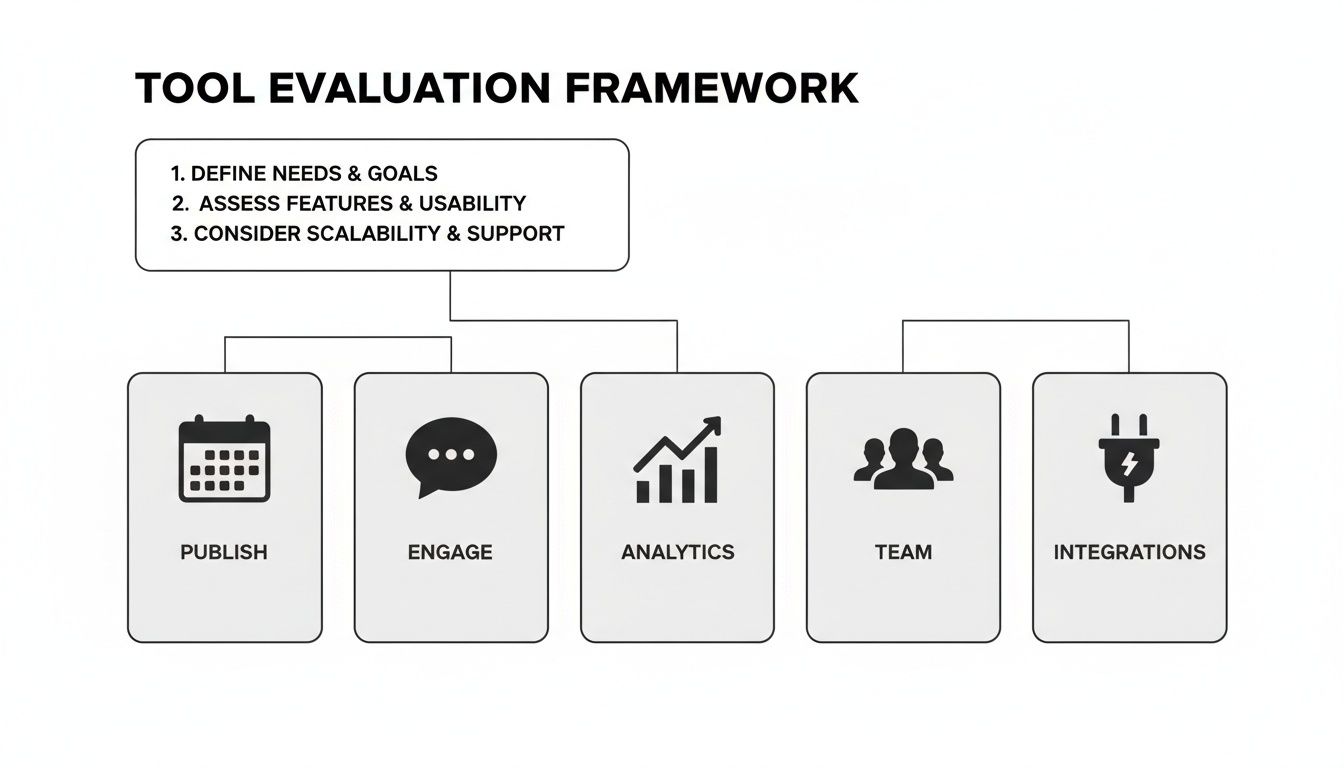
Think of these five areas—Publish, Engage, Analytics, Team, and Integrations—as the foundation for any solid tool evaluation. They’re the core of what makes or breaks a platform.
Sprout Social: The Analytics Powerhouse
Sprout Social has built its reputation as the go-to for data-obsessed teams, and frankly, its analytics suite earns the hype. This is the platform for turning raw social data into real business intelligence, which is why it’s a favorite for mid-market and enterprise companies that live and die by proving ROI.
The reporting is where Sprout really pulls away from the pack. You can generate beautiful, presentation-ready reports on everything from post-performance to competitor benchmarks. Their patented ViralPost® tech even analyzes your audience’s engagement patterns to tell you the exact best times to post. No more guesswork.
Of course, all that power comes with a hefty price tag. In 2023, the demand for all-in-one solutions drove the social media management market, capturing over 75.1% of the share. But the premium cost of tools like Sprout can be a real hurdle for smaller businesses, as you can read more about in this analysis of market trends on Technavio.
What Makes It Stand Out: Sprout's integrated Social CRM is a game-changer. It creates detailed profiles for your followers, complete with conversation histories, turning generic engagement into genuinely personal interactions.
Best For:
- Data-driven agencies needing to deliver impressive client reports.
- Enterprise marketing teams who have to justify every dollar of social media spend.
- Brands focused on customer care that will use the Social CRM to provide top-tier support.
Hootsuite: The Integration and Team Veteran
As one of the original players in this space, Hootsuite’s biggest advantage is its sheer scale. It’s a workhorse that connects with over 35 social networks and a massive library of third-party apps, making it a flexible command center for sprawling marketing operations.
For larger teams, the customizable dashboards and "Streams" feature are indispensable. You can set up dedicated feeds to monitor keywords, hashtags, or competitor activity in real-time, making it an incredible tool for social listening.
Its approval workflows and user permission settings are also incredibly robust. This is the kind of governance big organizations need to keep brand messaging consistent and secure when multiple people have their hands in the pot.
Where It Falls Short:
While it’s undeniably powerful, some find Hootsuite’s interface a bit clunky compared to more modern competitors. The per-seat pricing can also add up fast as your team expands, so be prepared for a significant investment.
Best For:
- Large organizations with multiple departments and social media managers.
- Agencies managing a diverse client portfolio across a wide range of platforms.
- Teams needing deep social listening capabilities to keep a pulse on brand health.
Buffer: The Champion of Simplicity
Buffer’s entire philosophy is built on doing one thing exceptionally well: making content publishing easy. Its clean, almost minimalist interface makes scheduling content feel less like a chore and more like a creative process. It’s no wonder it has long been the darling of creators and small businesses.
There’s virtually no learning curve. You can connect your accounts and have your first posts scheduled in minutes. Buffer also includes a simple link-in-bio tool (Start Page) and offers analytics that give you just the essential metrics, without drowning you in data you don’t need.
Lately, Buffer has been adding more engagement tools and deeper analytics, but its core appeal is still that beautiful design and laser focus on making publishing effortless.
What Makes It Stand Out: Simplicity is Buffer’s superpower. It’s a tool designed to give you back your time and mental energy, so you can focus on creating great content instead of fighting with a complicated dashboard.
Best For:
- Solo creators and influencers who just need an efficient way to stay consistent.
- Small businesses with limited time and resources to dedicate to social media.
- Marketing teams looking for a straightforward scheduler to complement other specialized tools.
Agorapulse: The All-In-One Contender
Agorapulse is built to be the complete package, skillfully blending publishing, engagement, and reporting into one cohesive platform. It’s especially strong in its engagement features, offering a unified social inbox that brings order to the chaos of managing comments, DMs, and mentions.
One of its most beloved features is the inbox automation. You can set up rules to automatically hide spammy comments, assign messages to the right team member, or tag conversations for later. For teams dealing with high-volume interactions, this is a lifesaver.
Agorapulse also delivers fantastic value for money. Its pricing plans are more inclusive than many rivals, often bundling features like social listening that others treat as expensive add-ons. This makes it a seriously compelling option for teams that need a full suite of tools but don’t have an enterprise budget.
Comparative Analysis of Top Social Media Platforms
To make sense of it all, here's a detailed breakdown of how these leading tools perform across core functionalities. Think of this as your cheat sheet for matching a platform's strengths to your specific business goals.
| Evaluation Criteria | Sprout Social | Hootsuite | Buffer | Agorapulse |
|---|---|---|---|---|
| Primary Strength | Advanced Analytics & CRM | Extensive Integrations | Simplicity & Publishing | All-in-One Value |
| Ideal User | Enterprise Teams | Large Agencies | Creators & Small Biz | SMBs & Agencies |
| User Interface | Polished, Data-Heavy | Customizable, Dense | Clean, Minimalist | User-Friendly, Modern |
| Pricing Model | Premium Per-Seat | Per-Seat, Tiered | Per-Channel, Affordable | Inclusive Tiers |
Ultimately, this table shows that while all four tools can get a post scheduled, their core philosophies are worlds apart. Your choice depends entirely on what you need a platform to do for you, guiding you toward the right fit for how your team actually works.
Finding the Right Tool for Your Job
Let's cut to the chase. A feature-by-feature breakdown is nice, but the only thing that really matters is finding the tool that’s right for you. The “best” platform isn’t the one with the longest feature list; it's the one that actually clicks with your daily workflow, solves your specific headaches, and doesn't break the bank.
A tool built for a data-obsessed marketing agency will be total overkill for a solo creator. To help you skip the analysis paralysis, here are my recommendations tailored for three very different roles, matching the strengths of each platform to the reality of the work.
For the Solo Creator and Influencer
When you're a solo creator, your time is everything. Your job is to create killer content and connect with your audience, not wrestle with a clunky dashboard. You need a tool that's quick, intuitive, and makes publishing feel effortless.
Think simplicity. You're looking for a clean interface, dead-simple scheduling, and analytics that show you the important stuff without burying you in data.
Top Recommendation: Buffer
Buffer feels like it was designed from the ground up for the creator economy. Its minimalist approach and sharp focus on publishing mean you can get up and running in minutes. For anyone juggling content creation, editing, and community management all by themselves, that’s a massive win.
- Zero Learning Curve: The interface is so clean and straightforward that you can schedule your first week of content almost immediately.
- Pay-as-You-Grow Pricing: Buffer’s per-channel pricing is perfect for creators. You can start with just one or two profiles and only add more as your brand expands, keeping costs down.
- No-Nonsense Analytics: It gives you the core metrics you need to see what’s working, without making you feel like you need a degree in data science to understand it.
For a creator, consistency is currency. A tool like Buffer removes the friction from scheduling, ensuring your content pipeline is always full and your audience stays engaged, even when you’re focused on your next big project.
For the Small Business Owner
If you’re a small business owner, you're playing every position on the field—CEO, marketer, customer service, and more. You need a tool that punches above its weight, giving you an all-in-one solution that balances powerful features with a price tag that actually makes sense.
Your perfect platform needs to be a workhorse. It should handle scheduling, funnel all your comments and DMs into one place, and deliver clear reports that show how your social media efforts are actually helping the bottom line.
Top Recommendation: Agorapulse
Agorapulse nails that tricky balance between power and price, which is why it’s my go-to recommendation for small businesses. It packs publishing, engagement, listening, and reporting into one cohesive package, delivering incredible value for what you pay.
Its real standout feature is community management. The unified social inbox is a game-changer, letting you set up automation rules to manage customer interactions so no question or complaint ever gets missed. For a small business, that kind of responsiveness is how you build an army of loyal fans.
For the Marketing Agency
Agencies live in a different world—one filled with multiple clients, demanding deadlines, and the constant need to prove your worth. Your needs are way more complex. You’re looking for sophisticated client management, bulletproof approval workflows, and deep, white-label reporting.
Collaboration, control, and governance are the name of the game. The right tool helps your team work together smoothly while giving clients just enough visibility to feel confident. Most importantly, it has to deliver the kind of deep-dive analytics that justify your retainer fees.
Top Recommendation: Sprout Social
When it comes to managing multiple clients at scale, Sprout Social is the undisputed heavyweight champion. Its analytics suite is second to none, allowing you to generate gorgeous, presentation-ready reports that scream professionalism and clearly show the value you’re delivering.
- Ironclad Client Management: You can easily wall off each client's accounts, assign granular permissions to your team, and build custom approval workflows to keep everything on-brand.
- Built-in Social CRM: Sprout’s CRM tools are a secret weapon. They track conversation histories with individual users, letting you turn generic replies into highly personalized, relationship-building moments.
- Best-in-Class Reporting: The depth of Sprout’s reporting is what sets it apart. It provides the heavy-duty insights you need to build long-term strategies and prove the direct business impact of your work.
Yes, it's a serious investment. But Sprout Social provides the professional-grade infrastructure that lets a growing agency operate like a well-oiled machine, wow its clients, and scale with confidence.
Completing Your Strategy with a Link-in-Bio Hub
After digging into the best social media management tools, it's clear they are powerhouses for getting your content out there—scheduling posts, jumping into conversations, and tracking what works. But a winning strategy doesn't stop the moment you hit "publish." The real magic happens next: turning all that attention into actual results, and that's where your link-in-bio becomes the MVP.
Think about it. That single link is the only permanent, clickable piece of real estate you truly own on platforms like Instagram and TikTok. While your management tool pushes content out, a dedicated link-in-bio hub pulls your audience in. It transforms your bio from a static list into an interactive, branded destination—the essential bridge between your social feed and your business goals.

Beyond a Simple List of Links
Let’s be honest, most link-in-bio pages are pretty uninspired. They're just a vertical list of buttons that feel like a dead end. But modern platforms are built to be dynamic digital storefronts that actually reflect your brand’s personality and pull your entire online world together. They create an experience, not just a directory.
This is where a visual-first platform like Taap.bio completely changes the game. Instead of that boring old list, it gives you an engaging, modular grid to play with. This lets you build a personalized dashboard that feels like a natural extension of your brand. Every piece of content—a new YouTube video, a featured product, your latest blog post—becomes a resizable, draggable block on your own creative canvas.
A great link-in-bio doesn’t just direct traffic; it is the destination. It should feel like a curated extension of your brand, designed to capture attention and guide your audience to their next step with you.
Integrating Real-Time Social Proof
The best link-in-bio hubs do more than just send people away; they bring your live social activity right onto your landing page. For creators trying to build a community, this dynamic approach is a game-changer. Imagine someone lands on your page and can instantly see what's happening across all your channels. It builds trust and keeps them clicking.
Smart widgets can showcase:
- Your Latest Instagram Posts: A live grid of your recent photos keeps your page feeling fresh and current.
- New YouTube Videos: Embed your newest uploads with clickable thumbnails and your latest subscriber count.
- Spotify Playback: Let visitors listen to your new track or podcast episode without ever leaving the page.
- TikTok Previews: Show off your most recent TikToks to pull them deeper into your content ecosystem.
This approach turns your link-in-bio into a living portfolio that builds undeniable social proof and encourages people to explore more. When you pair a top-tier social media management tool with a dynamic hub like this, you create a complete system. One tool handles distribution, and the other converts followers into a loyal community. By focusing on both, you're not just posting online—you're building a powerful, end-to-end social media engine.
So, How Do You Choose the Right Tool?
Picking a winner from this lineup of social media management tools can feel overwhelming, but it really boils down to one simple truth: there is no single "best" platform. The only thing that matters is finding the one that’s best for you. A tool's real value is tied directly to your specific goals, the size of your team, and what your budget looks like.
To really get to the heart of the matter, you need to stop thinking about features and start focusing on outcomes. Don't just ask which tool has the most integrations; ask which one plugs into the software you already rely on every single day. That subtle shift in perspective changes everything—it frames your decision around your real-world workflow, not some generic checklist.
Your Final Gut-Check Before Committing
Before you jump into a free trial or hand over your credit card, take a minute to answer these three questions. Think of this as your personal filter. It will instantly weed out the tools that won't work and shine a spotlight on the ones that will actually help you grow.
- What are my top three deal-breakers? Pinpoint your absolute must-haves. Is it a unified inbox to handle customer DMs, or is it sophisticated analytics for those monthly client reports?
- What’s a realistic monthly budget I can stick to? Be honest about what you can comfortably spend. This alone will slash your list of options in half and keep you from paying for bells and whistles you’ll never use.
- How much time can we actually spend learning a new system? If your team is already stretched thin, a tool with a steep learning curve will just become another roadblock. Be realistic about your onboarding capacity.
The right tool shouldn’t feel like a compromise. It should feel like a smart investment that gives you back time, simplifies your workflow, and delivers the data you need to prove your social media efforts are paying off.
At the end of the day, your social media management tool is just one part of a bigger strategy. It’s fantastic at getting your content out there and managing conversations, but the journey can't end there.
To build a presence that truly sticks, you need to pair your management platform with a powerful hub for your audience. While your scheduler pushes content out, a visual link-in-bio tool like Taap.bio pulls your audience in. This one-two punch creates a complete system that doesn’t just manage your content—it turns casual followers into a dedicated community.
Got Questions? We've Got Answers
Picking the right social media tool can feel like a huge decision, and it's normal to have a few questions left. Let's clear up some of the most common things people ask when they're in your shoes.
Can One Tool Really Do It All for Every Platform?
For the most part, yes. The big players like Hootsuite and Sprout Social connect to all the major networks—Facebook, Instagram, X, LinkedIn, and TikTok. But here's the catch: the quality of that connection isn't always equal.
You might find a tool that gives you incredibly detailed analytics for Instagram but only offers bare-bones scheduling for Pinterest. So, before you pull out your credit card, double-check that the platform delivers the specific features you need for your most important channels. Never assume one size fits all.
How Can I Justify Paying for a Social Media Tool?
It’s all about the ROI, and that starts with time. Think about how many hours your team sinks into manually scheduling posts, pulling reports, and just trying to keep up. A solid management tool can easily hand you back 10-15 hours a week.
The real win isn't just about saving time—it's about what you do with that time. Better analytics fuel smarter campaigns. A unified inbox lets you reply faster, building real customer relationships that drive sales.
When you factor in the efficiency boost and the improved campaign results from data-driven decisions, the tool often pays for itself.
What’s the Real Difference Between Free and Paid Tools?
Free tools are great for getting started. They’ll let you schedule posts for a profile or two, and that's about it. They’re a starting block, not a growth engine.
Paid tools, on the other hand, are built for serious business. They give you the professional-grade features you need to actually scale your efforts.
- Advanced Analytics: Move beyond vanity metrics and truly understand what makes your audience tick.
- Team Collaboration: Set up approval workflows and assign roles to keep your brand's voice consistent and secure.
- Unified Inbox: Stop hopping between apps. Manage all your DMs and comments in one streamlined feed.
- Customer Support: When something breaks, you need real help, fast. Paid tools offer that safety net.
If you're a business, agency, or a creator who’s serious about growth, these features aren't just nice to have—they're essential.
Ready to create a link-in-bio page that’s as dynamic as your content? Taap.bio helps you build a stunning visual hub that unifies your entire online presence. Start building your page for free!


